CM Fadnavis pays tribute to Babamaharaj Satarkar on death anniversary
Synopsis
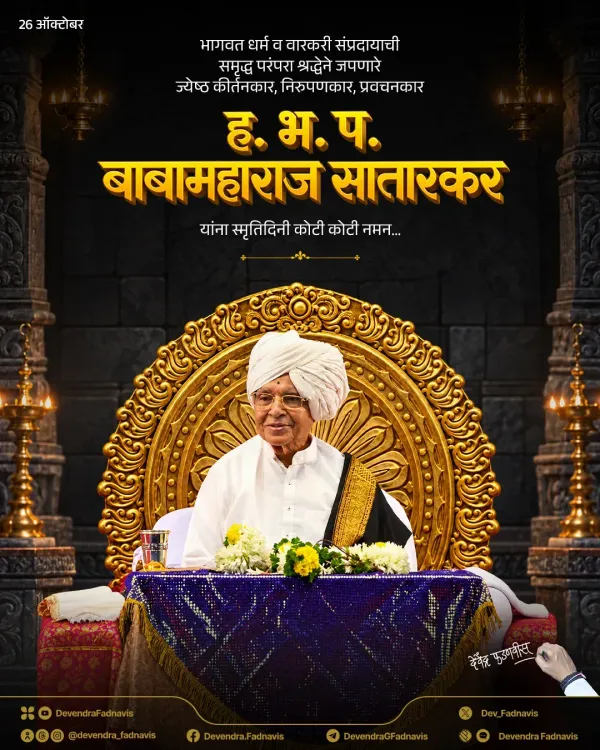
Maharashtra Chief Minister Devendra Fadnavis offered a tribute to senior Warkari kirtankar H. B. P. Babamaharaj Satarkar on his death anniversary, honouring a life devoted to Bhagwat Dharma and the Warkari Sampradaya's rich spiritual tradition.
Key Takeaways
CM Devendra Fadnavis paid public tribute to H.
Babamaharaj Satarkar on 26 October 2026 , the kirtankar's death anniversary.
Babamaharaj Satarkar was a senior kirtankar, nirupankar, and pravachankar associated with Bhagwat Dharma and the Warkari Sampradaya .
The Warkari Sampradaya is a Vaishnava devotional tradition centred on the worship of Vithoba of Pandharpur , with a lineage of saints including Tukaram, Dnyaneshwar, and Eknath.
Maharashtra chief ministers routinely mark such anniversaries, reflecting the Warkari tradition's broad social and cultural significance across the state.
The tradition's high points include the mass Ashadhi and Kartiki Ekadashi pilgrimages to Pandharpur each year.
On the death anniversary of one of Maharashtra's most revered spiritual voices, Maharashtra Chief Minister Devendra Fadnavis bowed in remembrance — offering a heartfelt tribute to H. B. P. Babamaharaj Satarkar, the celebrated kirtankar, nirupankar, and pravachankar who devoted his life to the Bhagwat Dharma and the Warkari Sampradaya.
Fadnavis posted on Monday, 26 October 2026, writing in Marathi: 'भागवत धर्म व वारकरी संप्रदायाची समृद्ध परंपरा श्रद्धेने जपणारे ज्येष्ठ कीर्तनकार... ह. भ. प. बाबामहाराज सातारकर यांना स्मृतिदिनी कोटी कोटी नमन' — 'Countless salutations on the death anniversary of senior kirtankar H. B. P. Babamaharaj Satarkar, who faithfully preserved the rich tradition of Bhagwat Dharma and the Warkari Sampradaya.'
A life in kirtan — who Babamaharaj Satarkar was
H. B. P. Babamaharaj Satarkar stood among the most distinguished voices of Maharashtra's Warkari tradition. As a kirtankar, nirupankar, and pravachankar — one who performs devotional singing, scriptural exposition, and spiritual discourse respectively — he served as a living bridge between the ancient bhakti texts and the everyday Marathi devotee.
The Warkari Sampradaya is a Vaishnava devotional tradition rooted in the worship of Vithoba of Pandharpur. Its saints — from Dnyaneshwar and Namdev to Tukaram and Eknath — composed the abhangas (devotional verses) that form the soul of Marathi spiritual culture. Figures like Babamaharaj Satarkar carried that oral, performative tradition forward into the modern era.
Why Maharashtra's leaders pause for the Warkari heritage
Maharashtra's chief ministers have long observed the practice of publicly honouring Warkari saints and scholars on their death anniversaries. It reflects the tradition's deep roots across caste and community lines — the Warkari movement historically cut across social hierarchies, making it one of the most broadly unifying threads in Marathi public life.
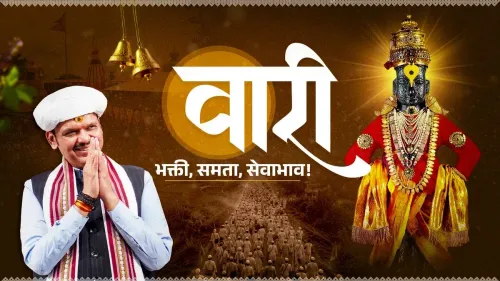
The tradition's calendar centres on the Ashadhi and Kartiki Ekadashi pilgrimages to Pandharpur, when hundreds of thousands of warkaris walk in procession — a living demonstration of the movement's unbroken continuity. Tributes on death anniversaries of figures like Babamaharaj Satarkar reinforce that continuum, connecting institutional authority to devotional identity.
For the millions of Warkari devotees across Maharashtra, today's remembrance is more than a political formality — it is an acknowledgement that the tradition's custodians are not forgotten.
Point of View
Honouring figures from the bhakti tradition also reinforces a cultural-nationalist idiom that frames Hindu devotional heritage as mainstream Marathi identity. Such gestures are low-cost politically but carry real resonance among lakhs of warkari households. The consistency of this engagement, from one chief minister to the next, suggests it is now institutional rather than merely personal.
NationPress
26 Oct 2026
Frequently Asked Questions
Who was Babamaharaj Satarkar?
H. B. P. Babamaharaj Satarkar was a senior kirtankar, nirupankar, and pravachankar who devoted his life to preserving and propagating the Bhagwat Dharma and the Warkari Sampradaya of Maharashtra.
What is the Warkari Sampradaya?
The Warkari Sampradaya is a Vaishnava devotional tradition in Maharashtra centred on the worship of Vithoba at Pandharpur. Its saints composed devotional verses called abhangas, and followers undertake annual pilgrimages on Ashadhi and Kartiki Ekadashi.
Why did CM Devendra Fadnavis pay tribute to Babamaharaj Satarkar?
CM Fadnavis paid tribute on Babamaharaj Satarkar's death anniversary, honouring his contribution to the Warkari tradition. Maharashtra's chief ministers routinely mark the death anniversaries of prominent Warkari spiritual figures as part of engagement with the state's bhakti heritage.
What are the major Warkari pilgrimages in Maharashtra?
The two most significant Warkari pilgrimages are the Ashadhi Ekadashi and Kartiki Ekadashi yatras to Pandharpur, where hundreds of thousands of devotees walk in procession to the temple of Vithoba.
What does H. B. P. stand for in Warkari tradition?
H. B. P. stands for 'Hari Bhakta Parayan,' an honorific title in the Warkari tradition denoting a person fully devoted to the worship of Hari (Vishnu/Vithoba).