CM Samrat Choudhary Greets Nation on Meerabai Jayanti
Synopsis
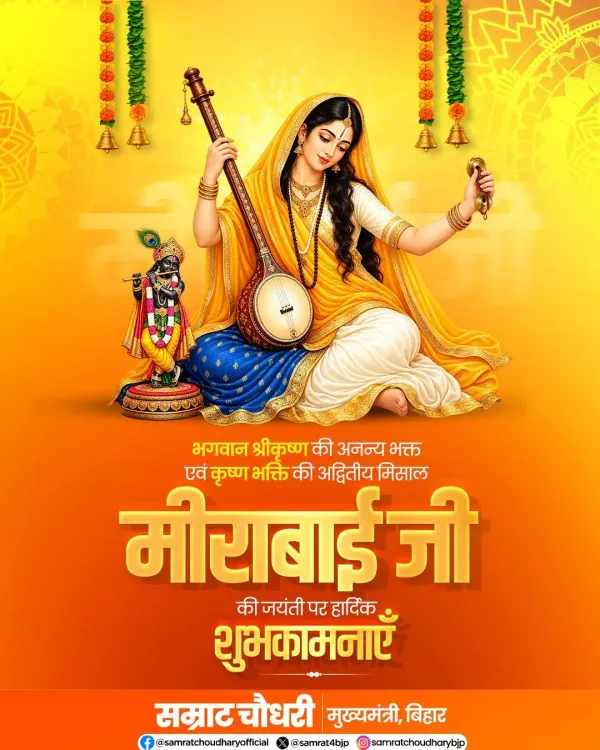
Bihar Chief Minister Samrat Choudhary marked Meerabai Jayanti on 26 October 2026 with a Hindi tribute on X, honouring the 16th-century Rajput bhakti poet-saint's legacy of devotion to Lord Krishna as an 'invaluable heritage of Indian culture.'
Key Takeaways
Bihar CM Samrat Choudhary posted a tribute on 26 October 2026 marking Meerabai Jayanti .
Meerabai was a 16th-century Rajput princess from Rajasthan and one of India's most revered bhakti poet-saints.
Her bhajans were devoted entirely to Lord Krishna and remain widely sung across India today.
CM Choudhary described her 'unshakeable faith, devotion, and dedication' as an 'invaluable heritage of Indian culture.' The tribute reflects the BJP 's broader pattern of cultural outreach through acknowledgement of bhakti and devotional traditions.
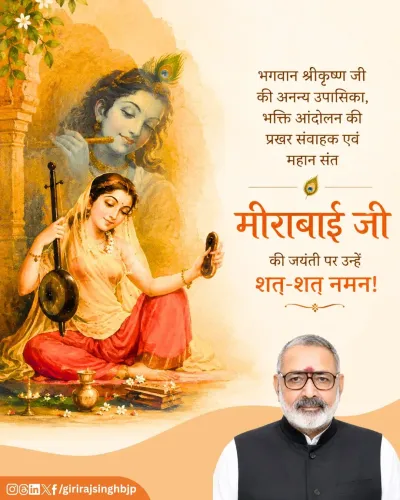
A 16th-century Rajput princess who walked away from a throne for devotion — and whose songs are still sung across India five centuries later. On Monday, 26 October 2026, Bihar Chief Minister Samrat Choudhary marked Meerabai Jayanti with a heartfelt message honouring the bhakti poet-saint's enduring legacy.
Posting in Hindi on X, CM Choudhary wrote: 'भगवान श्रीकृष्ण की अनन्य भक्त मीराबाई जी की जयंती पर हार्दिक बधाई एवं शुभकामनाएँ' — 'Heartfelt congratulations and good wishes on the birth anniversary of Meerabai, the devoted bhakta of Lord Krishna.' He described her 'unshakeable faith, devotion, and dedication' as an 'invaluable heritage of Indian culture,' adding that her life would 'continue to inspire walking the path of love, faith, and devotion.'
Who Was Meerabai — and Why She Still Matters
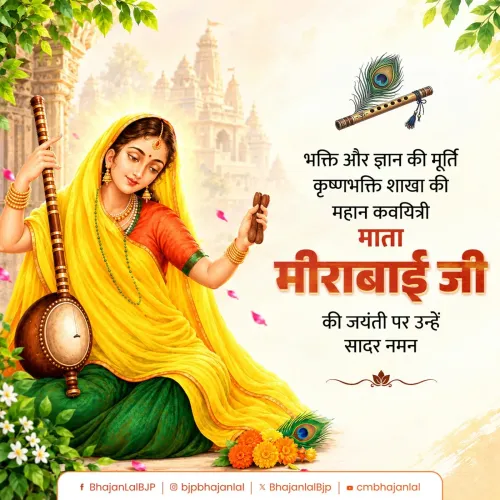
Meerabai was a Rajput princess born in Rajasthan in the early 16th century, widely believed to have been a princess of the Merta kingdom. She is revered across the Hindu devotional tradition as one of the foremost bhakti saints — a poet-mystic whose compositions, known as bhajans, were addressed entirely to Lord Krishna, whom she regarded as her true husband and lord. Her willingness to defy royal convention and caste hierarchy in pursuit of personal devotion made her a radical figure in her own time and a beloved symbol of spiritual independence ever since. Her verses are recited and sung from Rajasthan to Gujarat to Punjab, cutting across region, language, and denomination. That living resonance is precisely the heritage CM Choudhary invoked.A Familiar Ritual With Real Roots
Indian political leaders — particularly those from the BJP — routinely issue public tributes on the birth anniversaries of bhakti saints, connecting their cultural outreach to the devotional traditions that run deep in constituencies across the country. Meerabai Jayanti observances typically see temple programmes and cultural events in Rajasthan and other states with strong Vaishnava traditions. For CM Choudhary, the tribute fits a wider pattern of public acknowledgement of India's spiritual heritage — but the choice of Meerabai carries a particular weight. Her story is not merely religious; it is about the primacy of inner conviction over external authority. That is a message with resonance well beyond any single occasion. Five hundred years on, Meerabai's bhajans still open lips at dawn in village temples across the subcontinent. The Chief Minister's post is a small gesture — but it points toward something much older and larger than any news cycle.Point of View
Functioning as cultural signalling that aligns the party with mainstream Hindu devotional identity without entering explicitly sectarian territory. Meerabai is a particularly potent choice: her story of defying orthodox hierarchy in the name of personal devotion resonates with a broad swathe of Indian religious sentiment, from rural Rajasthan to the diaspora. For CM Choudhary — a senior BJP figure governing a state with a large and devout Hindu electorate — invoking her legacy reinforces a narrative of cultural stewardship. The gesture is ceremonial, but its political grammar is deliberate.
NationPress
26 Oct 2026
Frequently Asked Questions
Who was Meerabai and why is her Jayanti celebrated?
Meerabai was a 16th-century Rajput princess from Rajasthan who became one of India's most celebrated bhakti poet-saints. Her birth anniversary, Meerabai Jayanti, is observed by Hindus across India to honour her devotional songs dedicated to Lord Krishna and her life of spiritual surrender.
What did Bihar CM Samrat Choudhary say on Meerabai Jayanti 2026?
CM Samrat Choudhary posted a message in Hindi on 26 October 2026, extending greetings on Meerabai Jayanti and calling her unshakeable faith, devotion, and dedication an 'invaluable heritage of Indian culture.'
When is Meerabai Jayanti observed?
Meerabai Jayanti is observed on a date determined by the Hindu lunar calendar; the exact date can vary by region and year. In 2026, public tributes including CM Choudhary's were posted on 26 October.
What is Meerabai known for in Indian culture?
Meerabai is known for her deeply personal bhajans addressed to Lord Krishna, her rejection of royal convention in pursuit of devotion, and her influence on the Bhakti movement in medieval India. Her compositions continue to be sung across India centuries after her lifetime.
Why do Indian politicians post tributes on bhakti saint anniversaries?
Indian political leaders, particularly from the BJP, routinely mark the birth anniversaries of bhakti saints to connect with devotional traditions that resonate strongly with voters across states. These tributes are a form of cultural outreach rooted in India's long tradition of honouring poet-saints.