CM Fadnavis Pays Tribute to Sant Muktabai on Jayanti
Synopsis
On Sant Muktabai's Jayanti, Maharashtra CM Devendra Fadnavis offered a threefold salutation to the 13th-century saint-poetess and child yogini, quoting her Marathi abhanga verse celebrating devotion to Lord Hari and her timeless spiritual wisdom.
Key Takeaways
Maharashtra CM Devendra Fadnavis marked Sant Muktabai Jayanti on 11 October 2026 with a post on X.
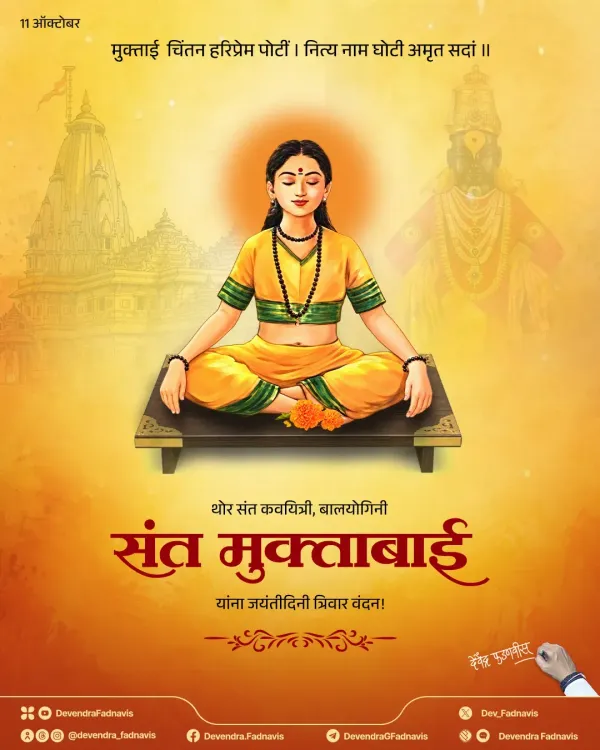
He quoted a Marathi abhanga verse by Muktabai: 'मुक्ताई चिंतन हरिप्रेम पोटीं । नित्य नाम घोटी अमृत सदां ॥' Sant Muktabai was the youngest sibling of Sant Dnyaneshwar and a key figure in 13th-century Varkari tradition.
She is among the rare women saints of her era whose devotional poetry has been preserved and is still sung in Maharashtra.
The Varkari Sampradaya, centred on Vitthal of Pandharpur , counts millions of followers across Maharashtra and Karnataka.
A voice that sang of divine love eight centuries ago still echoes across Maharashtra — and on Sunday, 11 October 2026, Maharashtra Chief Minister Devendra Fadnavis joined millions in honouring that voice, marking the Jayanti of Sant Muktabai, the revered saint-poetess and child yogini of the Varkari tradition.
Posting on X in both English and Marathi, CM Fadnavis offered a verse from Muktabai's own abhanga (devotional poetry): 'मुक्ताई चिंतन हरिप्रेम पोटीं । नित्य नाम घोटी अमृत सदां ॥' — loosely rendered as 'Muktai's contemplation springs from love of Hari; she churns the divine name like nectar, always.' He then offered trivar vandan — a threefold salutation — to the 'great saint-poetess and child yogini Sant Muktabai' on her Jayanti.
Who Was Sant Muktabai?
Sant Muktabai is one of the most celebrated figures in the Varkari Sampradaya, Maharashtra's deeply rooted devotional movement centred on the worship of Vitthal of Pandharpur. She was the youngest sibling of the legendary saint-poet Sant Dnyaneshwar, and tradition places her in 13th-century Maharashtra. Despite her youth, she is remembered as a spiritually advanced yogini whose abhangas carry a rare directness — challenging ego, celebrating surrender, and pointing unflinchingly toward the divine.
Her compositions remain part of living devotional practice across Maharashtra, sung in households, temples, and the annual Wari pilgrimage to Pandharpur. She is among the very few women saints of her era whose voice was recorded and preserved within a predominantly male canon — a fact that lends her legacy a significance that stretches well beyond theology.
Muktabai's Place in Maharashtra's Cultural Memory
For Maharashtra's political leadership, paying tribute to Varkari saints on their Jayantis is both a cultural duty and a signal of continuity with the state's spiritual heritage. The Varkari movement, which counts millions of followers across Maharashtra and parts of Karnataka, has historically bridged caste and community — its saints drew from across the social spectrum and preached radical equality before the divine. Muktabai, as a woman and a child, embodies that democratising spirit most sharply.
CM Fadnavis's salutation, framed in the classical devotional register, reflects the enduring weight these figures carry in Maharashtra's public life — not merely as historical saints but as living moral touchstones whose wisdom, as he noted, 'continues to inspire generations.'
Point of View
Aligning with figures like Muktabai reinforces its outreach into Maharashtra's deeply devotional heartland ahead of any electoral cycle. The choice to quote an original Marathi abhanga, rather than offer a generic salutation, also reflects a deliberate effort to engage authentically with the state's classical literary tradition. Muktabai's identity as a woman saint and child prodigy gives the tribute an additional resonance in contemporary conversations about women's spiritual agency.
NationPress
11 Oct 2026
Frequently Asked Questions
Who was Sant Muktabai?
Sant Muktabai was a 13th-century Maharashtrian saint-poetess and child yogini, the youngest sibling of Sant Dnyaneshwar, and a revered figure in the Varkari Sampradaya devoted to Vitthal of Pandharpur.
When is Sant Muktabai Jayanti celebrated?
Sant Muktabai Jayanti is observed annually; in 2026 it fell on 11 October, when tributes were paid across Maharashtra including by CM Devendra Fadnavis.
What is the Varkari Sampradaya?
The Varkari Sampradaya is a devotional movement in Maharashtra centred on the worship of Lord Vitthal at Pandharpur, known for its tradition of saint-poets who preached equality and devotion across caste lines.
What abhanga did CM Fadnavis quote for Muktabai Jayanti?
CM Fadnavis quoted the Marathi verse 'मुक्ताई चिंतन हरिप्रेम पोटीं । नित्य नाम घोटी अमृत सदां ॥', meaning Muktai's contemplation springs from love of Hari and she churns the divine name like eternal nectar.
Why is Sant Muktabai significant for Maharashtra?
Sant Muktabai is one of the very few women saints of medieval Maharashtra whose devotional poetry was preserved; her abhangas are still sung during the annual Wari pilgrimage to Pandharpur and in homes across the state.