CM Himanta: Assam conviction rate soars from 6.1% to 30.88%
Synopsis
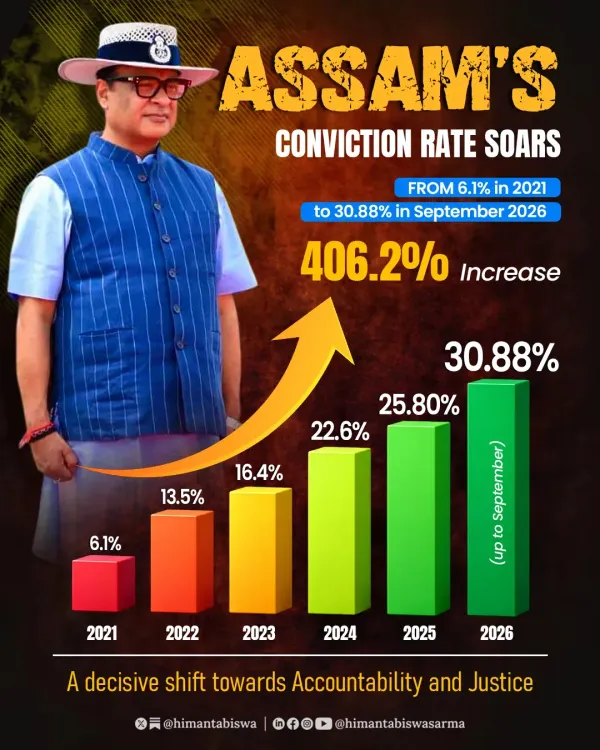
Assam Chief Minister Himanta Biswa Sarma announced the state's criminal conviction rate has risen from 6.1% in 2021 to 30.88% in September 2026, citing stronger investigations, better prosecution, and the Centre's criminal-law overhaul as key drivers.
Key Takeaways
Assam's criminal conviction rate climbed from 6.1% in 2021 to 30.88% in September 2026 — a nearly fivefold increase.
CM Himanta Biswa Sarma credited the turnaround to stronger investigations, effective prosecution, and greater accountability.
The improvement coincides with Parliament's December 2023 enactment of three new criminal laws replacing the IPC, CrPC, and Indian Evidence Act.
The state has Assam Police , the prosecution directorate, and the district judiciary as the three key pillars of the reform drive.
Similar conviction-rate claims have emerged from other BJP-governed states after the 2023 legal overhaul, placing Assam within a national pattern.
Full-year 2026 conviction data and further district-court implementation of new laws are the next metrics to watch.
A single statistic tells a story five years in the making: Assam Chief Minister Himanta Biswa Sarma announced on Monday, 26 October 2026, that the state's criminal conviction rate has surged from a dismal 6.1% in 2021 to 30.88% as of September 2026 — a nearly fivefold jump that he attributes to stronger investigations, more effective prosecution, and greater accountability across the justice chain.
From 6.1% to 30.88%: what the numbers mean
A conviction rate measures the share of concluded criminal trials that end in a guilty verdict. At 6.1%, Assam's courts in 2021 were acquitting or discharging the overwhelming majority of accused persons — a figure that advocates and police reformers had long flagged as a symptom of weak evidence collection, poor witness protection, and strained prosecution machinery. Crossing the 30% threshold in under five years represents a structural shift, not a marginal tweak.
Sarma framed the achievement squarely within Prime Minister Narendra Modi's national governance push, crediting the Centre's leadership for creating the political and policy conditions that made the turnaround possible. The state has consistently positioned itself as a front-runner in implementing the BJP's law-and-order agenda in India's Northeast.
The national legal overhaul behind Assam's push
Parliament enacted three landmark criminal-law statutes in December 2023 — the Bharatiya Nyaya Sanhita, the Bharatiya Nagarik Suraksha Sanhita, and the Bharatiya Sakshya Adhiniyam — replacing the colonial-era Indian Penal Code, Code of Criminal Procedure, and Indian Evidence Act respectively. The new laws place explicit timelines on investigations, strengthen forensic evidence requirements, and streamline trial procedures, all of which directly bear on conviction outcomes. Assam's climb in conviction figures tracks closely with the rollout period of these reforms in district courts.
The broader pattern is visible beyond Assam: several BJP-governed states have cited improving conviction metrics in the years since the 2023 legal overhaul, making Sarma's announcement part of a coordinated national narrative around measurable criminal-justice delivery. The difference here is the scale of the reported gain.
What the accountability chain actually looks like
Assam Police, the state prosecution directorate, and the district judiciary are the three pressure points the CM's formulation — 'stronger investigations, effective prosecution, greater accountability' — maps onto directly. Each link in that chain must improve for a conviction rate to move; a watertight charge sheet collapses if the prosecutor is unprepared, and a strong prosecution fails if evidence was gathered sloppily. A near-fivefold rise implies all three links tightened simultaneously.
For crime victims — the constituency that conviction statistics most directly affect — the gap between a 6% and a 31% rate is the difference between near-certain acquittal of an accused and a meaningful chance of a guilty verdict. That human dimension is what makes the number consequential, not just political.
The next test will come with the release of full-year 2026 conviction data and the further embedding of the three new criminal laws in Assam's district courts. If the September figure holds or climbs through the year-end, the state will have a benchmark every other northeastern administration will be asked to match.
Point of View
Auditable metric deployed to validate an ideological claim about the BJP's law-and-order credentials ahead of the continued operationalisation of India's new criminal codes. The near-fivefold rise is striking enough to demand scrutiny of the methodology — specifically, whether the denominator (trials concluded) has shrunk, inflating the rate — but if the figure withstands audit, it marks a genuine institutional shift in Assam. Framing it under PM Modi's leadership also serves NEDA's broader Northeast consolidation strategy, signalling to partner states that BJP-aligned governance delivers measurable justice outcomes. The real test arrives when full-year data is published and independent legal observers assess whether the new conviction rate reflects quality verdicts or expedited disposals.
NationPress
26 Oct 2026
Frequently Asked Questions
What is Assam's current criminal conviction rate?
As of September 2026, Assam's criminal conviction rate stands at 30.88%, up from 6.1% in 2021, according to Chief Minister Himanta Biswa Sarma.
Why did Assam's conviction rate increase?
CM Sarma attributes the rise to stronger police investigations, more effective prosecution, and greater accountability — aided by India's 2023 criminal-law overhaul that replaced the IPC, CrPC, and Indian Evidence Act.
What are the new criminal laws that replaced the IPC and CrPC?
Parliament enacted the Bharatiya Nyaya Sanhita, Bharatiya Nagarik Suraksha Sanhita, and Bharatiya Sakshya Adhiniyam in December 2023, replacing the Indian Penal Code, Code of Criminal Procedure, and Indian Evidence Act respectively.
How does Assam's conviction rate compare to other Indian states?
Several BJP-governed states have reported improving conviction metrics after the 2023 legal overhaul, though Assam's reported gain — from 6.1% to 30.88% — is among the most dramatic claimed in this period.
What will show whether Assam's conviction rate improvement is sustained?
The release of full-year 2026 conviction data and the complete operationalisation of the three new criminal laws in Assam's district courts will be the key indicators to watch.