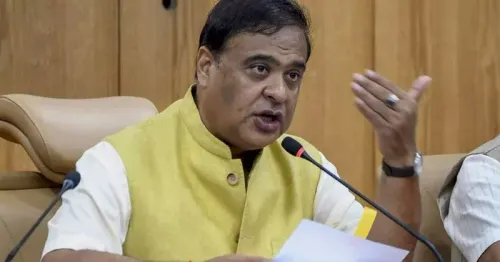
CM Himanta flags Assam's 29.3% conviction rate, vows crackdown

Synopsis
Assam CM Dr Himanta Biswa Sarma spotlights the state's 29.3% conviction rate as evidence of criminal-justice progress and pledges a continued crackdown, with the CMO sharing the remarks on 29 September 2026.
Key Takeaways
The Chief Minister's Office of Assam shared CM Himanta Biswa Sarma 's remarks on 29 September 2026 , highlighting a 29.3 per cent state conviction rate.
Sarma framed the figure as a direct rebuttal to narratives labelling Assam a crime-ridden state, using the phrase 'This is not Crimezapur.' Conviction rates track guilty verdicts against total tried cases — a metric the Assam government has consistently cited since Sarma took office in May 2021 .
The data-driven messaging aligns with a broader pattern of BJP-governed states using NCRB statistics to assert law-and-order credibility.
The next NCRB 'Crime in India' report and state budget allocations for policing and fast-track courts will be key tests of these claims.
A single number — 29.3 per cent — is at the centre of Assam Chief Minister Dr Himanta Biswa Sarma's latest law-and-order statement, as the Chief Minister's Office of Assam shared his remarks on Tuesday, 29 September 2026, framing the state's conviction rate as proof that the government's criminal-justice push is producing measurable results — and signalling the crackdown is far from over.
The 29.3% figure and what it signals
Conviction rates — the share of tried cases that end in a guilty verdict — are among the most watched metrics in Indian criminal-justice discourse, tracked annually by the National Crime Records Bureau. Himanta Biswa Sarma, who has governed Assam since May 2021, has repeatedly cited NCRB data to benchmark policing and judicial performance in the state. The 29.3 per cent figure, highlighted in this latest statement, is presented by his office as evidence that improved coordination between the Assam Police and the state judiciary is translating charges into convictions — a chain that often breaks down nationwide due to poor evidence management and court pendency.
The Chief Minister's office framed the message pointedly — pushing back against any characterisation of Assam as a 'crime capital', with the implicit assertion: this is not 'Crimezapur.' The rhetorical confidence is deliberate. Conviction rates, not merely arrest numbers, are politically harder to inflate and therefore carry more credibility as governance claims.
Sarma's law-and-order record since 2021
Dr Himanta Biswa Sarma — a former senior Congress leader who crossed over to the BJP in 2015 and rose to become one of the party's most prominent northeastern faces — has made law and order a signature of his administration. High-profile operations against drug trafficking, illegal cattle smuggling, and organised crime have been recurring features of his tenure. The government has also pushed for fast-track disposal of pending cases, positioning the judiciary-police interface as a reform priority.
Assam carries a historically complex security backdrop: decades of insurgency, concerns over illegal immigration, and deeply rooted inter-community tensions have made crime statistics in the state politically charged. When his government points to a conviction rate, it is arguing that the state has moved from merely arresting suspects to actually securing accountability through courts — a distinction that matters to both citizens and investors tracking the state's stability.
The data-driven law-and-order playbook
Assam's approach fits a broader pattern visible across several BJP-governed states: deploying NCRB statistics as a governance report card, tying crime metrics to administrative performance, and making those numbers part of the public narrative ahead of budgetary and electoral cycles. The emphasis on conviction rates — rather than just FIRs or charge-sheets — reflects a more sophisticated use of criminal-justice data in political communication.
What to watch next: the next annual NCRB 'Crime in India' report will either validate or complicate the 29.3 per cent claim, and any upcoming state budget allocations for police modernisation or fast-track courts will show whether the rhetoric is backed by resources.
If the courts keep pace with the arrests, Assam's conviction clock will keep ticking — and Himanta Sarma will make sure everyone hears it.
Point of View
Since court verdicts involve an independent judiciary. This fits a wider BJP governance playbook of anchoring political claims in auditable data, particularly ahead of budgetary cycles and eventual electoral contests. However, a 29.3% conviction rate, while cited as progress, still means nearly three in four tried cases do not end in conviction — a detail that opposition parties and criminal-justice reformers will likely deploy as a counter-narrative. The real governance test lies in whether Assam's investment in police capacity and fast-track courts keeps pace with the rhetoric.
NationPress
29 Sept 2026
Frequently Asked Questions
What is Assam's conviction rate in 2026?
Chief Minister Himanta Biswa Sarma has highlighted a 29.3 per cent conviction rate for Assam, meaning roughly 29 out of every 100 tried cases result in a guilty verdict.
What does the conviction rate mean for Assam's law and order?
A conviction rate measures the percentage of criminal trials that end in a guilty verdict. A rising rate is treated by the Assam government as evidence that police cases are being built well enough to withstand court scrutiny, indicating improved criminal-justice outcomes.
Who is Himanta Biswa Sarma?
Dr Himanta Biswa Sarma is the Chief Minister of Assam since May 2021 . A former senior Congress leader, he joined the BJP in 2015 and has since become one of the party's most influential figures in northeast India.
What is NCRB and why does it matter for Assam's crime data?
The National Crime Records Bureau (NCRB) is the central government body that publishes annual 'Crime in India' reports compiling state-wise data on FIRs, charge-sheets, trials, and conviction rates — the same data the Assam government uses to benchmark its criminal-justice performance.
What comes next after Assam's conviction rate announcement?
The next NCRB annual report will be a key independent check on the state's claims, while upcoming Assam state budget allocations for police modernisation and fast-track courts will indicate whether the government is backing its law-and-order rhetoric with funding.