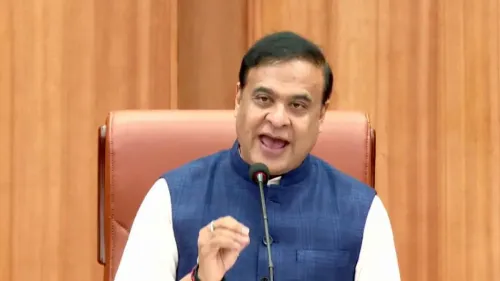
CM Himanta flags Assam conviction rate jump from 8% to 29.3%

Synopsis
Assam Chief Minister Himanta Biswa Sarma declared on 27 September 2026 that the state's conviction rate has surged from 8% to 29.3% in six years, directly warning criminals that enforcement will not relent until Assam is crime-free.
Key Takeaways
Assam's conviction rate has reportedly risen from 8% to 29.3% in six years , according to CM Himanta Biswa Sarma.
Sarma's post directly addressed 'anti-social elements,' framing the statistic as a deterrent warning rather than a routine governance update.
The BJP-led government in Assam has prioritised law-and-order outcomes since 2016 , with Sarma accelerating the push after becoming CM in May 2021 .
Conviction rates in India are tracked annually by the National Crime Records Bureau (NCRB) ; official data will be the benchmark against which Sarma's claim is tested.
Sarma pledged 'no let-up' until Assam achieves a #crimefree status, anchoring a clear public accountability marker for his administration.
Assam's criminal-justice machinery is producing numbers that would have looked impossible half a decade ago — and Chief Minister Himanta Biswa Sarma wants every would-be offender in the state to know it. In a pointed message posted on 27 September 2026, Sarma announced that Assam's conviction rate has climbed from 8% to 29.3% in just six years, framing the milestone as a warning rather than a celebration.
The numbers Sarma put on the table
The post dispensed with diplomatic language entirely. Addressing 'anti-social elements' directly, Sarma wrote: 'Assam's conviction rate has jumped from 8% to 29.3% in just six years. And we're only getting started. You can do the maths. Or, we'll do that as well.' The message closed with an unambiguous pledge: 'No let-up until Assam is #crimefree.'
A jump of more than 21 percentage points in conviction rate — if borne out by official crime data — would represent one of the more striking improvements in criminal-justice outcomes recorded by any Indian state in recent years. Conviction rates in India have historically lagged, weighed down by overburdened courts, delayed investigations, and under-resourced prosecution offices.
Six years of law-and-order as a political identity
Himanta Biswa Sarma took charge as Chief Minister in May 2021, having been a central figure in the BJP-led government in Assam since 2016. From his first weeks in office, law and order was front and centre — ranging from crackdowns on drug trafficking and organised crime to high-visibility policing operations in areas previously associated with militancy and illegal immigration.
The pattern of public messaging has been consistent: quantify outcomes, name the adversary, and signal relentlessness. Today's post fits squarely in that playbook — except the numbers are now projected forward as a deterrent, not merely reported backward as an achievement.
What a conviction-rate leap actually signals
Conviction rates are a downstream product of several interlocking systems: police investigation quality, forensic infrastructure, prosecution competence, and judicial capacity. A sustained rise across all case categories requires movement in each of these. The National Crime Records Bureau (NCRB) publishes annual state-by-state conviction data, and Assam's trajectory in the next annual release will be the hard test of the figures Sarma cited today.
Critics and opposition voices will likely press for a breakdown — which offence categories drove the improvement, whether the base numbers were suppressed by pandemic-era court closures, and whether faster disposal also meant fair process. Those are legitimate questions. The government's answer, for now, is the headline number itself.
The #crimefree pledge is also a political marker ahead of whatever electoral calendar Assam faces next. Sarma has staked a significant part of his governance brand on visible, measurable safety outcomes — and the 29.3% figure is the clearest public benchmark he has set yet.
Point of View
Compressing weeks of policy narrative into a single viral moment. The broader BJP pattern in Assam has been to weaponise measurable outcomes — encounter numbers, drug seizures, eviction drives — as electoral communication, and today's figure is the most headline-ready of them all. Whether the 29.3% figure survives scrutiny from NCRB disaggregation will determine whether this becomes a durable plank or an exposed flank.
NationPress
28 Sept 2026
Frequently Asked Questions
What is Assam's current conviction rate according to CM Himanta Biswa Sarma?
CM Himanta Biswa Sarma stated on 27 September 2026 that Assam's conviction rate has reached 29.3% , up from 8% six years ago, representing a rise of over 21 percentage points.
How is conviction rate measured in Indian states?
Conviction rate is the proportion of cases that end in a court conviction out of all cases where trials are completed. The National Crime Records Bureau (NCRB) publishes this data annually for each state and union territory.
When did Himanta Biswa Sarma become Chief Minister of Assam?
Himanta Biswa Sarma took charge as Chief Minister of Assam in May 2021 . He is a senior BJP leader and also serves as convenor of the North-East Democratic Alliance (NEDA).
What factors affect a state's conviction rate in India?
Conviction rates depend on the quality of police investigation, forensic infrastructure, the strength of prosecution, and judicial capacity and speed. A sustained rise typically requires improvements across all four areas simultaneously.
Is Assam's reported 29.3% conviction rate officially verified?
The figure of 29.3% was cited by CM Sarma in his post. Official verification will come from the next annual NCRB crime statistics report, which provides state-level conviction data.