Assam conviction rate jumps to 30.88% in 2026, up from 6.1% in 2021: CM Sarma

Synopsis
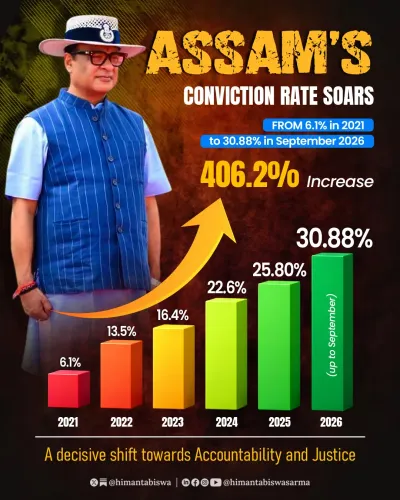
Assam's conviction rate has jumped from 6.1% in 2021 to 30.88% in September 2026 — a 24.78 percentage-point rise in five years. CM Himanta Biswa Sarma announced the data on X, framing it as evidence of stronger policing and prosecution. The figures lack a category-wise breakdown, leaving open questions about methodology and which crime types drove the gains.
Key Takeaways
Assam's conviction rate reached 30.88 per cent in September 2026 , up from 6.1 per cent in 2021 .
The rise of 24.78 percentage points over five years was announced by Chief Minister Himanta Biswa Sarma in a post on X.
Year-on-year figures: 13.5% (2022), 16.4% (2023), 22.6% (2024), 25.80% (2025), 30.88% (September 2026).
The government attributed improvement to stronger investigations, effective prosecution, and greater accountability.
No category-wise breakdown or detailed methodology was provided alongside the announcement.
Assam Chief Minister Himanta Biswa Sarma on Monday, 26 October 2026, announced that the state's conviction rate had climbed sharply to 30.88 per cent as of September 2026, compared to just 6.1 per cent in 2021 — a rise of 24.78 percentage points over five years. Sarma attributed the improvement to stronger criminal investigations, more effective prosecution, and greater accountability in the state's law enforcement machinery.
Year-on-Year Conviction Rate Trend
According to figures shared by the Chief Minister, Assam's conviction rate followed a sustained upward trajectory: 6.1 per cent in 2021, 13.5 per cent in 2022, 16.4 per cent in 2023, 22.6 per cent in 2024, 25.80 per cent in 2025, and 30.88 per cent in September 2026. The consistent year-on-year gains suggest a structural shift rather than a single-year anomaly.
What the Government Said
Sarma shared the data in a post on X, underlining what he described as the state government's resolve to uphold the law and deliver justice. 'Stronger investigations. Effective prosecution. Greater accountability,' the Chief Minister wrote, connecting the improvements to the broader governance framework under Prime Minister Narendra Modi. The announcement places emphasis on the complementary roles of investigative agencies and public prosecutors in securing convictions.
Context and Caveats
Conviction rates are widely used as a benchmark for criminal justice performance, though experts note that comparisons can be affected by the nature of cases tried, the stage at which convictions are counted, and the methodology applied. Notably, the figures shared in the social media post did not include a breakdown by crime category, nor did they specify whether the September 2026 figure reflects cases decided during that month alone or represents a cumulative measure for the year. Independent verification of the methodology and category-wise data would allow a fuller assessment of the improvement across different types of criminal cases.
Why It Matters
A low conviction rate has historically been seen as a systemic weakness in India's criminal justice system, often attributed to poor evidence collection, prosecution gaps, and witness-related challenges. Assam's reported turnaround — if sustained and independently verified — would represent one of the sharper state-level improvements in recent years. This comes amid a broader push by several state governments to reform policing and prosecution practices, with conviction data increasingly cited as a governance indicator ahead of electoral cycles.
What Comes Next
Civil society groups and legal observers are likely to seek a detailed, category-wise breakdown of the conviction figures to assess whether improvements are evenly spread across serious crimes such as murder, rape, and organised crime, or concentrated in lower-stakes cases. The state government has not yet indicated a timeline for releasing a granular methodology report.
Point of View
Magistrate court verdicts, or both can dramatically alter the percentage. The absence of a crime-category breakdown is a significant gap: a surge in convictions for minor or bailable offences would tell a very different story than gains in heinous crimes. Assam has also been a state with a high volume of preventive detention and special-law cases, where conviction dynamics differ from ordinary IPC offences. Until an independent audit of the methodology is published, the number is best read as a political signal rather than a fully verified justice-sector turnaround.
NationPress
26 Oct 2026
Frequently Asked Questions
What is Assam's current conviction rate and how much has it improved?
Assam's conviction rate stood at 30.88 per cent as of September 2026, up from 6.1 per cent in 2021 — a rise of 24.78 percentage points over five years, according to figures shared by Chief Minister Himanta Biswa Sarma.
What factors did CM Sarma credit for the improvement in Assam's conviction rate?
Sarma attributed the improvement to stronger criminal investigations, more effective prosecution, and greater accountability in law enforcement. He also connected the gains to the broader governance framework under Prime Minister Narendra Modi.
Are there any caveats to Assam's conviction rate data?
Yes. The figures shared by the Chief Minister did not include a breakdown by crime category or a detailed explanation of the methodology used. It is also unclear whether the September 2026 figure represents cases decided that month or a cumulative annual measure, making independent verification difficult.
How does a higher conviction rate benefit ordinary citizens?
A higher conviction rate is generally seen as evidence that the criminal justice system is functioning more effectively — deterring crime, delivering justice to victims, and building public confidence in law enforcement. However, experts caution that the quality and fairness of convictions matter as much as the quantity.
What happens next after this announcement?
Legal observers and civil society groups are expected to seek a detailed, category-wise breakdown to assess whether gains span serious crimes or are concentrated in lower-stakes cases. The Assam government has not yet indicated when or whether it will release a granular methodology report.