Assam scores 92% in new criminal laws rollout, leads national average: Himanta Sarma

Synopsis
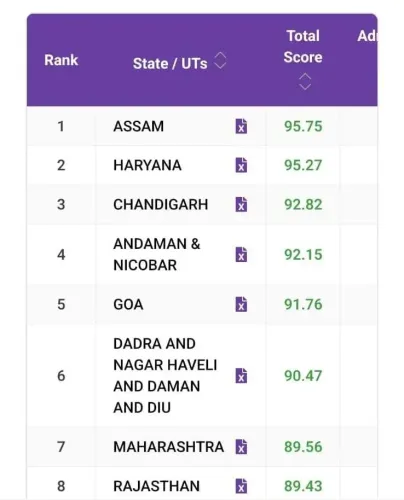
Assam is outpacing most Indian states in adopting the new criminal laws, posting a 92.16% compliance score against a national average of 74.86%. CM Himanta Biswa Sarma's disclosure — made via X — is one of the first detailed state-level performance readouts since the Nyay Sanhitas replaced colonial-era penal codes in July 2024, setting a live benchmark for how India's criminal justice overhaul is actually landing on the ground.
Key Takeaways
Assam recorded a compliance score of 92.16 per cent in implementing the new criminal laws, against a national average of 74.86 per cent .
The state achieved 100 per cent compliance in ICJS Data Sharing , NAFIS , and the Medico-Legal Examination and Post-Mortem Reporting System .
The three new laws — Bharatiya Nyaya Sanhita , Bharatiya Nagarik Suraksha Sanhita , and Bharatiya Sakshya Adhiniyam — replaced colonial-era codes from 1 July 2024 .
Chief Minister Himanta Biswa Sarma shared the assessment on 3 September via social media platform X .
Assam's progress is attributed to greater use of technology , improved inter-agency coordination , and adherence to the new legal provisions.
Assam has emerged as one of India's top-performing states in the implementation of the new criminal laws, recording a compliance score of 92.16 per cent against the national average of 74.86 per cent, Chief Minister Himanta Biswa Sarma announced on Thursday, 3 September. The state's performance comes more than a year after the landmark rollout of the Nyay Sanhitas on 1 July 2024.
Key Compliance Achievements
According to Chief Minister Sarma, Assam has achieved 100 per cent compliance across several critical parameters tied to the new criminal justice framework. These include the adoption of the Nyay Sanhitas and Model Rules, as well as full integration with the Inter Operable Criminal Justice System (ICJS) Data Sharing Matrix — a platform designed to facilitate seamless exchange of criminal justice information across agencies.
The state has also recorded full compliance in the National Automated Fingerprint Identification System (NAFIS) and the Medico-Legal Examination and Post-Mortem Reporting System, both of which are central to modern forensic and investigative processes under the new legal regime.
What the Government Said
Sharing the assessment on social media platform X, Chief Minister Sarma attributed the progress to greater use of technology, improved inter-agency coordination, and strict adherence to the provisions of the new laws. He said the results reflect the state government's sustained commitment to strengthening criminal justice delivery.
'Every victim is heard, every case is pursued to the end, and every citizen receives timely justice,' Sarma said, outlining the administration's stated priorities under the new framework.
Background: The Three New Criminal Laws
The three statutes at the centre of this overhaul — the Bharatiya Nyaya Sanhita, the Bharatiya Nagarik Suraksha Sanhita, and the Bharatiya Sakshya Adhiniyam — replaced the Indian Penal Code, the Code of Criminal Procedure, and the Indian Evidence Act respectively, effective 1 July 2024. The transition marked one of the most comprehensive overhauls of India's criminal justice architecture in over 150 years.
National Context and What Comes Next
Assam's performance assessment comes as states across India work to align policing, investigation, prosecution, and judicial processes with the new legal provisions. The national average compliance of 74.86 per cent indicates that a significant gap remains between leading and lagging states. Notably, this is among the first detailed state-level compliance disclosures since the laws came into force, setting a potential benchmark for peer comparison.
Chief Minister Sarma said Assam would continue to work towards strengthening its justice delivery mechanism and ensuring timely outcomes for citizens. Further progress reviews are expected as implementation deepens across the state's districts.
Point of View
And the government has not yet detailed who conducted this assessment or how parameters were weighted. Assam's 92.16% figure is striking, but the 74.86% national average also signals that a large portion of India's criminal justice machinery is still catching up — nearly 14 months after the laws took effect. The real test of the Nyay Sanhitas will not be data-sharing matrices or fingerprint system uptake, but whether trial timelines shorten and conviction rates improve for ordinary citizens. Those outcomes will take years to surface, and no compliance dashboard captures them yet.
NationPress
18 Oct 2026
Frequently Asked Questions
What is Assam's compliance score in implementing the new criminal laws?
Assam has recorded a compliance score of 92.16 per cent in implementing the new criminal laws, significantly above the national average of 74.86 per cent, according to Chief Minister Himanta Biswa Sarma's announcement on 3 September.
What are the three new criminal laws that replaced India's colonial-era codes?
The Bharatiya Nyaya Sanhita, Bharatiya Nagarik Suraksha Sanhita, and Bharatiya Sakshya Adhiniyam replaced the Indian Penal Code, Code of Criminal Procedure, and Indian Evidence Act respectively, coming into effect on 1 July 2024.
Which parameters did Assam achieve 100 per cent compliance in?
Assam achieved full compliance in the Inter Operable Criminal Justice System (ICJS) Data Sharing Matrix, the National Automated Fingerprint Identification System (NAFIS), and the Medico-Legal Examination and Post-Mortem Reporting System, among other key parameters.
Why does Assam's performance in the Nyay Sanhita rollout matter?
Assam's high compliance score sets a state-level benchmark at a time when India is still in the early stages of transitioning to its new criminal justice framework. It also highlights the gap between leading and lagging states, with the national average at 74.86 per cent.
What did CM Himanta Biswa Sarma say about Assam's criminal justice goals?
Chief Minister Sarma said the government remains committed to ensuring victims receive due attention and cases are pursued to their logical conclusion. He stated: 'Every victim is heard, every case is pursued to the end, and every citizen receives timely justice.'