Rahul Gandhi Demands: Who Ordered Assault on Students?
Synopsis
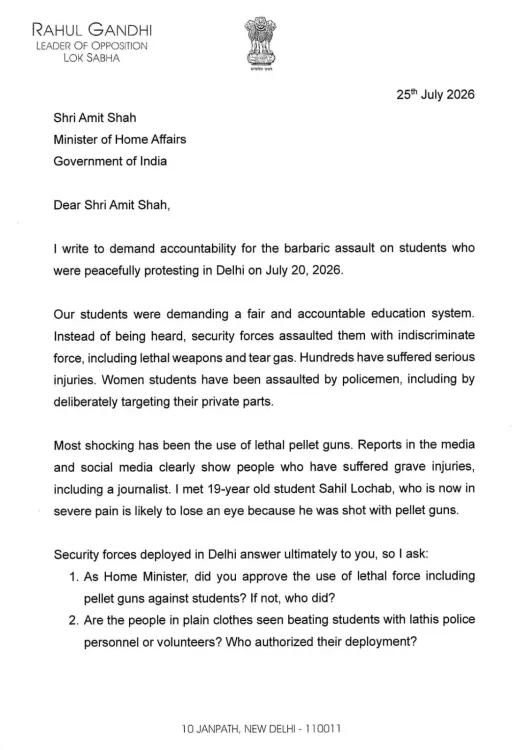
Leader of the Opposition Rahul Gandhi on 27 July 2026 posted a pointed question on X — 'Who gave the order to beat the students?' — demanding government accountability over an alleged assault on students, backed by two images.
Key Takeaways
Rahul Gandhi , Leader of the Opposition in Lok Sabha, posted on X on 27 July 2026 demanding accountability for an alleged assault on students.
His post in Hindi asks: 'Who gave the order to beat the students?' — a direct challenge to the government.
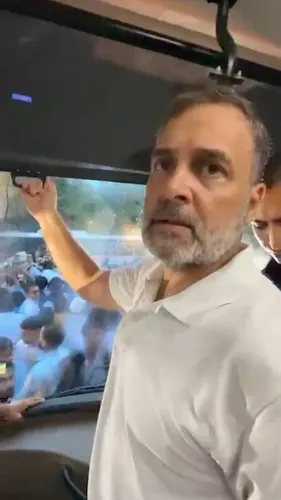
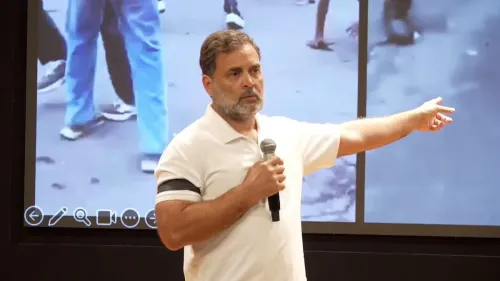
The post was accompanied by two images that appear to document the incident.
The specific location and date of the underlying incident have not been independently confirmed at the time of publication.
Gandhi has a consistent record of using social media to demand accountability for alleged use of state force against civilians and students.
The matter is likely to be raised formally in the Lok Sabha when Parliament is next in session.
Congress leader Rahul Gandhi, Leader of the Opposition in Lok Sabha, on Sunday, 27 July 2026, posted a sharp question on X demanding accountability over an alleged assault on students, asking: 'छात्रों को मारने का आदेश किसने दिया?' ('Who gave the order to beat the students?'). The post, accompanied by two images, has drawn immediate attention to what appears to be a law-and-order incident involving students.
Context
Rahul Gandhi's post poses a direct, unambiguous question to the government: 'Who gave the order to beat the students?' The two images attached to the post appear to provide visual evidence of the incident, though the precise location and date of the underlying event have not been independently confirmed at the time of publication. The post signals that the Congress party intends to hold the administration accountable for the use of force against students.
Gandhi has consistently used social media as a platform to demand accountability on incidents where state force is alleged to have been used against civilians, students, or protesters. This post follows that established pattern of public questioning directed at the ruling establishment.
Policy Backdrop
The use of force against students and protesters has been a recurring flashpoint in Indian politics. Opposition leaders, including Rahul Gandhi, have previously raised such incidents in Parliament and on public platforms, demanding inquiry commissions and ministerial accountability. Under Indian constitutional norms, law-and-order is a state subject, meaning responsibility for police action rests with the concerned state government.
Parliamentary procedure allows the Leader of the Opposition to raise such matters through starred and unstarred questions, adjournment motions, and zero-hour interventions. Gandhi's social media post may be a precursor to a formal parliamentary challenge when the Lok Sabha is next in session.
Stakeholders and Impact
Students are the central stakeholders in this controversy. If the images attached to Gandhi's post depict a genuine incident of police or administrative force against students, the matter carries significant implications for civil liberties, the right to peaceful assembly, and the accountability of law-enforcement agencies. Student organisations across the political spectrum are likely to respond to the post.
The ruling government — at the Centre or in the relevant state — faces pressure to clarify the chain of command that authorised any use of force. Civil-society groups, bar associations, and human-rights bodies may also seek details of the incident. The post has the potential to escalate into a broader political confrontation if no official response is forthcoming.
What's Next
All eyes are now on an official government response — whether from the Union Home Ministry, the concerned state government, or the police establishment. An inquiry commission or a statement by the district or state administration would be the most immediate institutional response. Gandhi's question is also likely to be raised formally in the Lok Sabha, where he commands the opposition benches as Leader of the Opposition. The incident, and the government's handling of it, will be a test of institutional accountability on the use of force against students in India.
Point of View
Gandhi shifts the burden of explanation onto the executive. This kind of intervention has historically succeeded in extracting at least a procedural government response, even when the underlying facts remain contested. The broader pattern signals that student welfare and state accountability will remain live political issues heading into the next parliamentary session.
NationPress
26 Jul 2026
Frequently Asked Questions
What did Rahul Gandhi post about students on 27 July 2026?
Rahul Gandhi posted on X asking 'Who gave the order to beat the students?' along with two images, demanding government accountability for an alleged assault on students.
Which incident is Rahul Gandhi referring to in his student post?
The specific incident referenced in his 27 July 2026 post has not been independently confirmed at the time of publication. Gandhi's post and images appear to document an alleged assault on students, but location and date details are unverified.
What can Rahul Gandhi do as Leader of the Opposition on student issues?
As Leader of the Opposition in Lok Sabha, Rahul Gandhi can raise the matter through starred and unstarred questions, adjournment motions, and zero-hour interventions during Parliament sessions.
Has Rahul Gandhi raised student assault issues before?
Yes. Rahul Gandhi has consistently used social media and Parliament to demand accountability on incidents involving alleged use of state force against students and protesters.
What government response is expected after Rahul Gandhi's post?
A response from the Union Home Ministry or the concerned state government is expected. An inquiry or official statement from police or district administration would be the most immediate institutional reply.