Rahul Gandhi Slams Govt Over Student Despair, Ministerial Apathy
Synopsis
Congress leader Rahul Gandhi on 21 July 2026 posted a sharp critique contrasting Indian students' despair over their futures with ministers' focus on retaining power, declaring there is 'no justice' in such a country. The statement intensifies opposition pressure on the government over education and youth welfare.
Key Takeaways
Congress leader Rahul Gandhi posted on X on 21 July 2026 criticising the government over student despair and ministerial self-interest.
Gandhi quoted students as saying 'we have no future' and contrasted this with ministers determined not to lose their positions.
He declared that a country where students lose their future while ministers keep their seats has 'no justice at all.' The post comes against the backdrop of ongoing concerns over graduate unemployment, examination irregularities, and NEP 2020 implementation gaps.
The Monsoon Session of Parliament is expected to see opposition pressure on the Education Ministry over examination reforms and budget demands.
Gandhi's framing is consistent with a pattern of linking institutional failures in education to political self-preservation across multiple election cycles.
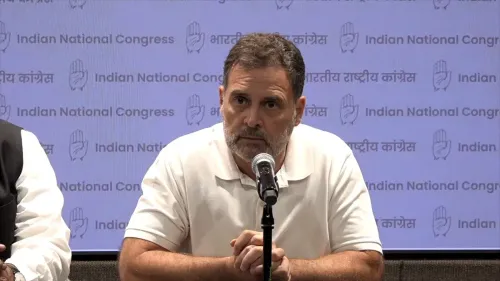
Congress leader and Leader of the Opposition in Lok Sabha Rahul Gandhi on Tuesday, 21 July 2026, sharply criticised the ruling government, contrasting what he described as students losing hope in their futures with ministers clinging to their positions. The post, shared on X in Hindi, drew a pointed moral contrast between youth despair and political self-preservation.
In the post, Gandhi wrote: 'देश का छात्र कह रहा है - हमारा कोई भविष्य नहीं।' ('The student of this country is saying — we have no future.') He then juxtaposed this with: 'और इस सरकार के मंत्री कह रहे हैं — हमारी कुर्सी नहीं जाएगी।' ('And the ministers of this government are saying — our chair will not go.') Gandhi concluded: 'जिस देश में छात्र भविष्य खो दे और मंत्री कुर्सी न खोए — वहां न्याय है ही नहीं।' ('In a country where students lose their future and ministers do not lose their seat — there is no justice at all.')
Context
Gandhi's statement arrives against a backdrop of sustained unease among Indian students and youth over employment prospects, examination integrity, and access to quality higher education. Opposition leaders, including Gandhi, have repeatedly drawn attention to what they describe as a widening gap between government claims of an 'education revolution' and ground realities faced by students.
The post does not name a specific minister or cite a specific incident, but the framing — ministers prioritising political survival over student welfare — is consistent with Gandhi's broader parliamentary and public messaging on institutional accountability.
Policy Backdrop
The National Education Policy (NEP) 2020, approved by the Union Cabinet in July 2020, was positioned as a landmark overhaul replacing the 1986 education policy. It promised a restructured curriculum, reformed assessment systems, and multidisciplinary learning across school and higher education. Critics, however, have argued that implementation has been uneven and that structural issues — graduate unemployment, examination irregularities, and underfunded institutions — remain unresolved.
The 2024–25 academic cycle saw significant controversy over paper leaks in national-level competitive examinations, triggering protests on campuses across the country and parliamentary debates over the conduct and oversight of examination bodies. These incidents have become a recurring reference point in opposition critiques of education governance.
Stakeholders and Impact
Indian students, particularly those competing for limited government jobs and university seats, are the primary constituency Gandhi is addressing. Youth unemployment and the credibility of competitive examinations have emerged as politically sensitive issues ahead of multiple state assembly elections.
The post also implicitly targets the political class, framing ministerial job security as a symbol of a system that protects incumbents while leaving aspirants behind. This framing resonates with a pattern Gandhi has employed across multiple election cycles, linking education failures to what he describes as institutional capture by those in power.
What's Next
The Monsoon Session of Parliament is a key arena to watch, as debates on the Education Ministry's demands for grants and any follow-up legislation on examination-conduct reforms are expected. Gandhi's post signals that the opposition intends to keep student welfare and ministerial accountability at the centre of parliamentary discourse.
Whether the ruling government responds with a formal rebuttal or policy announcement will determine how this narrative develops in the coming weeks of the session.
Point of View
The statement is designed to resonate broadly with any young person who has faced examination failures, unemployment, or institutional indifference, making it difficult for the government to rebut on factual grounds alone. The recurring pattern of such interventions suggests the Congress is building a sustained narrative around youth welfare and accountability ahead of the Monsoon Session and upcoming state elections. The absence of a specific trigger also insulates the statement from fact-checking while maximising its emotional reach.
NationPress
20 Oct 2026
Frequently Asked Questions
What did Rahul Gandhi say about students and ministers on 21 July 2026?
Rahul Gandhi posted on X saying that students are declaring they have no future while government ministers are focused on not losing their positions, concluding that a country where this happens has no justice.
Why is Rahul Gandhi criticising the government on education?
Gandhi has consistently raised concerns about graduate unemployment, examination irregularities such as paper leaks, and gaps in the implementation of the National Education Policy 2020, framing these as evidence of a government that protects its own interests over student welfare.
What is the National Education Policy 2020?
The National Education Policy 2020 was approved by the Union Cabinet in July 2020 to replace the 1986 education policy. It aims to restructure school and higher education with a focus on multidisciplinary learning and reformed assessment, though critics say implementation has been uneven.
What are Indian students protesting about in 2025 and 2026?
Indian students have raised concerns over paper leaks in national competitive examinations, limited government job opportunities, and the credibility of examination bodies, leading to campus protests and parliamentary debates.
What is expected in the Monsoon Session of Parliament on education?
The Monsoon Session is expected to include debates on the Education Ministry's budget demands and potential follow-up legislation on examination-conduct reforms, with the opposition likely to press the government on student welfare and institutional accountability.