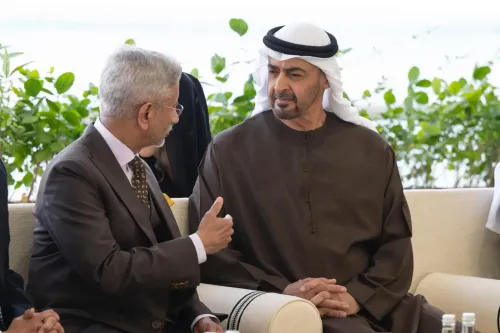
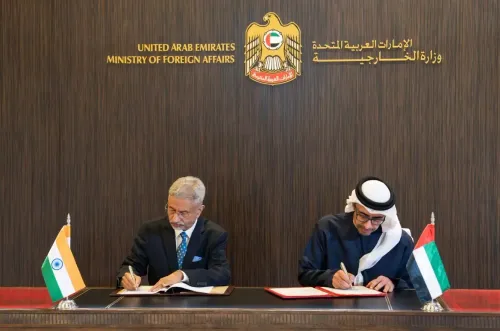
Jaishankar Welcomes UAE Deputy PM Sheikh Abdullah to Mumbai
Synopsis
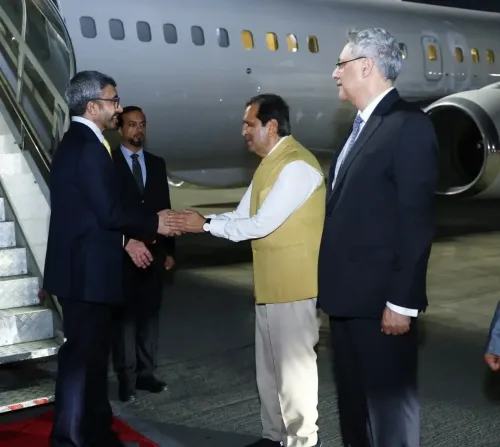
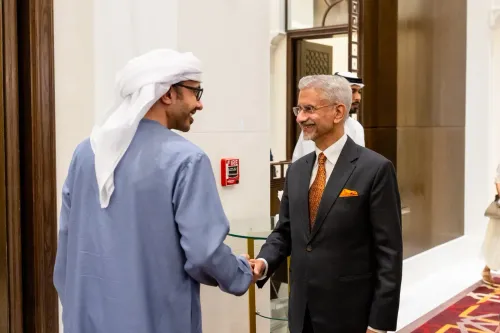
Union External Affairs Minister Dr. S. Jaishankar welcomed UAE Deputy Prime Minister and Foreign Minister Sheikh Abdullah bin Zayed Al Nahyan to Mumbai on 20 October 2026. The high-level visit advances India-UAE ties under their Comprehensive Strategic Partnership, with trade, energy, and investment likely on the agenda.
Key Takeaways
Union External Affairs Minister Dr.
Jaishankar welcomed UAE Deputy PM and FM Sheikh Abdullah bin Zayed Al Nahyan to Mumbai on 20 October 2026 .
The visit is set against the India-UAE Comprehensive Strategic Partnership , one of India's most active Gulf relationships.
The two countries signed a Comprehensive Economic Partnership Agreement (CEPA) in February 2022 , the fastest such deal in India's history.
The UAE hosts approximately 3.5 million members of the Indian diaspora — the largest single national community there.
Mumbai was chosen as the venue, reflecting the commercial and financial depth of the bilateral relationship.
A joint statement or follow-up framework from the talks is possible, consistent with recent India-UAE engagement patterns.
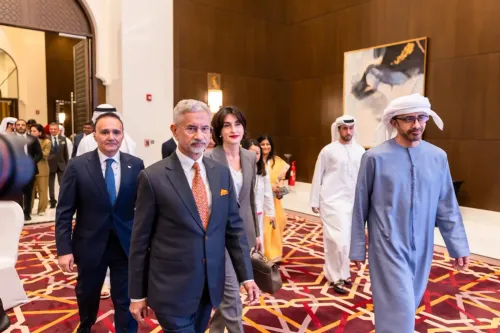
A high-level Gulf visitor touched down in India's financial capital on Tuesday, 20 October 2026, as Union External Affairs Minister Dr. S. Jaishankar welcomed Sheikh Abdullah bin Zayed Al Nahyan, Deputy Prime Minister and Foreign Minister of the United Arab Emirates, to Mumbai — signalling that one of India's most consequential bilateral relationships is back in active gear.
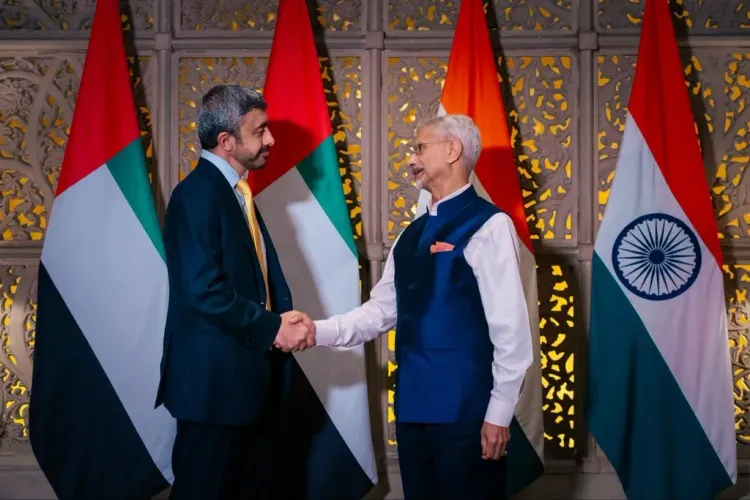
Jaishankar posted on X: 'Delighted to welcome DPM and FM UAE Sheikh Abdullah bin Zayed to Mumbai. Look forward to our talks.' The warm, direct phrasing — coupled with both nations' flags — underscored the personal rapport that has come to define India-UAE diplomatic exchanges at the ministerial level.
Why Mumbai, and Why It Matters
Choosing Mumbai as the venue rather than New Delhi is itself a signal. The city is the nerve centre of India's finance, trade, and diaspora remittance corridors — all of which feed directly into the bilateral agenda. The UAE is home to roughly 3.5 million members of the Indian diaspora, the largest single national community in the Emirates, and their remittances form a significant thread in the economic fabric binding the two countries.
The backdrop for these talks is the landmark Comprehensive Economic Partnership Agreement (CEPA) signed in February 2022 — the fastest-negotiated free-trade deal in India's history, concluded in under 90 days. Since then, both governments have worked to translate that framework into measurable trade flows, with non-oil bilateral commerce a particular focus.
From Energy Partner to Strategic Ally
The India-UAE relationship has travelled a long road from a purely energy-and-diaspora dynamic to a Comprehensive Strategic Partnership, a status formalised in recent years. Defence cooperation, cybersecurity, food security, and payment-system linkages — including India's UPI being accepted in the UAE — have all become live tracks on the bilateral agenda.
High-level exchanges between the two sides have grown notably frequent, often clustering around multilateral moments such as the UN General Assembly or G20 summits. Sheikh Abdullah's Mumbai visit fits this pattern of sustained, senior-level engagement rather than one-off diplomacy.
What the Talks Could Yield
While the specific agenda for the Mumbai meeting has not been officially detailed, the established rhythm of India-UAE engagement points toward discussions on energy security, investment flows into India's infrastructure and technology sectors, and possibly a review of CEPA implementation benchmarks. A joint statement or follow-up framework emerging from the talks would be consistent with the seriousness the two sides have attached to recent meetings.
For Jaishankar — a career diplomat who has navigated India's relationships with the Gulf, the West, and China with studied precision — the Mumbai setting also offers an opportunity to engage the UAE's leadership in the commercial ecosystem that makes these ties tangible for ordinary Indians and Emiratis alike.
Point of View
Rather than the capital, is a deliberate framing: it places trade, investment, and diaspora welfare — not just state protocol — at the centre of the conversation. For India, the Gulf remains a uniquely layered relationship where energy security, remittance economics, and strategic positioning intersect. The CEPA signed in 2022 gave the partnership a durable commercial spine, and follow-through meetings like this one are how governments convert framework agreements into ground-level outcomes. Sustaining senior-level cadence with Abu Dhabi also serves India's broader West Asia balancing act at a time when the region's geopolitics remain in flux.
NationPress
20 Oct 2026
Frequently Asked Questions
Why did UAE Deputy PM Sheikh Abdullah bin Zayed visit Mumbai in October 2026?
Sheikh Abdullah bin Zayed Al Nahyan, UAE Deputy Prime Minister and Foreign Minister, visited Mumbai on 20 October 2026 for bilateral talks with Indian External Affairs Minister Dr. S. Jaishankar, advancing the India-UAE Comprehensive Strategic Partnership.
What is the India-UAE Comprehensive Economic Partnership Agreement?
The India-UAE CEPA was signed in February 2022 and is the fastest free-trade agreement India has concluded, negotiated in under 90 days. It aims to boost non-oil bilateral trade and reduce tariff barriers across goods and services.
What is the India-UAE Comprehensive Strategic Partnership?
The Comprehensive Strategic Partnership is the highest diplomatic designation India and the UAE have assigned to their bilateral relationship, covering energy, defence, trade, investment, cybersecurity, and people-to-people ties.
How large is the Indian diaspora in the UAE?
Approximately 3.5 million Indians live in the UAE, making them the largest single national community there. They are a central element of the people-to-people dimension of India-UAE ties.
Why was Mumbai chosen for the India-UAE foreign minister talks instead of New Delhi?
Mumbai's status as India's financial and commercial capital makes it a fitting venue for India-UAE talks, which increasingly focus on trade flows, investment, and the large Indian diaspora community rather than purely state-level diplomacy.