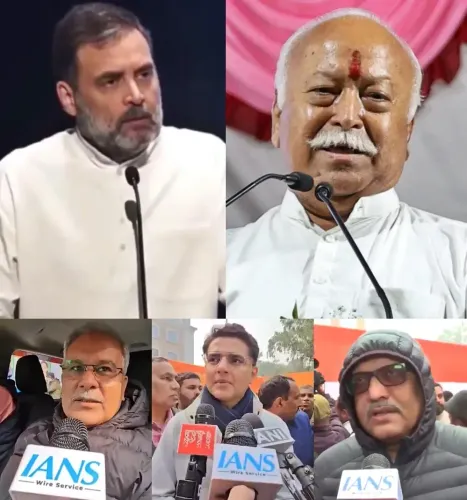
Rahul Gandhi calls actions against India 'treason', names Modi, Shah, Bhagwat

Synopsis
Congress leader Rahul Gandhi named Prime Minister Narendra Modi, Home Minister Amit Shah, Chief Election Commissioner Gyanesh Kumar, and RSS chief Mohan Bhagwat in an X post on 6 October 2026, calling their actions against India 'treason' and warning that none would escape accountability.
Key Takeaways
Rahul Gandhi posted on X on 6 October 2026 , labelling actions against India as 'treason' ( देशद्रोह ).
He directly named PM Narendra Modi , Home Minister Amit Shah , Chief Election Commissioner Gyanesh Kumar , and RSS chief Mohan Bhagwat .
The inclusion of a sitting constitutional authority, the CEC , alongside political and ideological leaders marks a significant escalation.
Gandhi warned that 'no one will escape', framing his charge as an accountability ultimatum rather than a routine political criticism.
The post contained a video, indicating a prepared, deliberate communication timed for maximum news-cycle reach.
In one of his most direct and incendiary political statements in recent memory, Congress leader Rahul Gandhi on Tuesday, 6 October 2026 levelled a charge of treason against some of India's most powerful figures — naming Prime Minister Narendra Modi, Home Minister Amit Shah, Chief Election Commissioner Gyanesh Kumar, and RSS chief Mohan Bhagwat in a single, unsparing post on X.
Posting in Hindi, Gandhi wrote: 'मेरे भारत के साथ जो किया गया है, वो देशद्रोह है।' — 'What has been done to my India is treason.' He added, with unambiguous finality: 'Whether it is Narendra Modi, Amit Shah, Gyanesh Kumar, or Mohan Bhagwat — no one will escape.'
A four-name salvo: who Gandhi is targeting and why it matters
The list is deliberate and telling. By naming Narendra Modi and Amit Shah — the executive apex of the Union government — alongside Mohan Bhagwat, the ideological head of the Rashtriya Swayamsevak Sangh (RSS), Gandhi is framing his charge as one that spans both political power and its perceived ideological engine. The inclusion of Gyanesh Kumar, the Chief Election Commissioner, is particularly striking — it signals that Gandhi's accusation extends to India's electoral architecture itself.
Gandhi, who serves as Leader of the Opposition in the Lok Sabha and MP from Rae Bareli, has in the past months sharpened his critique of institutions he argues have been politically subordinated. The explicit naming of a sitting constitutional authority like the CEC alongside party leaders and an RSS chief marks a significant escalation in the register of opposition politics.
The word 'treason' — and what Gandhi is signalling
'Treason' — देशद्रोह — is not a word Indian politicians deploy casually. Its use by the Leader of the Opposition against a sitting Prime Minister, Home Minister, election chief, and RSS head simultaneously is designed to reframe the political contest: not as a policy disagreement, but as a fundamental question of constitutional loyalty. Gandhi's phrasing — 'my India' (मेरे भारत) — positions him as a custodian of a national idea he argues is under assault.
The accompanying video in the post, while its contents are not independently described here, suggests this was a prepared, deliberate communication — not an off-the-cuff remark. The post was made in the afternoon of a Tuesday, timed for maximum news-cycle impact.
No escape clause: the accountability warning
The closing line — 'no one will escape' — is the sharpest rhetorical stake Gandhi has planted. It implies not just political competition but eventual accountability, the nature and forum of which he leaves open. Whether that is electoral, legal, or historical reckoning is unstated — but the framing is unambiguous: Gandhi is presenting himself as the force that will deliver it.
For an opposition that has struggled to break through the BJP's structural dominance since 2014, a statement this sharp — naming four individuals, using the word treason, promising no escape — is a calculated bet that the political ground has shifted enough to bear the weight of such language. Whether the charge lands or rebounds will depend on the events that follow.
Point of View
Shah), the electoral (Gyanesh Kumar), and the ideological (Bhagwat) arms of India's ruling establishment is a carefully constructed political narrative — one that frames the opposition's case not as a contest over policy but over constitutional legitimacy itself. The use of 'treason' by the Leader of the Opposition signals a shift from adversarial politics to existential framing, a tactic that raises the stakes for both sides. If the charge finds traction with voters, it could redefine the terms of the next electoral cycle; if it overreaches, it hands the BJP a ready counter-narrative of irresponsibility. The naming of CEC Gyanesh Kumar is the most institutionally consequential element — it places electoral credibility at the centre of the opposition's indictment.
NationPress
6 Oct 2026
Frequently Asked Questions
What did Rahul Gandhi say in his 6 October 2026 X post?
Rahul Gandhi stated in Hindi that 'what has been done to my India is treason' and warned that PM Narendra Modi, Home Minister Amit Shah, Chief Election Commissioner Gyanesh Kumar, and RSS chief Mohan Bhagwat would not escape accountability.
Why did Rahul Gandhi name Gyanesh Kumar alongside political leaders?
By naming Chief Election Commissioner Gyanesh Kumar, Gandhi extended his treason charge to India's electoral machinery, signalling that his critique targets not just the ruling party but also constitutional institutions he alleges have been compromised.
What does 'देशद्रोह' mean and why is it significant?
'देशद्रोह' means treason or betrayal of the nation in Hindi. Its use by the Leader of the Opposition against a sitting Prime Minister and other senior figures is highly unusual and deliberately escalatory in Indian political discourse.
Who is Rahul Gandhi in Indian politics?
Rahul Gandhi is the Leader of the Opposition in the Lok Sabha, an Indian National Congress MP from Rae Bareli, and one of the most prominent faces of the opposition to the BJP-led Union government.
What is the significance of Rahul Gandhi naming Mohan Bhagwat?
Mohan Bhagwat is the chief of the RSS, the ideological parent organisation of the BJP. His naming alongside government ministers signals that Gandhi is targeting the entire political-ideological ecosystem he holds responsible for what he calls harm to India.