Rahul Gandhi Raises Paper Leak 'Rate Card', Questions Modi
Synopsis
Congress leader Rahul Gandhi on 18 July 2026 posted an alleged 'Paper Leak Rate Card' listing bribe rates for NEET, IIT-JEE and state recruitment exams, citing 152 leaks and 7.5 crore affected students, and demanding Prime Minister Modi explain why no one has been convicted.
Key Takeaways
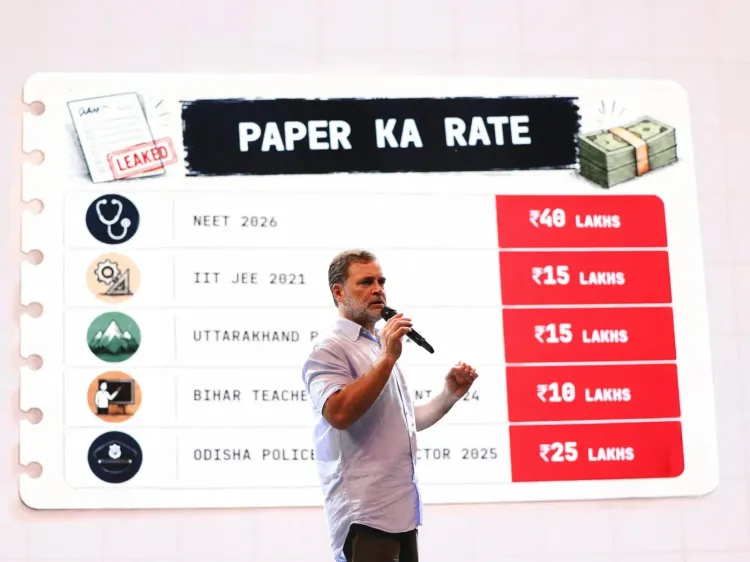
Rahul Gandhi posted an alleged 'Paper Leak Rate Card' on 18 July 2026 , listing unverified bribe rates ranging from ₹10 lakh (Bihar Teacher Recruitment) to ₹40 lakh (NEET).
The post claims 152 paper leaks have occurred, affecting 7.5 crore students — these figures are unverified allegations.
Gandhi directly questioned Prime Minister Narendra Modi , asking on whose backing the alleged exam leak network operates fearlessly.
The Public Examinations (Prevention of Unfair Means) Act, 2024 prescribes 3–10 years imprisonment for paper leaks, but Gandhi alleges not a single person has been punished.
The National Testing Agency (NTA) , which conducts NEET and JEE Main since 2019, is at the centre of accountability questions around centralised exam conduct.
Exams cited span medical, engineering and state government job admissions, affecting aspirants across multiple states including Uttarakhand , Bihar , and Odisha .
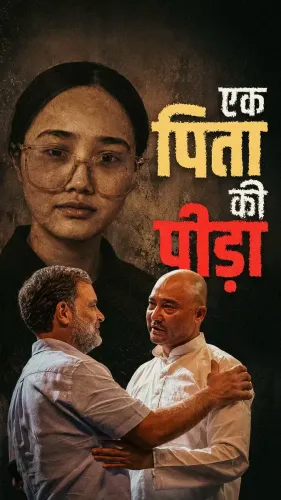
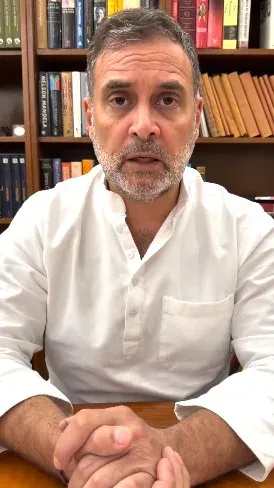
Congress leader Rahul Gandhi, Leader of the Opposition in Lok Sabha, on Saturday, 18 July 2026, posted a sharp attack on the Union government over recurring examination paper leaks, listing alleged bribe rates for securing leaked papers in major national and state-level tests — and demanding to know why no one has been punished.
Context
Gandhi's post, written in Hindi, presents what he calls a 'Paper Leak Rate Card' (paper leak rate card), listing alleged prices at which question papers were purportedly available: ₹40 lakh for NEET, ₹15 lakh for IIT-JEE, ₹15 lakh for Uttarakhand Patwari recruitment, ₹10 lakh for Bihar Teacher Recruitment, and ₹25 lakh for Odisha Police Recruitment. These figures are unverified allegations, not established facts.
He wrote: 'Jiske paas paisa hai, wo menu se paper chun leta hai. Aur jo sirf mehnat karta hai wo apna sapna kho deta hai.' ('Whoever has money picks a paper off the menu. And whoever only works hard loses their dream.') The post further claims 152 paper leaks have occurred, affecting 7.5 crore students — figures that have not been independently verified by NationPress.
Policy Backdrop
The National Testing Agency (NTA), an autonomous body under the Ministry of Education, has conducted NEET and JEE Main since 2019, centralising what were previously dispersed exam systems. NEET was introduced in 2013 and became the mandatory single-window medical entrance from 2016, replacing multiple state-level tests. Critics have argued that centralisation, while intended to standardise admissions, also concentrated systemic risk.
Parliament passed the Public Examinations (Prevention of Unfair Means) Act, 2024, prescribing 3 to 10 years of imprisonment and heavy fines for paper leaks. Gandhi's post implicitly challenges the effectiveness of this law, noting — 'saza? Ek ko bhi nahin' — 'punishment? Not a single person.' He directly addressed Prime Minister Narendra Modi, asking: 'Every student in this country is asking you — on whose backing is this gang so fearless?'
Stakeholders and Impact
The examinations cited span critical life-determining pathways: NEET gates entry into undergraduate medical colleges, while IIT-JEE determines admission to the country's premier engineering institutions. State-level recruitment exams for Uttarakhand Patwari, Bihar Teacher posts, and Odisha Police directly affect government employment aspirants, particularly from economically weaker sections who cannot afford coaching or private alternatives.
Recurring leaks disproportionately harm students who rely solely on merit, often from rural or lower-income backgrounds, while those with financial resources allegedly gain an unfair advantage. The pattern, if the allegations hold, would represent a structural breakdown of merit-based selection across both national and state examination systems.
What's Next
The 2024 anti-cheating law faces its first major tests in the upcoming NEET and JEE examination cycles, with enforcement and conviction rates remaining a key metric. Parliamentary standing committee recommendations on examination reform and possible state-level probes into the recruitment exams named in Gandhi's post are expected to shape the political and legislative response in the months ahead.
Gandhi's post closes with a direct political challenge to Prime Minister Modi, framing examination integrity as a question of political will — and signalling that the opposition intends to keep the issue at the centre of public debate through the current session of Parliament and beyond.
Point of View
Targeting a demographic that cuts across caste and class lines: competitive exam aspirants. By attaching rupee figures to specific exams, he shifts the narrative from systemic failure to alleged organised crime with political cover, directly implicating the Prime Minister. The timing follows the 2024 anti-cheating legislation, allowing the opposition to argue that law-making without enforcement is performative. If the opposition sustains this line of attack through the parliamentary session, it could force the government into a visible accountability response on NTA reform and conviction records.
NationPress
18 Jul 2026
Frequently Asked Questions
What is the paper leak rate card Rahul Gandhi posted about?
Rahul Gandhi posted an alleged 'Paper Leak Rate Card' listing unverified bribe amounts reportedly charged for leaked question papers: ₹40 lakh for NEET, ₹15 lakh for IIT-JEE, ₹15 lakh for Uttarakhand Patwari, ₹10 lakh for Bihar Teacher Recruitment, and ₹25 lakh for Odisha Police Recruitment. These are unverified allegations, not established facts.
How many paper leaks has India seen according to Rahul Gandhi's post?
Gandhi's post claims 152 paper leaks have occurred, affecting 7.5 crore students. NationPress has not independently verified these figures, and they remain unverified allegations at this stage.
What law exists in India against paper leaks?
Parliament passed the Public Examinations (Prevention of Unfair Means) Act in 2024, which prescribes 3 to 10 years of imprisonment and heavy fines for anyone found guilty of leaking examination papers.
Who conducts NEET and JEE in India?
The National Testing Agency (NTA), an autonomous body under the Ministry of Education, has conducted NEET and JEE Main since 2019. It centralised these examinations, which were previously administered by CBSE.
Why is Rahul Gandhi targeting Modi over paper leaks?
Gandhi's post alleges that despite 152 paper leaks affecting crores of students, not a single person has been punished, and he directly asked Prime Minister Modi on whose backing the alleged exam leak network operates with impunity. The opposition frames this as a failure of political will under the current central government.