Rajasthan Cabinet Adds Daughters-in-Law to Compassionate Appointment List

Synopsis
The Rajasthan Cabinet, chaired by CM Bhajanlal Sharma, has approved a rule change to include daughters-in-law among eligible dependents for compassionate appointments — jobs given to families of deceased state government employees — widening the welfare net for affected households.
Key Takeaways
The Rajasthan Cabinet chaired by CM Bhajanlal Sharma approved the inclusion of daughters-in-law in the compassionate appointment eligibility list.
Compassionate appointments provide government jobs to dependents of state employees who die in service, preventing sudden loss of household income.
Previously, daughters-in-law were not formally listed as eligible dependents under Rajasthan's compassionate appointment rules.
The change aligns with a broader national pattern of states periodically updating dependent definitions to reflect real family structures.
Formal implementation will follow through a government order from the Rajasthan personnel department.
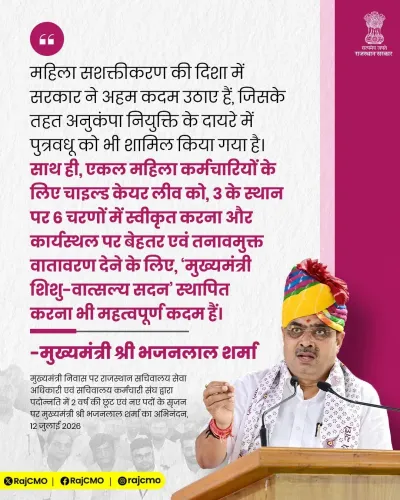
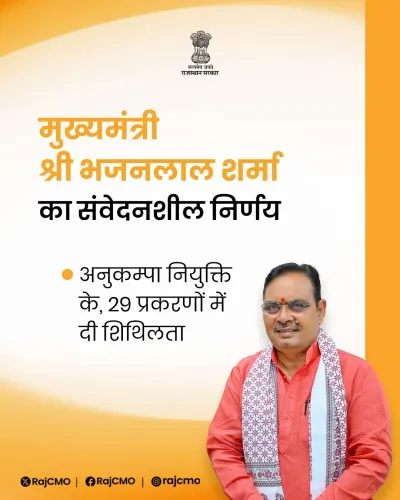
A quiet but meaningful shift in Rajasthan's welfare rules is now on the books. The Rajasthan Cabinet, chaired by Chief Minister Bhajanlal Sharma, has decided to include daughters-in-law (putravadhu) among the eligible dependents who can claim compassionate appointments when a state government employee dies in service.
The decision was taken at a cabinet meeting presided over by CM Sharma and announced by the Chief Minister's Office of Rajasthan on 13 August 2026. Under the existing Compassionate Appointment Rules, the Rajasthan government provides jobs to eligible family members of deceased state employees to ensure the household does not lose its primary source of income overnight. Until now, that circle of eligible dependents did not formally include daughters-in-law — a gap the cabinet has now closed.
What compassionate appointment actually means
Compassionate appointment is not a quota or a privilege — it is a lifeline. When a government employee dies unexpectedly, the family often loses both income and financial security in one blow. The state steps in by offering a job to one eligible dependent, typically a spouse, son, or daughter. The scheme has existed in Rajasthan and across several Indian states for decades, and its rules are periodically updated to reflect how Indian families actually live. The inclusion of daughters-in-law addresses a real-world gap. In many households, a daughter-in-law is a primary caregiver and economic contributor. If she is widowed or if the household loses the earning member she depended on, leaving her outside the eligibility list was both a practical and an equity problem.A routine amendment with a real-world edge
Indian states have periodically widened the definition of 'dependent' under compassionate appointment rules — extending it beyond direct blood relations to account for evolving family structures. Rajasthan's move fits within that broader national pattern of administrative welfare adjustment, but it carries concrete weight for the families of the state's large government workforce. The formal impact will depend on the government order issued by the Rajasthan personnel department and any subsequent implementation circulars. Those documents will set out the exact conditions — such as whether the daughter-in-law must be residing in the household or financially dependent on the deceased employee — that will determine who actually qualifies. For now, the cabinet's decision signals that the Bhajanlal Sharma government is willing to use administrative tools, not just headline schemes, to shore up the welfare net for families of those who served the state.Point of View
It also reinforces a social-welfare messaging track ahead of future electoral cycles, demonstrating administrative action on family welfare without requiring new fiscal outlay. The real test will be in the implementing order: how the personnel department defines 'dependent' will determine whether this is genuine inclusion or a narrowly drawn gesture.
NationPress
28 Sept 2026
Frequently Asked Questions
What is compassionate appointment in Rajasthan?
Compassionate appointment is a Rajasthan government scheme that offers a state job to an eligible dependent of a government employee who dies in service, providing the family with a source of income to replace what was lost.
Who is now eligible for compassionate appointment in Rajasthan after the 2026 cabinet decision?
The Rajasthan Cabinet has added daughters-in-law ( putravadhu ) to the list of eligible dependents, alongside existing categories such as spouses, sons, and daughters of the deceased employee.
What did the Rajasthan Cabinet decide on 13 August 2026?
The cabinet, chaired by CM Bhajanlal Sharma, decided to include daughters-in-law among the dependents eligible to apply for compassionate appointments when a state government employee dies in service.
When will the new compassionate appointment rule take effect in Rajasthan?
The cabinet decision sets the policy direction, but the formal rule change will take effect once the Rajasthan personnel department issues an official government order and implementation circulars.
Why were daughters-in-law excluded from compassionate appointments earlier?
Older compassionate appointment rules were typically drafted around direct blood relations and spouses. Daughters-in-law were not explicitly listed as eligible dependents, leaving a gap that the latest cabinet amendment has now addressed.