Rajasthan Assembly at 75: Governor unveils new emblem, names 13 gates
Synopsis
Seventy-five years after it was formally constituted, the Rajasthan Legislative Assembly has a new emblem — one rooted in the Rohida flower, the Khejri tree, and the Assembly building itself. Governor Haribhau Bagde's unveiling also gave names to 13 Assembly gates, anchoring the legislature's identity in the state's cultural and historical legacy.
Key Takeaways
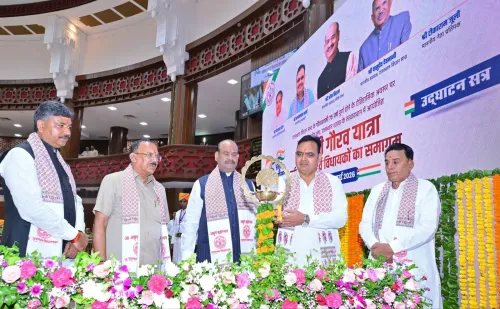
Governor Haribhau Bagde unveiled the new emblem of the Rajasthan Legislative Assembly on Monday, 18 May , marking its 75th anniversary .
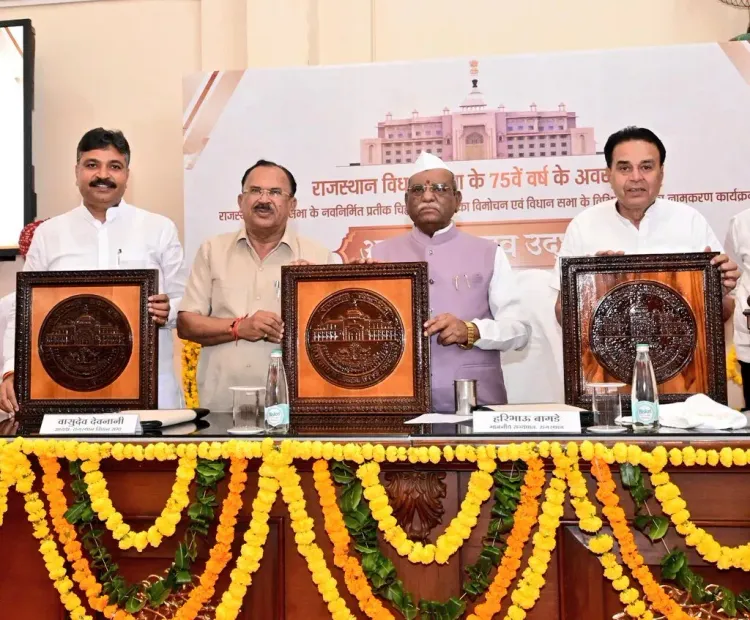
The emblem incorporates the Rohida flower , the Khejri tree , and the Assembly building , developed at the initiative of Speaker Vasudev Devnani .
13 gates within the Assembly premises were formally named after places associated with Rajasthan's valour and heritage.
The Assembly was formally constituted in 1952 , though representative governance in Rajasthan dates to 1913 under Maharaja Ganga Singh .
The Governor called for stronger focus on quality education for underprivileged children and cited personal discipline as the foundation of good governance.
Rajasthan Governor Haribhau Bagde on Monday unveiled the newly designed emblem of the Rajasthan Legislative Assembly and announced names for 13 gates within the Assembly premises, marking the institution's 75th anniversary in Jaipur. The ceremony underscored the Assembly's journey from its formal constitution in 1952 to its current standing as a cornerstone of democratic governance in the state.
The New Emblem and Its Symbolism
The emblem, developed on the initiative of Assembly Speaker Vasudev Devnani, incorporates three distinct elements: the Rohida flower, the Khejri tree, and the Rajasthan Legislative Assembly building. Governor Bagde described these symbols as representations of the resilience and vibrant cultural spirit of Rajasthan's people, who, he noted, continue to celebrate life despite the region's harsh geographical conditions.
Referring to the Khejri tree as 'Rajasthan's own Kalpa Vriksha,' the Governor recalled the historic sacrifice made by villagers in Khejadli to protect trees — an event he described as a lasting symbol of harmony between nature and society. The emblem, he said, reflects the state's rich cultural identity and democratic heritage.
Roots of Representative Governance
Calling the unveiling a significant milestone during India's Amrit Kaal, Bagde noted that while the Legislative Assembly was formally constituted in 1952 following Independence, the roots of representative governance in Rajasthan stretch back to 1913, when Maharaja Ganga Singh established a Pratinidhi Sabha (Representative Assembly). This historical context, the Governor argued, places the current institution within a longer continuum of democratic thought in the region.
Gates Named After Rajasthan's Valour
The Governor praised the decision to name the Assembly's 13 gates after places associated with Rajasthan's valour and heroic traditions, calling it a tribute to the state's glorious legacy. The naming is intended to embed a sense of historical pride within the everyday functioning of the legislature, according to officials present at the ceremony.
Governance, Education, and Democratic Responsibility
During his address, the Governor shared an anecdote involving Ganesh Vasudev Mavalankar, the first Speaker of the Lok Sabha, who reportedly once told a man claiming expertise in management that 'proper management begins with personal discipline' — pointing to food left wasted on the man's plate. Bagde used the story to underline the importance of responsibility and practical conduct in governance.
Drawing from his own experience as Speaker of the Maharashtra Legislative Assembly, the Governor stressed that democracy grows stronger when citizens remain equally conscious of their duties and rights. He also called for greater emphasis on practical learning and quality education for underprivileged children, stating that a nation progresses through education and the talent of its youth.
With the emblem now formally adopted and the gates named, the Assembly's 75th-anniversary celebrations are set to serve as a reference point for future legislative milestones in Rajasthan.
Point of View
From the Khejadli sacrifice to ongoing desertification pressures. What is less clear is whether the naming of 13 gates and a new logo will translate into the institutional reforms — stronger committee systems, better legislative scrutiny — that a 75-year-old assembly actually needs. Ceremonial milestones are easy; substantive democratic renewal is harder, and the Governor's own invocation of Mavalankar's discipline anecdote suggests an awareness of that gap.
NationPress
7 Oct 2026
Frequently Asked Questions
What is the new emblem of the Rajasthan Legislative Assembly?
The new emblem features the Rohida flower, the Khejri tree, and the Rajasthan Legislative Assembly building. It was developed on the initiative of Assembly Speaker Vasudev Devnani and unveiled by Governor Haribhau Bagde on 18 May 2025 to mark the Assembly's 75th anniversary.
Why were 13 gates of the Rajasthan Assembly named?
The 13 gates were named after places associated with Rajasthan's valour and heroic traditions as a tribute to the state's historical legacy. Governor Bagde praised the decision as a way to embed a sense of pride within the legislature's everyday environment.
When was the Rajasthan Legislative Assembly established?
The Rajasthan Legislative Assembly was formally constituted in 1952 after Independence. However, representative governance in the state dates back to 1913, when Maharaja Ganga Singh established the Pratinidhi Sabha, or Representative Assembly.
Who developed the new Rajasthan Assembly emblem?
The emblem was developed on the initiative of Assembly Speaker Vasudev Devnani. It was formally unveiled by Governor Haribhau Bagde at a ceremony in Jaipur marking 75 years of the Assembly.
What did Governor Bagde say about education and governance at the ceremony?
Governor Bagde stressed the need to improve educational opportunities for underprivileged children, stating that a nation progresses through education and the talent of its youth. He also used an anecdote about Lok Sabha's first Speaker, Ganesh Vasudev Mavalankar, to argue that effective governance must begin with personal discipline.