Rajasthan becomes India's 4th largest MSME state with 33 lakh units
Synopsis
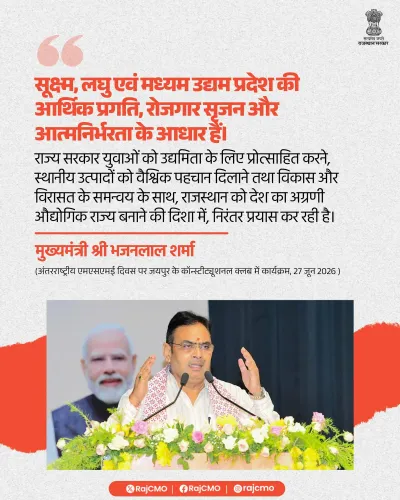
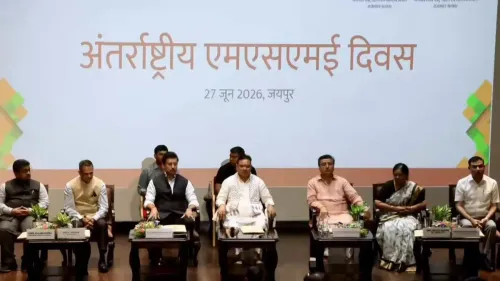
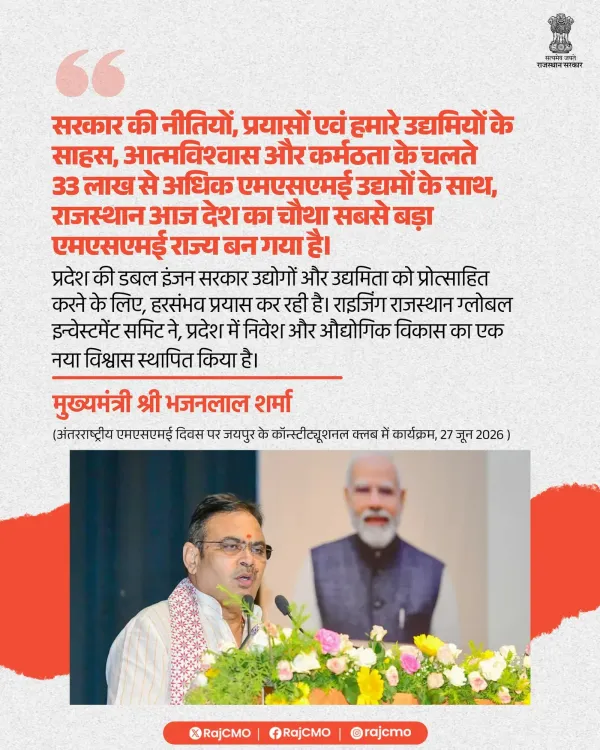
Rajasthan has emerged as India's fourth largest MSME state with over 33 lakh registered enterprises, the Chief Minister's Office announced on June 28, 2026, attributing the milestone to government policy and the resolve of the state's entrepreneurs.
Key Takeaways
Rajasthan now hosts more than 33 lakh MSME units , making it the fourth largest MSME state in India.
The announcement was made by the Chief Minister's Office of Rajasthan on June 28, 2026 , tagging CM Bhajanlal Sharma .
The achievement is attributed to state government policies and the entrepreneurial drive of Rajasthan's business community.
Key MSME clusters include textiles in Bhilwara , gems in Jaipur , handicrafts in Jodhpur , and marble processing in Udaipur .
The ranking positions Rajasthan ahead of many industrially established states and signals a structural shift in the state's economy.
Central schemes such as MUDRA Yojana and PM Vishwakarma have complemented state-level efforts to formalise small enterprises.
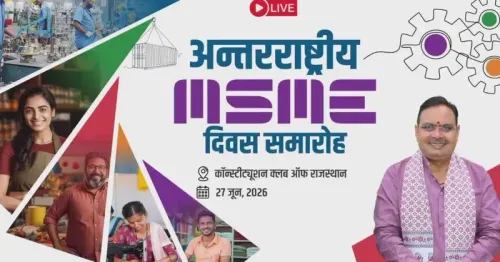
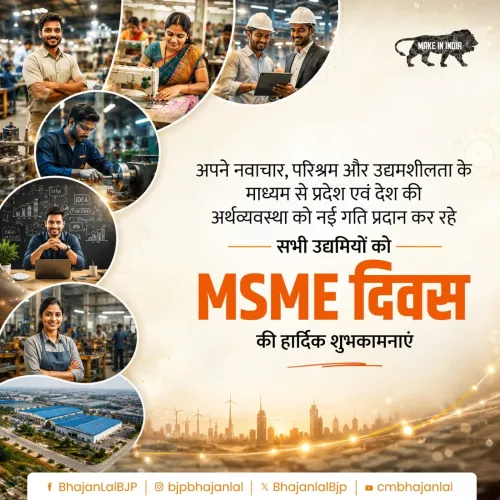
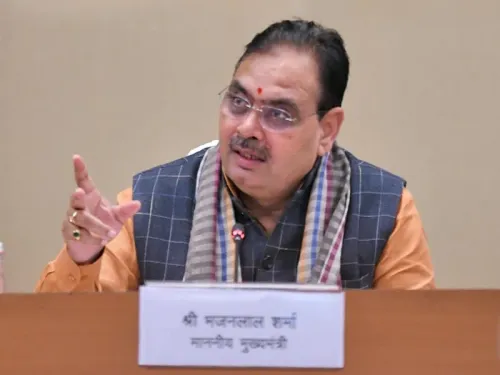
The Chief Minister's Office of Rajasthan announced on Sunday, June 28, 2026, that the state has become the fourth largest MSME state in India, with more than 33 lakh micro, small, and medium enterprises now registered — crediting government policy, entrepreneurial drive, and the efforts of Chief Minister Bhajanlal Sharma.
Context
The official post, shared under the hashtag #आपणो_अग्रणी_राजस्थान ('Our Pioneering Rajasthan'), states: 'सरकार की नीतियों, प्रयासों एवं हमारे उद्यमियों के साहस, आत्मविश्वास और कर्मठता के चलते' — meaning, 'through the government's policies, efforts, and the courage, confidence, and diligence of our entrepreneurs' — Rajasthan has achieved this ranking. The announcement marks a significant milestone for a state that has historically been viewed as agriculture-dependent with a nascent industrial base.
Rajasthan, covering 342,239 sq km, is India's largest state by area. Its MSME sector has traditionally been anchored in textiles, handicrafts, gems and jewellery, marble processing, and agro-processing — industries with deep roots in districts like Jaipur, Jodhpur, Udaipur, and Barmer.
Policy Backdrop
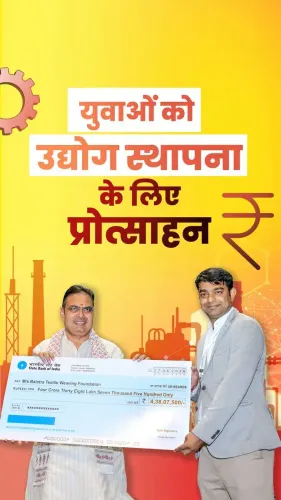
The Bhajanlal Sharma-led BJP government, which came to power in December 2023, has positioned MSME expansion as a cornerstone of its economic agenda. The state has pursued single-window clearances, investment summits, and targeted credit-linkage schemes to accelerate enterprise registration and formalisation under the Udyam Registration Portal, the Central government's framework for MSME recognition.
Nationally, the MSME sector contributes approximately 30 percent to India's GDP and employs over 11 crore people. States such as Uttar Pradesh, Maharashtra, and Tamil Nadu have traditionally led MSME counts, and Rajasthan's entry into the top four signals a meaningful shift in the state's industrial profile. The Central government's PM Vishwakarma scheme and MUDRA Yojana have also provided tailwind to enterprise creation in Tier-2 and Tier-3 towns across the state.
Stakeholders and Impact
The 33 lakh-plus MSME units span manufacturing, services, and trading segments, providing livelihoods to millions of workers and their families across both urban and rural Rajasthan. Artisan clusters in Jaipur's gem-cutting belt, Jodhpur's furniture and handicraft corridor, and Bhilwara's textile hub stand to gain visibility and institutional support as the state leverages this ranking for further investment attraction.
For entrepreneurs, the ranking carries practical weight: a higher-profile MSME ecosystem typically attracts larger anchor investors, better logistics infrastructure, and preferential treatment in government procurement quotas reserved for MSMEs. Small business owners, self-help groups, and first-generation entrepreneurs — particularly women entrepreneurs in rural Rajasthan — are among the key beneficiaries of sustained formalisation drives.
What's Next
The Rajasthan government is expected to use this milestone as a centrepiece at upcoming investment forums and trade expos to draw private capital into the state. Sustaining the momentum will require continued focus on credit access, skilling, and market linkages — areas where the gap between registration numbers and actual enterprise viability remains a policy challenge across India.
With the state targeting further improvement in ease-of-doing-business rankings, the fourth-place MSME position sets a competitive benchmark — and raises the question of whether Rajasthan can close the gap on the top three states in the medium term.
Point of View
Which has sought to reposition the state as an investment destination since taking office in late 2023. The milestone reflects the cumulative effect of formalisation drives under the Udyam portal rather than overnight industrial transformation, but the optics of a top-four ranking give the ruling party a concrete economic achievement to campaign on. For the broader MSME policy landscape, Rajasthan's rise underscores how geographic size and a diversified artisan economy can be leveraged through targeted registration pushes. The key test ahead is whether enterprise quality — measured by turnover, employment, and export contribution — keeps pace with the headline count.
NationPress
28 Jun 2026
Frequently Asked Questions
Which rank is Rajasthan in MSME in India?
As of June 2026, Rajasthan is the fourth largest MSME state in India, with more than 33 lakh registered MSME units.
How many MSMEs are there in Rajasthan in 2026?
Rajasthan has more than 33 lakh (3.3 million) MSME enterprises as announced by the Chief Minister's Office on June 28, 2026.
What are the top MSME states in India?
States like Uttar Pradesh, Maharashtra, and Tamil Nadu have traditionally led MSME counts in India, with Rajasthan now joining the top four.
What is the Bhajanlal Sharma government doing for MSMEs in Rajasthan?
The Bhajanlal Sharma-led government has pursued single-window clearances, investment summits, and credit-linkage schemes to boost MSME registration and growth in Rajasthan.
Which industries drive the MSME sector in Rajasthan?
Rajasthan's MSME sector is anchored in textiles, gems and jewellery, handicrafts, marble processing, and agro-processing, with major clusters in Jaipur, Jodhpur, Bhilwara, and Udaipur.