Rajasthan Sets Up 9 Incubation Centres, 65 Launchpads for Startups
Synopsis
The Rajasthan government has established 9 incubation centres and 65 launchpads statewide to promote innovation, the Chief Minister's Office announced on 2 July 2026, coinciding with 11 Years of Digital India and the National Conference on e-Governance 2026.
Key Takeaways
The Rajasthan government has set up 9 incubation centres and 65 launchpads to support innovation and entrepreneurship across the state.
The announcement was made by the Chief Minister's Office of Rajasthan on 2 July 2026 , tagging CM Bhajan Lal Sharma .
The initiative is tied to the 11th anniversary of Digital India , the Government of India's flagship digital transformation programme launched in 2015 .
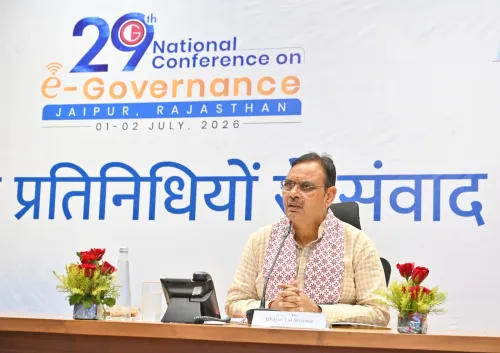
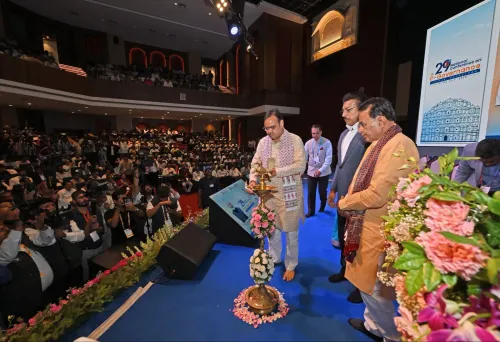
The rollout coincides with the National Conference on e-Governance 2026 (NCeG2026) , a key national forum for state-level digital governance showcases.
The network of 65 launchpads signals an effort to decentralise startup support beyond urban centres to smaller districts across Rajasthan .
Key stakeholders include tech startups, student entrepreneurs, and early-stage digital ventures seeking mentorship, workspace, and investor access.
The Chief Minister's Office of Rajasthan announced on 2 July 2026 that the state government has established 9 incubation centres and 65 launchpads across the state to foster innovation and entrepreneurship, marking the occasion of 11 Years of Digital India.
Context
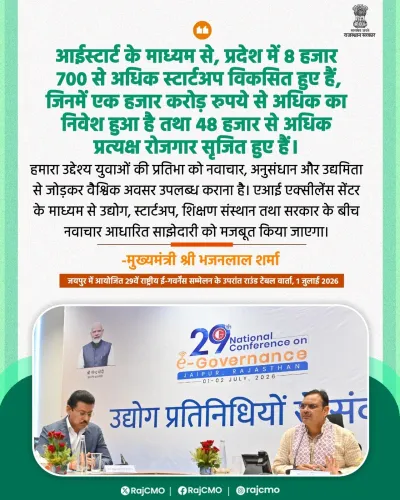
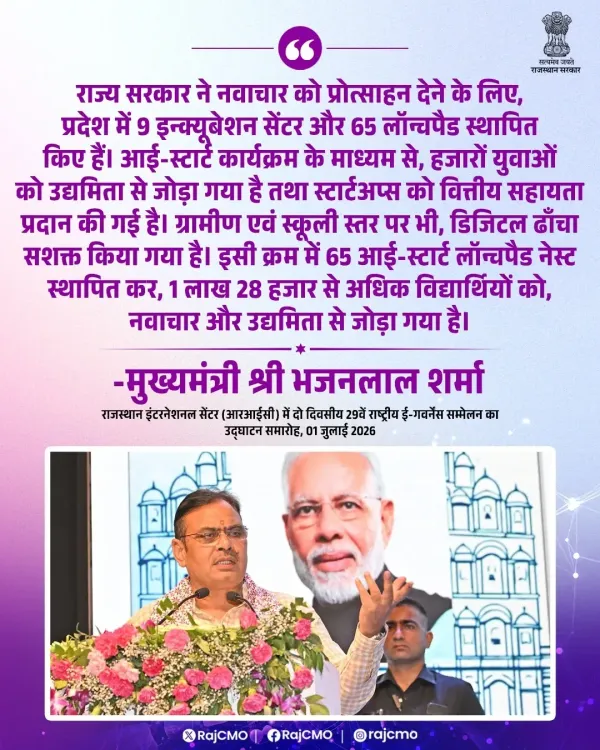
The post, shared by the official Rajasthan CMO account and tagging Chief Minister Bhajan Lal Sharma, states: 'Rajya sarkar ne navachar ko protsahan dene ke liye, pradesh mein 9 incubation centre aur 65 launchpad sthapit kiye hain' — meaning 'The state government has established 9 incubation centres and 65 launchpads in the state to promote innovation.' The announcement coincides with the National Conference on e-Governance 2026 (NCeG2026), a national forum where states showcase digital governance milestones.
The announcement aligns with the broader celebration of Digital India's 11th anniversary, a programme launched by the Government of India in 2015 to build digital infrastructure, expand e-services, and cultivate innovation ecosystems across all states.
Policy Backdrop
The Digital India initiative, now over a decade old, has served as the foundational framework under which states have developed regional startup and innovation infrastructure. Incubation centres provide early-stage startups with mentorship, workspace, and access to funding networks, while launchpads serve as lighter-touch entry points for aspiring entrepreneurs at the grassroots level.
Rajasthan, a western Indian state, has been actively implementing central digital schemes through state-level infrastructure. The establishment of 65 launchpads — a notably large network — suggests an effort to decentralise innovation support beyond major urban centres like Jaipur, reaching smaller districts and towns.
Stakeholders and Impact
The primary beneficiaries of these facilities are tech startups, student entrepreneurs, and early-stage digital ventures across Rajasthan. Incubation centres typically offer structured programmes, investor connects, and technical resources, while launchpads are designed to be accessible entry points that lower the barrier for first-time founders.
For the broader digital economy, a distributed network of 9 incubation centres and 65 launchpads represents a significant expansion of the state's capacity to produce homegrown technology ventures, reducing dependence on metro hubs and building innovation capacity at the district level.
What's Next
Attention will now turn to the National Conference on e-Governance 2026, where Rajasthan's model may be presented as a replicable framework for other states. Observers will watch for announcements on operational metrics — including the number of startups incubated, funding raised, and jobs created — as indicators of whether the infrastructure is translating into tangible entrepreneurial outcomes.
The scale of the launchpad network, in particular, will be a key variable: sustaining 65 active launchpads across a geographically large state like Rajasthan will require consistent administrative follow-through and resource allocation beyond the initial rollout.
Point of View
A strategy that plays well politically but carries real execution risk across a large, diverse state. For CM Bhajan Lal Sharma, this is also an opportunity to demonstrate that Rajasthan under BJP governance is a proactive implementer of central schemes, not merely a recipient. The durability of these centres — and their actual startup output — will be the true measure of whether this is infrastructure-building or announcement-making.
NationPress
1 Oct 2026
Frequently Asked Questions
How many incubation centres has Rajasthan set up?
Rajasthan has established 9 incubation centres and 65 launchpads across the state to promote innovation and support startups, as announced by the Chief Minister's Office on 2 July 2026.
What is the difference between an incubation centre and a launchpad?
Incubation centres offer structured programmes with mentorship, workspace, and investor access for early-stage startups, while launchpads are lighter-touch entry points designed to make entrepreneurial support accessible to first-time founders at the grassroots level.
What is Digital India and why is it being celebrated in 2026?
Digital India is a Government of India programme launched in 2015 to expand digital infrastructure, e-services, and innovation ecosystems. In 2026, the programme completes 11 years, and states like Rajasthan are marking the anniversary by showcasing digital governance milestones.
Who is the Chief Minister of Rajasthan overseeing these digital initiatives?
Bhajan Lal Sharma of the BJP is the Chief Minister of Rajasthan and is responsible for the state's digital and innovation policies, including the establishment of these incubation centres and launchpads.