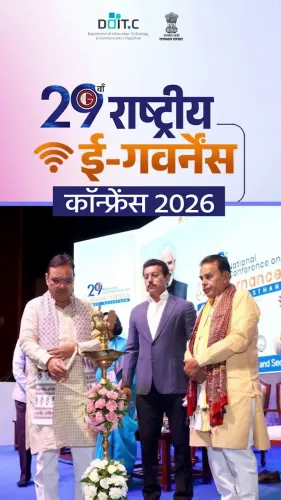
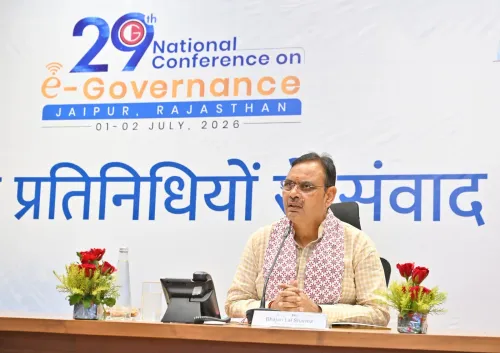
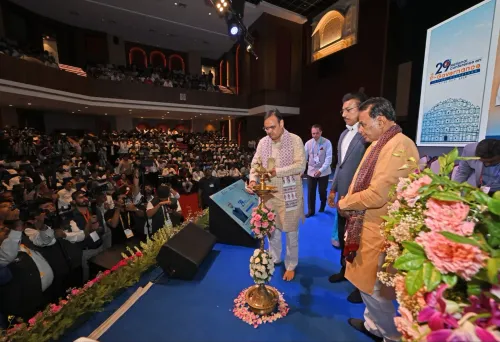
CM Bhajan Lal inaugurates 29th National e-Governance Conference in Jaipur
Synopsis
Rajasthan CM Bhajan Lal Sharma inaugurated the 29th National e-Governance Conference in Jaipur on 1 July 2026, launching the e-Mitra WhatsApp Service, Rajasthan Innovation Challenge Portal, and a Smart Platform, reinforcing the state's commitment to AI-enabled, citizen-centric governance under the Viksit Bharat 2047 vision.
Key Takeaways
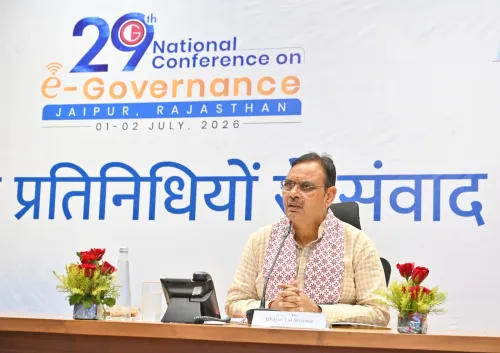
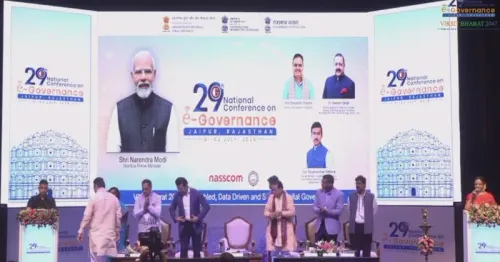
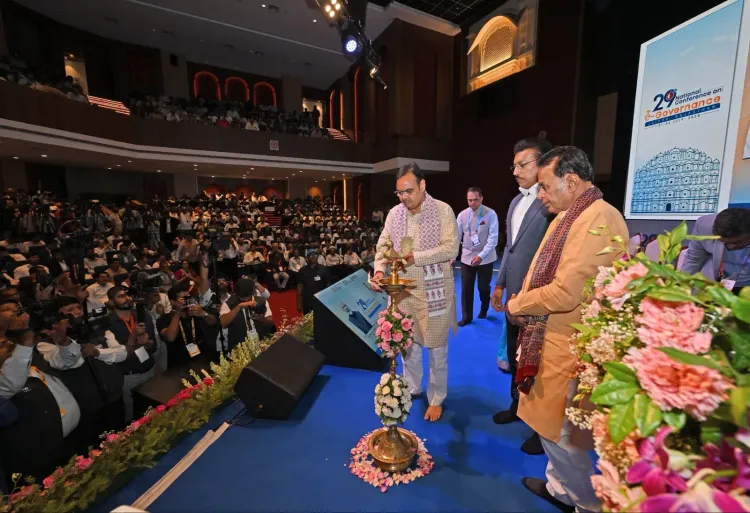
CM Bhajan Lal Sharma inaugurated the 29th National e-Governance Conference at Rajasthan International Centre, Jaipur on 1 July 2026 .
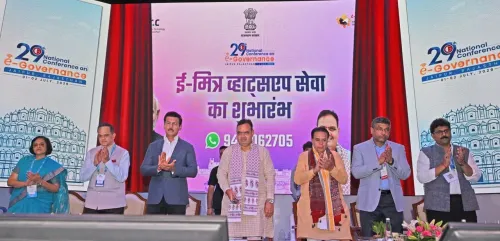
The e-Mitra WhatsApp Service was launched, extending Rajasthan's integrated citizen-services platform to the messaging app.
The Rajasthan Innovation Challenge Portal and a Smart Platform were also launched at the event.
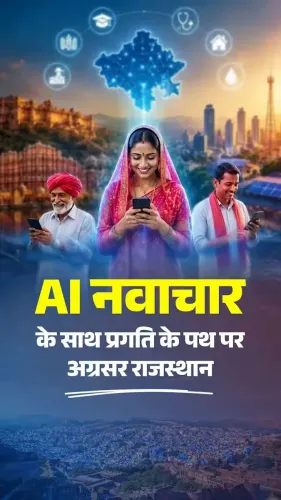
The conference theme is centred on AI-enabled, data-driven and secure digital governance aligned with the Viksit Bharat 2047 national vision.
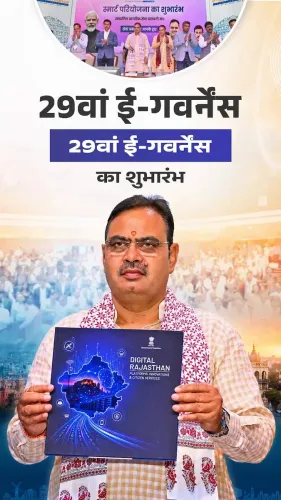
A Digital Rajasthan Coffee Table Book was released, documenting the state's e-governance milestones.
The event coincides with 11 years of Digital India , the central government's flagship digital services programme launched in July 2015 .
Rajasthan Chief Minister Bhajan Lal Sharma on Wednesday, 1 July 2026, inaugurated the 29th National e-Governance Conference at the Rajasthan International Centre, Jaipur, and launched three citizen-facing digital initiatives alongside a commemorative publication on the state's digital journey.
What was launched
At the conference, CM Sharma unveiled the e-Mitra WhatsApp Service, enabling citizens to access Rajasthan's flagship single-window government portal directly through the messaging platform. He also launched the Smart Platform and the Rajasthan Innovation Challenge Portal, which is designed to crowdsource technology-driven solutions from innovators across the state.
A Digital Rajasthan Coffee Table Book was released at the event, documenting the state's progress in e-governance. CM Sharma also reviewed an accompanying exhibition showcasing digital initiatives from state departments.
Context
The conference carries the theme 'Viksit Bharat 2047: AI Saksham, Data Sanchaalit evam Surakshit Digital Governance' — translated as 'Developed India 2047: AI-Enabled, Data-Driven and Secure Digital Governance.' The theme directly aligns with the national roadmap to transform India into a developed economy by 2047, with artificial intelligence and data analytics as central pillars of public administration.
CM Sharma invoked Prime Minister Narendra Modi's governing philosophy of 'Minimum Government, Maximum Governance,' framing the state's digital push as an expression of that vision under what he described as the 'double engine government' — the BJP being in power at both the state and central levels.
Policy backdrop
The National e-Governance Conference is an annual forum co-organised by the central government to showcase and standardise best practices in digital public service delivery across states. It traces its lineage to the National e-Governance Plan approved by the Union Cabinet in 2006 and received a significant boost when the Digital India programme was launched in July 2015.
e-Mitra, Rajasthan's integrated services platform, has been a cornerstone of the state's citizen-services architecture for over a decade, offering single-window access to hundreds of state and central government services. The new WhatsApp integration extends that reach to mobile users without requiring them to navigate a separate application or website.
Digital India recently marked 11 years since its launch — referenced in the conference hashtag #11YearsOfDigitalIndia — a milestone that has coincided with a push by multiple states to layer AI and data capabilities onto existing e-governance infrastructure.
Stakeholders and impact
The primary beneficiaries of the newly launched services are Rajasthan's citizens, particularly those in semi-urban and rural areas who rely on mobile messaging platforms rather than desktop portals for information and service access. The e-Mitra WhatsApp Service is positioned to reduce friction in obtaining certificates, utility connections, and welfare scheme benefits.
The Rajasthan Innovation Challenge Portal targets technology entrepreneurs, startups, and academic institutions, creating a structured channel for them to propose solutions to governance problems identified by state departments. The Department of Information Technology and Communication, Rajasthan (DoITCRaj) is the nodal agency overseeing implementation.
What's next
The real test for the newly launched platforms will be citizen adoption rates over the coming quarters. The uptake of the e-Mitra WhatsApp Service in particular will be closely watched as a measure of whether conversational interfaces can meaningfully expand the reach of existing e-governance infrastructure beyond traditional digital channels.
Any budgetary allocations for AI-based governance pilots — at either the state or central level — in forthcoming budget cycles will determine the pace at which the themes articulated at this conference translate into on-the-ground implementation across Rajasthan's districts.
Point of View
Where state and central digital agendas are presented as seamlessly aligned. The e-Mitra WhatsApp integration is a pragmatic move — rather than building new infrastructure, it extends an existing trusted platform to where millions of citizens already spend time. The Rajasthan Innovation Challenge Portal, if structured with transparent evaluation criteria, could generate genuine policy-tech feedback loops, though such portals have historically struggled to sustain momentum beyond their launch cycles. Overall, the event reflects a broader pattern of states using the Viksit Bharat 2047 framework as a legitimising lens for incremental digital upgrades, with the true measure of success deferred to adoption and delivery metrics.
NationPress
30 Sept 2026
Frequently Asked Questions
What is the 29th National e-Governance Conference about?
The 29th National e-Governance Conference, held in Jaipur on 1 July 2026 , is an annual national forum focused on best practices in digital public service delivery. This year's theme is AI-enabled, data-driven and secure digital governance under the Viksit Bharat 2047 vision.
What is the e-Mitra WhatsApp Service launched by CM Bhajan Lal Sharma?
The e-Mitra WhatsApp Service is a new channel that allows Rajasthan citizens to access the state's integrated single-window government services platform, e-Mitra , directly through WhatsApp, making it easier to obtain certificates and welfare benefits without visiting a portal or service centre.
What is the Rajasthan Innovation Challenge Portal?
The Rajasthan Innovation Challenge Portal is a newly launched digital platform designed to invite technology solutions from entrepreneurs, startups, and academic institutions to address governance challenges identified by state departments.
What is Viksit Bharat 2047 and how does it relate to e-governance?
Viksit Bharat 2047 is India's national vision to become a fully developed country by the centenary of independence in 2047. In the context of e-governance, it serves as the overarching framework for integrating AI, data analytics, and digital infrastructure into public administration at both central and state levels.
How old is the Digital India programme?
Digital India was launched in July 2015 by Prime Minister Narendra Modi , making it 11 years old in 2026. It was designed to expand electronic delivery of government services and build a digitally empowered society, building on the earlier National e-Governance Plan of 2006.