CM Bhajan Lal Sharma Clears Wage Code Rules for Rajasthan Workers

Synopsis
Rajasthan CM Bhajan Lal Sharma announced that the state cabinet has approved the Majduri Sanhita (Rajasthan) Niyam, 2026, enabling ground-level implementation of the central Code on Wages, 2019, for the state's workers.
Key Takeaways
The Rajasthan state cabinet approved the Majduri Sanhita (Rajasthan) Niyam, 2026 on August 7, 2026 .
The rules implement the central Code on Wages, 2019 at the state level — a prerequisite for the law to be enforceable for Rajasthan workers.
The Code on Wages, 2019 consolidated four older labour statutes, including the Minimum Wages Act , into a single framework.
CM Bhajan Lal Sharma linked the decision to the state's 'Aapno Agrani Rajasthan' development vision.
Official notification and phased implementation are expected to follow, with rules slated to take effect from 2026 .
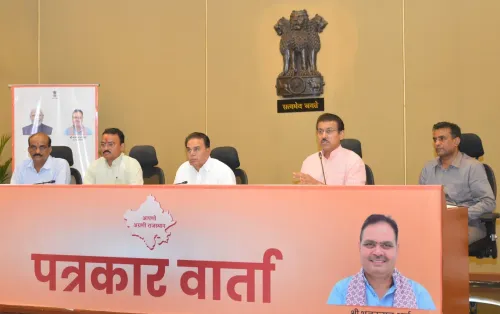
In a significant move for Rajasthan's estimated crores of wage earners, the state cabinet on Friday, August 7, 2026 cleared the 'Majduri Sanhita (Rajasthan) Niyam, 2026' — the state's implementation rules under the central Code on Wages, 2019. Rajasthan Chief Minister Bhajan Lal Sharma announced the cabinet decision, framing it as a direct fulfilment of the state's commitment to worker dignity and all-round development.
Sharing the decision on X, CM Sharma wrote: 'Prdesh ke hamare shramik bhaion-bahnon ke kalyan aur unke adhikaron ke sanrakshan ki disha mein...' — 'In the direction of welfare and protection of rights of our worker brothers and sisters of the state, the Majduri Sanhita (Rajasthan) Niyam, 2026 has been approved in today's state cabinet meeting. Respecting the labour of workers and their all-round development is the resolve of Aapno Agrani Rajasthan.'
The Central Law Rajasthan Is Now Putting Into Action
The Code on Wages, 2019 was enacted by Parliament as part of a landmark consolidation of 29 central labour laws into just four codes — a reform that successive governments had attempted for decades. The Code specifically merged four older statutes, including the Minimum Wages Act, into a single unified framework governing wages, bonuses, and related entitlements across all sectors and employment categories.
For the Code to bite at the ground level, each state must frame its own implementation rules. That is precisely what the Rajasthan cabinet has now done. Without state rules, the central law remains largely inoperative for workers in that state — making this cabinet approval a functional prerequisite, not a ceremonial one.
Rajasthan Joins a Widening State-Level Push
Several states have been racing to frame rules under the four central labour codes passed between 2019 and 2020. BJP-led state governments have broadly moved in alignment with the Centre's push to simplify and modernise labour regulation — replacing a patchwork of older, often contradictory statutes with streamlined rules that employers and workers can both navigate more easily.
Rajasthan's approval fits squarely into that national pattern. The 'Aapno Agrani Rajasthan' (Our Frontrunner Rajasthan) slogan that CM Sharma anchors the decision to has been the Sharma government's overarching development framework since taking office in December 2023.
The rules are set to take effect from 2026, with official notification and phased implementation the next milestones to watch. For Rajasthan's workers — in construction, agriculture, manufacturing, and the informal economy — the real test will be how swiftly enforcement machinery is put in place once the rules are notified.
Point of View
The timing also carries political logic: anchoring a tangible labour-welfare decision to the 'Aapno Agrani Rajasthan' brand reinforces the administration's pitch to a large, politically significant working-class constituency. The broader national pattern of BJP-governed states aligning with the Centre's four-code labour consolidation suggests coordinated federal momentum rather than isolated state initiative. Whether Rajasthan's enforcement infrastructure can match the ambition of the rules will determine whether this cabinet decision translates into lived change for workers on the ground.
NationPress
22 Sept 2026
Frequently Asked Questions
What is the Majduri Sanhita Rajasthan Niyam 2026?
The Majduri Sanhita (Rajasthan) Niyam, 2026 are state-level implementation rules approved by the Rajasthan cabinet on August 7, 2026, to operationalise the central Code on Wages, 2019 for workers in Rajasthan.
What is the Code on Wages 2019?
The Code on Wages, 2019 is a central law that consolidated four older labour statutes — including the Minimum Wages Act — into a single framework regulating wages, bonuses, and related entitlements for workers across India.
Why do states need to frame their own rules under the Code on Wages?
Central labour codes require each state to frame its own implementation rules before the law can be enforced at the ground level. Without state rules, the central code remains largely inoperative for workers in that state.
What is 'Aapno Agrani Rajasthan'?
'Aapno Agrani Rajasthan' — meaning 'Our Frontrunner Rajasthan' — is the overarching development vision of Chief Minister Bhajan Lal Sharma's government, under which the wage code approval was announced.
When will the Rajasthan wage code rules come into effect?
The rules are slated to take effect from 2026, subject to official notification and phased implementation by the state government.