Rajasthan CM announces Rs 30,000 yearly aid for ox-farming
Synopsis
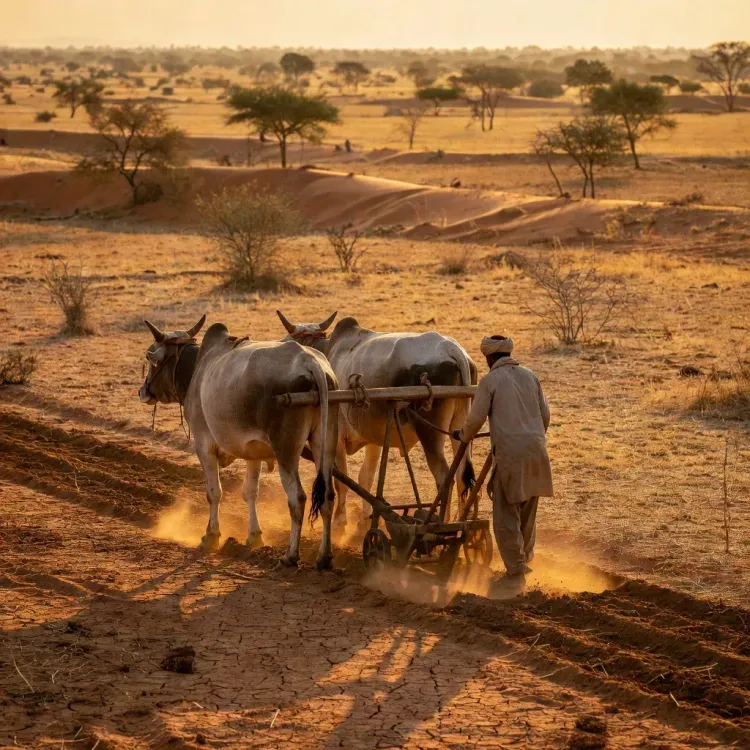
Rajasthan's Chief Minister's Office announced a Rs 30,000 annual incentive for small and marginal farmers who use bullocks for cultivation. Tagged to CM Bhajanlal Sharma, the provision aims to sustain traditional draught-animal farming across the state's dryland agricultural belt.
Key Takeaways
The Chief Minister's Office of Rajasthan announced a provision of Rs 30,000 per year for small and marginal farmers who farm using bullocks.
The announcement was made on 2 August 2026 and tagged Chief Minister Bhajanlal Sharma .
The scheme targets small and marginal landholders — farmers owning less than two hectares — who rely on draught animals rather than mechanised equipment.
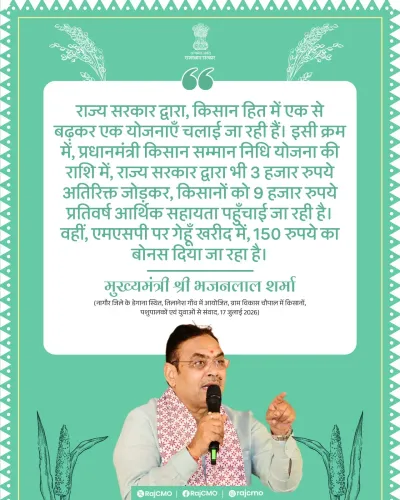
The incentive would nearly quadruple the Rs 6,000 per year provided under the central PM-KISAN scheme for eligible farmers.
Detailed eligibility norms and disbursement guidelines are yet to be published by the state agriculture department.
The announcement carries the hashtag #AapnoAgrani_Rajasthan , linking it to the state government's broader agricultural development branding.
A direct cash push for Rajasthan's most vulnerable farmers — the Chief Minister's Office of Rajasthan announced on Sunday, 2 August 2026 that small and marginal farmers who cultivate their land using bullocks will receive an annual incentive of Rs 30,000 under a new state provision.
The post, shared by the Chief Minister's Office and tagging Chief Minister Bhajanlal Sharma, reads: 'Laghu evam seemant kisanon ko bailon se kheti karne par, 30 hazar rupaye prativarsh ki protsahan rashi dene ka pravdhan kiya gaya hai' — 'A provision has been made to give small and marginal farmers an annual incentive of Rs 30,000 for farming with bullocks.' The hashtag #AapnoAgrani_Rajasthan ('Our Forward Rajasthan') frames the announcement as part of the state's broader agricultural development agenda.
Who stands to benefit — and why bullocks matter
Rajasthan's agricultural economy rests heavily on its small and marginal landholders — farmers who own less than two hectares of land and who, in many arid and semi-arid pockets of the state, still rely on draught animals rather than mechanised equipment. Tractors require capital, fuel, and maintenance that many of these households simply cannot afford. Bullock-based farming, by contrast, integrates livestock ownership with crop cultivation, keeping input costs low and preserving soil health in ways suited to dryland agriculture. The Rs 30,000 annual figure — if disbursed in full — would represent a meaningful supplement to incomes that already receive support under central schemes such as PM-KISAN, which provides Rs 6,000 per year in three instalments. A state-level top-up of this scale would nearly quadruple that baseline support for eligible farmers.Bhajanlal Sharma's farm-welfare push since December 2023
Chief Minister Bhajanlal Sharma, who took office in December 2023 after the BJP's return to power in Rajasthan, has positioned agricultural welfare as a signature theme of his administration. Periodic direct-benefit announcements targeting small landholders follow a pattern seen across BJP-governed states — using state budget provisions to complement central schemes and build a visible support floor for farming communities ahead of panchayat and local-body electoral cycles. The critical details that will determine real-world impact — eligibility documentation, proof-of-bullock-ownership norms, and the fund disbursement mechanism — are yet to be published in formal agriculture department orders. Farmers and farm organisations will be watching the state's official gazette and department circulars for the fine print. For now, the announcement plants a clear political and policy stake: Rajasthan's government is betting that keeping traditional farming viable with cash incentives is both economically sound and politically resonant in a state where the soil and the ox still define millions of livelihoods.Point of View
000 bullock-farming incentive is a textbook example of state governments layering direct-benefit provisions on top of central schemes to build a denser welfare floor for agrarian constituencies. For the Bhajanlal Sharma administration, targeting draught-animal farmers specifically signals a conscious effort to reach households that mechanisation schemes have structurally bypassed. The move also fits a broader BJP pattern of using state budgets to create visible, named benefits ahead of local electoral cycles. The real test will be implementation: whether the agriculture department publishes clear eligibility norms quickly enough for farmers to actually claim the benefit in the current crop season.
NationPress
2 Aug 2026
Frequently Asked Questions
What is the Rajasthan government's new scheme for bullock farmers?
The Rajasthan government has announced a provision to give small and marginal farmers an annual incentive of Rs 30,000 for cultivating their land using bullocks. The announcement was made by the Chief Minister's Office on 2 August 2026.
Who is eligible for the Rs 30,000 bullock farming incentive in Rajasthan?
The incentive is intended for small and marginal farmers — typically those owning less than two hectares of agricultural land — who use bullocks or draught animals for cultivation. Detailed eligibility norms are yet to be published by the state agriculture department.
Who is Bhajanlal Sharma and what is his role in this announcement?
Bhajanlal Sharma is the Chief Minister of Rajasthan from the BJP, in office since December 2023 . The Chief Minister's Office tagged him in the announcement, indicating the scheme is part of his administration's agricultural welfare agenda.
How does this scheme compare to PM-KISAN?
The central PM-KISAN scheme provides Rs 6,000 per year to eligible farmers. The Rajasthan state incentive of Rs 30,000 per year would be five times that amount, representing a substantial top-up for qualifying small and marginal farmers.
When will the Rajasthan bullock farming incentive be disbursed?
The disbursement timeline has not yet been announced. The state agriculture department is expected to publish formal guidelines, eligibility criteria, and the fund-release mechanism in official orders or budget documents.