Rajasthan CM Bhajanlal: 5 Lakh Youth Get Private Sector Jobs

Synopsis
The Chief Minister's Office of Rajasthan announced on 1 November 2026 that CM Bhajanlal Sharma's government has created private-sector employment opportunities for 5 lakh youth, framing it as a landmark under the 'Aapno Agrani Rajasthan' initiative.
Key Takeaways
The Chief Minister's Office of Rajasthan announced on 1 November 2026 that 5 lakh youth have been provided private-sector employment opportunities.
The announcement is attributed directly to Chief Minister Bhajanlal Sharma , who has led Rajasthan since December 2023 .
The post was made under the hashtag #आपणो_अग्रणी_राजस्थान ('Our Frontrunner Rajasthan'), framing job creation as central to the state's identity under the BJP government.
Private-sector placements — linked to skill development, job fairs, and industrial incentives — have been a recurring policy theme of the Bhajanlal administration.
Scheme-wise breakdowns, sectoral data, and third-party audits are needed to verify and contextualise the 5-lakh figure .
The next Rajasthan state budget and assembly session are the likely arenas for detailed legislative scrutiny of this claim.
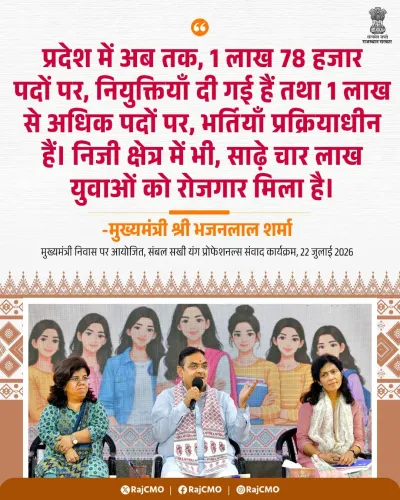
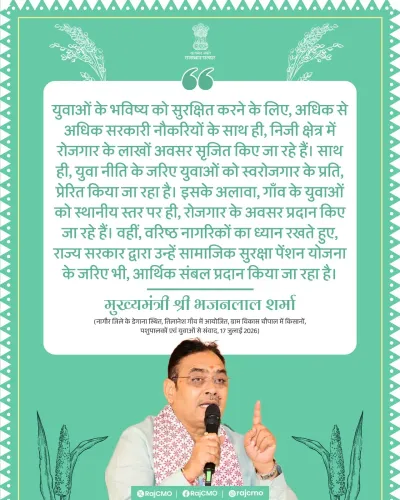
Five lakh young Rajasthanis now have private-sector employment opportunities — that is the claim the Chief Minister's Office of Rajasthan put on record on Sunday, 1 November 2026, attributing the milestone directly to Chief Minister Bhajanlal Sharma. The announcement, posted under the hashtag #आपणो_अग्रणी_राजस्थान ('Our Frontrunner Rajasthan'), frames private-sector job creation as a centrepiece of the BJP government's economic agenda.
The post, attributed to @BhajanlalBjp, states in Hindi: '5 lakh yuvaon ko niji kshetra mein rojgar ke avsar uplabdh karae gae hain' — 'employment opportunities in the private sector have been made available to 5 lakh youth.' Short and declarative, the message leans on a round number big enough to signal scale, and stakes the government's credibility on it.Bhajanlal's bet on private-sector placements
Bhajanlal Sharma has led Rajasthan since December 2023, when the BJP returned to power in the state. His administration has repeatedly positioned private-sector job creation — rather than government recruitment alone — as the primary answer to youth unemployment in a state where the working-age population is large and the public-sector hiring pipeline is finite. Announcements of placement drives, investor summits, and skill-development tie-ups have marked that policy pitch since the government's early months.
Rajasthan, like many large Indian states, has a history of governments linking employment claims to skill-training programmes, job fairs, and industrial incentive schemes. The 5-lakh figure sits squarely in that tradition: a headline number designed to demonstrate policy momentum ahead of budget sessions and assembly reviews.
What the number needs to show next
The figure invites scrutiny on specifics — which schemes or job fairs generated the placements, what industries absorbed the bulk of the hires, and whether these represent sustained employment or short-term engagements. Scheme-wise data, third-party audits, or a breakdown by district would give the number far sharper credibility. Rajasthan's next state budget and upcoming assembly session are the natural forums where opposition benches will press for that detail.
The broader pattern is familiar: private-sector placement drives have become a standard instrument in state-level employment policy across India under governments of both major parties. What separates a talking point from a transformative intervention is usually the quality of jobs created — sector, wage level, and retention rate — none of which a single social media post can settle.
For now, the Rajasthan government has planted a flag. Whether 5 lakh holds up as a verified, scheme-linked achievement or becomes contested data will depend on the transparency that follows — and the opposition is already watching.
Point of View
Round-number employment claims with brand-building hashtags ahead of budget cycles — a formula intended to shift public discourse from 'what has been promised' to 'what has been delivered.' For Bhajanlal Sharma, still consolidating his administration after the December 2023 electoral return, a 5-lakh milestone serves as a credibility marker against the Congress opposition's unemployment critique. However, until scheme-wise data and independent verification are published, the figure risks being treated as political assertion rather than policy achievement. The real test arrives in the assembly, where opposition members can demand audit-level accountability.
NationPress
1 Nov 2026
Frequently Asked Questions
How many jobs has the Rajasthan government created for youth in the private sector?
The Chief Minister's Office of Rajasthan has claimed that private-sector employment opportunities have been provided to 5 lakh (500,000) youth, an announcement made on 1 November 2026 and attributed to CM Bhajanlal Sharma.
Who is Bhajanlal Sharma and when did he become Rajasthan CM?
Bhajanlal Sharma is the Chief Minister of Rajasthan representing the BJP. He assumed office in December 2023 after the BJP won the Rajasthan assembly elections.
What is 'Aapno Agrani Rajasthan'?
Aapno Agrani Rajasthan translates to 'Our Frontrunner Rajasthan.' It is a hashtag campaign used by the Rajasthan government and CM Bhajanlal Sharma to brand the state's development and governance initiatives.
Which schemes are behind Rajasthan's private-sector job creation for youth?
The Rajasthan government has linked private-sector placements to skill-development programmes, job fairs, and industrial incentive policies. Specific scheme-wise breakdowns have not been publicly detailed in this announcement and await official clarification.
How can the Rajasthan government's 5-lakh jobs claim be verified?
Verification would require scheme-wise placement data, sector and wage-level breakdowns, and third-party or government audits. The upcoming Rajasthan assembly session and state budget are expected to be key forums for legislative scrutiny of this figure.