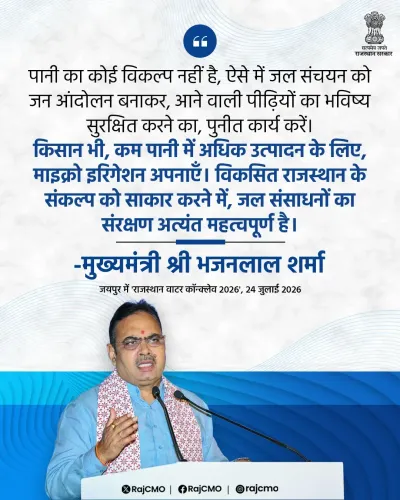
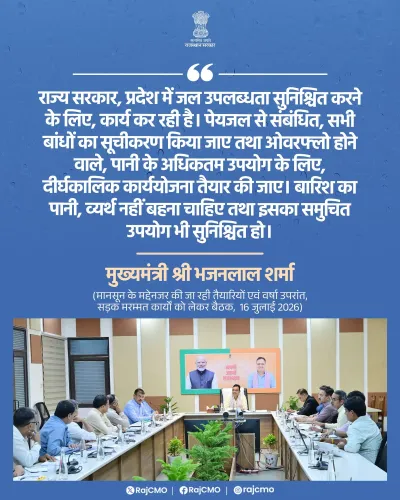
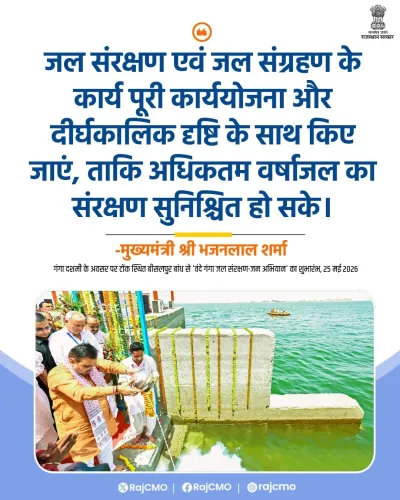
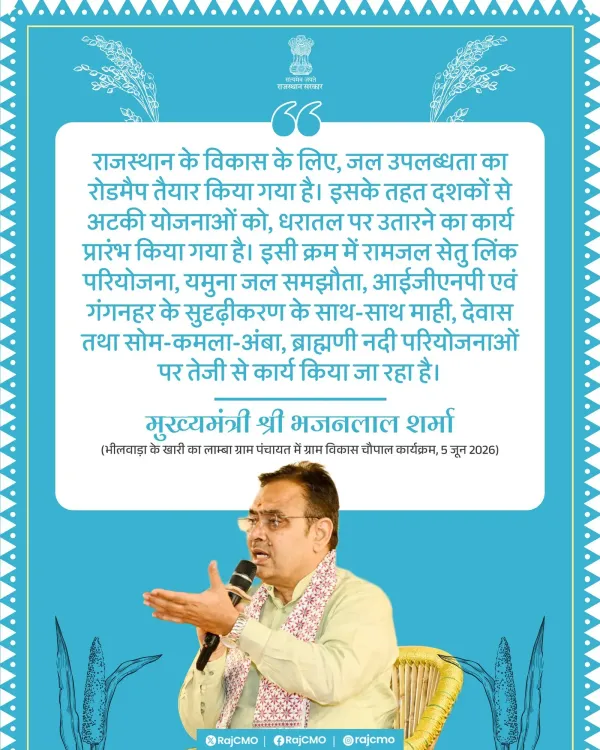
Rajasthan CM Bhajanlal unveils water roadmap for state growth
Synopsis
The Chief Minister's Office of Rajasthan announced on 6 June 2026 that CM Bhajanlal Sharma's government has prepared a water availability roadmap for the state's development, building on years of water policy and conservation initiatives in India's largest and most water-stressed state.
Key Takeaways
The Chief Minister's Office of Rajasthan announced on 6 June 2026 that a water availability roadmap has been prepared for the state's development.
CM Bhajanlal Sharma , who took office in December 2023 , is the named political principal behind the initiative.
Rajasthan is India's largest state by area and faces chronic water scarcity due to the Thar Desert and erratic monsoon patterns.
The roadmap builds on earlier initiatives including the Mukhyamantri Jal Swavalamban Abhiyan (2016) and the central Jal Jeevan Mission (2019) .
Key stakeholders include farmers in arid districts , rural households, and urban local bodies across the state.
The detailed roadmap document and associated 2026-27 budget allocations are yet to be publicly released.
The Chief Minister's Office of Rajasthan announced on Saturday, 6 June 2026 that a comprehensive water availability roadmap has been prepared to guide the development of Rajasthan, India's largest and most arid state. The announcement, attributed to Chief Minister Bhajanlal Sharma, was shared under the campaign hashtag #आपणो_अग्रणी_राजस्थान ('Our Leading Rajasthan').
Context
The post states: 'राजस्थान के विकास के लिए जल उपलब्धता का रोडमैप तैयार किया गया है' — 'A roadmap for water availability has been prepared for the development of Rajasthan.' The announcement signals a formal planning exercise by the BJP government that took office in December 2023 under CM Bhajanlal Sharma. Rajasthan, covering over 3.4 lakh square kilometres, encompasses the Thar Desert and large semi-arid zones where erratic monsoons and declining groundwater tables have long constrained agriculture, industry, and domestic supply.
Policy Backdrop
Rajasthan has a layered history of water governance. The state adopted its State Water Policy in 2010, establishing a framework for sustainable allocation across agriculture, industry, and domestic use. The Mukhyamantri Jal Swavalamban Abhiyan, launched in 2016, pushed rainwater harvesting and watershed management across rural districts. From 2019, the state participated in the central government's Jal Jeevan Mission, targeting functional household tap connections in every rural home.
When the current BJP government came to power in late 2023, it signalled renewed focus on inter-basin water transfer and groundwater recharge projects. The new roadmap appears to be the formal articulation of that policy direction, though the detailed document, its timeline, and specific budget allocations are yet to be made public.
Stakeholders and Impact
Farmers in arid districts stand to be among the most directly affected stakeholders, given that agricultural water demand accounts for the bulk of consumption in the state. Rural households dependent on groundwater and seasonal surface sources, as well as urban local bodies managing municipal supply in fast-growing cities like Jaipur and Jodhpur, are also key constituencies for any long-term water security plan.
Successive Rajasthan governments have treated water security as a core development constraint. The current roadmap continues a pattern of preparing long-term planning documents that link water infrastructure to economic growth targets in agriculture and industry — an approach mirrored by other water-stressed western Indian states facing groundwater depletion.
What's Next
Attention will now turn to the release of the detailed roadmap document and the specific budget allocations expected in the 2026-27 state budget. Observers will watch for any new public-private partnerships targeting desalination, canal modernisation, or large-scale groundwater recharge. The roadmap's alignment with the central Jal Jeevan Mission framework and its financing structure will be critical indicators of implementation credibility.
If the roadmap translates into actionable projects with clear timelines and funding, it could set a benchmark for water-stressed states across western India grappling with the dual pressures of climate variability and rising demand.
Point of View
Cutting across caste and regional lines, which makes a formal roadmap a high-visibility signal to rural constituencies ahead of future electoral cycles. However, the gap between policy documents and on-ground implementation has been a persistent criticism of Rajasthan's water governance across party lines. The real test will be whether the roadmap is backed by ring-fenced budget allocations and measurable delivery targets in the upcoming state budget.
NationPress
21 Oct 2026
Frequently Asked Questions
What is the Rajasthan water availability roadmap announced in 2026?
The Chief Minister's Office of Rajasthan announced on 6 June 2026 that a roadmap for water availability has been prepared to guide the state's development. The detailed contents and timeline of the document are yet to be made public.
Who is CM Bhajanlal Sharma?
Bhajanlal Sharma is the Chief Minister of Rajasthan from the BJP, sworn in December 2023 following the state assembly elections. He is the political principal credited with the new water roadmap initiative.
Why does Rajasthan face water scarcity?
Rajasthan is India's largest state by area and encompasses the Thar Desert along with large semi-arid zones. Erratic monsoons, declining groundwater tables, and high agricultural demand make chronic water scarcity a defining development challenge for the state.
What is the Mukhyamantri Jal Swavalamban Abhiyan?
The Mukhyamantri Jal Swavalamban Abhiyan is a Rajasthan state-level water conservation campaign launched in 2016 to promote rainwater harvesting and watershed management across rural districts.
What is the Jal Jeevan Mission and how does it relate to Rajasthan?
The Jal Jeevan Mission is a central government programme launched in 2019 aimed at providing functional household tap connections in rural India. Rajasthan has participated in the mission since its inception to improve rural drinking water access.