CM Bhajanlal Calls for Long-Term Rainwater Harvesting in Rajasthan
Synopsis
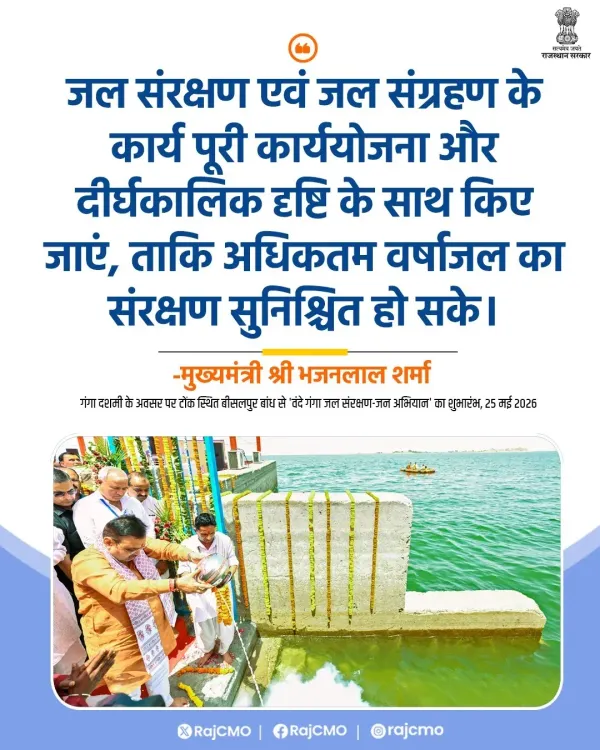
Chief Minister Bhajanlal Sharma has directed that water conservation and rainwater harvesting in Rajasthan be carried out with a comprehensive action plan and long-term vision to maximise rainwater storage ahead of the 2026 monsoon season.
Key Takeaways
The Chief Minister's Office of Rajasthan on 26 May 2026 issued a directive calling for water conservation and rainwater harvesting work to be executed with a 'complete action plan and long-term vision.' Chief Minister Bhajanlal Sharma is the source of the directive, shared under the campaign hashtag #आपणो_अग्रणी_राजस्थान .
Rajasthan is a chronically water-scarce state with large arid and semi-arid zones, making pre-monsoon harvesting infrastructure critical.
The state's Mukhya Mantri Jal Swavalamban Abhiyan , launched in 2015 , remains the primary framework for community-led rainwater harvesting structures.
District administrations and gram panchayats are expected to be the frontline implementing bodies for the directive.
District-level progress reports and potential supplementary budget allocations ahead of the 2026 monsoon will be key indicators of follow-through.
The Chief Minister's Office of Rajasthan, citing directions from Chief Minister Bhajanlal Sharma, on Tuesday, 26 May 2026, called for water conservation and rainwater harvesting work to be carried out with a complete action plan and long-term vision to ensure maximum preservation of rainwater across the state.
Context
The official post, shared under the hashtag #आपणो_अग्रणी_राजस्थान ('Our Leading Rajasthan'), directed that water conservation and storage efforts be undertaken with systematic planning and a far-sighted approach. The statement, attributed to CM Bhajanlal Sharma, underscores the administration's push to institutionalise rainwater harvesting before the 2026 monsoon season rather than treating it as a reactive, post-drought measure.
Rajasthan is among India's most water-stressed states, with large swathes of its territory falling in arid and semi-arid zones. Groundwater depletion and recurring drought cycles have made the systematic capture and storage of rainwater a perennial governance priority for successive administrations.
Policy Backdrop
Rajasthan has a documented history of state-led watershed interventions. The Mukhya Mantri Jal Swavalamban Abhiyan, launched in 2015, sought to build community-led rainwater harvesting structures across rural Rajasthan, combining check-dam construction, johad restoration, and anicut repair under a single campaign framework.
The current government has also aligned state-level water initiatives with the national Jal Jeevan Mission, which aims to expand household tap-water connectivity and improve source sustainability. The emphasis on 'complete action plans' and 'long-term vision' in the CM's latest directive signals an intent to move beyond ad hoc project approvals toward integrated watershed management across districts.
Check-dam construction and johad revival have historically been the two primary instruments through which Rajasthan governments have attempted to recharge groundwater and reduce dependence on the Indira Gandhi Nahar canal system in western districts.
Stakeholders and Impact
Farmers and rural households stand to benefit most directly from improved rainwater harvesting infrastructure. In a state where agriculture remains largely rain-fed in eastern and southern districts, higher rainwater storage capacity directly influences kharif crop yields and drinking-water availability during lean summer months.
District administrations and gram panchayats are the primary implementing bodies for such structures, meaning the directive places operational responsibility at the local governance level. The call for a 'complete action plan' suggests that district-level targets and timelines are expected to be formalised ahead of the monsoon.
What's Next
Observers will watch for district-level progress reports on new harvesting structures and any supplementary budget allocations linked to this directive. Whether the state government announces a formal campaign or integrates these targets into existing schemes such as the Jal Swavalamban Abhiyan will be a key indicator of implementation intent.
With the 2026 monsoon approaching, the window for completing civil works — earthen bunds, check-dams, and storage ponds — is narrow. The administration's ability to translate the CM's directive into measurable on-ground outcomes before the rains arrive will be closely tracked by water-sector stakeholders and rural communities alike.
Frequently Asked Questions
What did CM Bhajanlal Sharma say about water conservation in Rajasthan?
CM Bhajanlal Sharma directed that water conservation and rainwater harvesting work in Rajasthan be carried out with a complete action plan and long-term vision to ensure maximum preservation of rainwater, particularly ahead of the 2026 monsoon.
What is the Mukhya Mantri Jal Swavalamban Abhiyan?
The Mukhya Mantri Jal Swavalamban Abhiyan is a Rajasthan government scheme launched in 2015 to promote community-led rainwater harvesting structures, including check-dams, johads, and anicut repairs, across rural areas of the state.
Why is water conservation so important for Rajasthan?
Rajasthan has large arid and semi-arid regions, faces recurring drought cycles, and suffers from significant groundwater depletion, making systematic rainwater harvesting essential for both agricultural stability and drinking-water security.
Who are the main beneficiaries of rainwater harvesting schemes in Rajasthan?
Farmers and rural households are the primary beneficiaries, as improved rainwater storage directly supports rain-fed agriculture and ensures drinking-water availability during lean summer months.
What should we watch for after CM Bhajanlal's water conservation directive?
Key things to watch include district-level progress reports on new harvesting structures, any supplementary budget allocations linked to the directive, and whether a formal campaign is launched under existing schemes ahead of the 2026 monsoon.