CM Bhajanlal backs Rajasthan-Haryana Yamuna water project
Synopsis
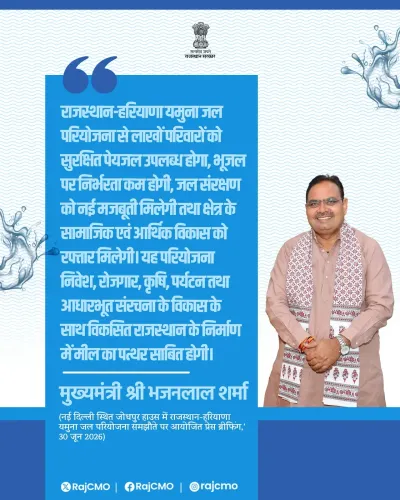
The Chief Minister's Office of Rajasthan has backed the Rajasthan-Haryana Yamuna Jal Pariyojana, calling it a pillar of the state's long-term water policy and a guarantee of water security for future generations amid chronic scarcity across arid districts.
Key Takeaways
The Chief Minister's Office of Rajasthan announced on 1 July 2026 that the Rajasthan-Haryana Yamuna Jal Pariyojana will strengthen the state's long-term water policy.
CM Bhajanlal Sharma was tagged in the post, signalling direct political ownership of the initiative.
The project aims to ensure water security for future generations in one of India's most water-stressed states.
Any bilateral Yamuna water arrangement between Rajasthan and Haryana must clear the Upper Yamuna River Board and align with the 1994 inter-state MOU .
The exact cost, scope, and timeline of the project have not yet been officially disclosed.
Both Rajasthan and Haryana are currently governed by the BJP , potentially easing inter-state negotiations.
The Chief Minister's Office of Rajasthan on Wednesday, 1 July 2026, declared that the Rajasthan-Haryana Yamuna Jal Pariyojana will strengthen the state's long-term water policy and ensure water security for future generations, citing the initiative as a landmark step in addressing the state's chronic water scarcity.
Context
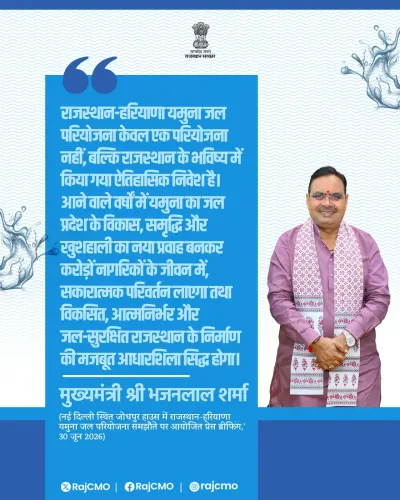
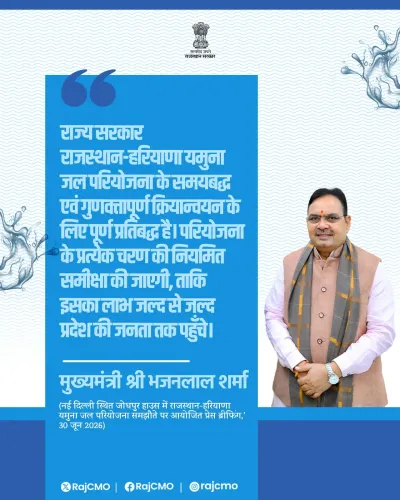
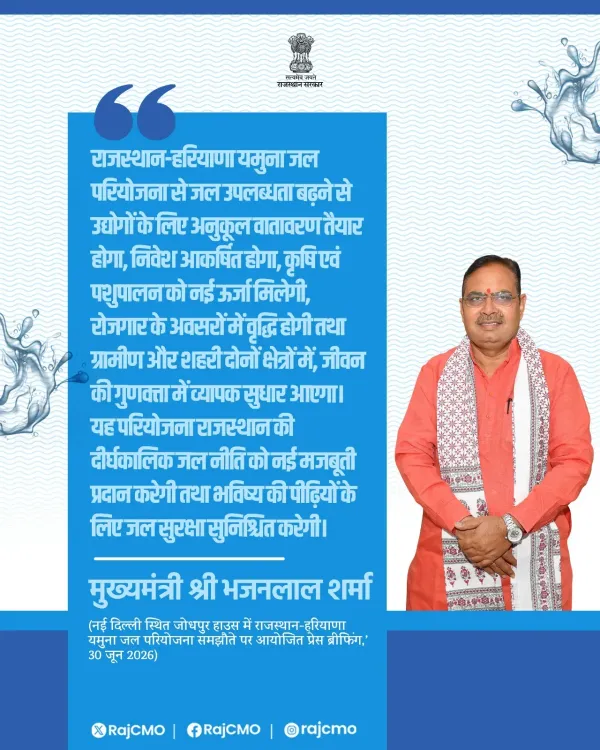
The post, attributed to the office of Chief Minister Bhajanlal Sharma, states in Hindi: 'Rajasthan-Haryana Yamuna Jal Pariyojana Rajasthan ki dirghakalik jal niti ko nayi mazbooti pradaan karegi tatha bhavishy ki peedhiyon ke liye jal suraksha sunishchit karegi' — meaning, 'The Rajasthan-Haryana Yamuna Water Project will provide new strength to Rajasthan's long-term water policy and ensure water security for future generations.' The hashtag #AapnoAgraniRajasthan ('Our Pioneering Rajasthan') frames the announcement within the ruling BJP government's broader development narrative.
Rajasthan is one of India's most water-stressed states, with large swathes of its arid and semi-arid districts dependent on inter-state river transfers. The state has historically relied on the Indira Gandhi Canal system for irrigation and drinking water supply, making any additional inter-state water arrangement of significant consequence.
Policy Backdrop
The proposed project draws on a long history of negotiated water-sharing in the Yamuna basin. A 1994 Memorandum of Understanding among Haryana, Uttar Pradesh, Rajasthan, Delhi, and Himachal Pradesh allocated Yamuna waters among the riparian states, forming the legal bedrock for any bilateral arrangement between Rajasthan and Haryana.
Haryana controls key headworks and canals on the Yamuna system, making its cooperation indispensable for any downstream transfer to Rajasthan. Bilateral water-sharing arrangements between the two states sit within the federal framework overseen by the Upper Yamuna River Board, which must clear such agreements before implementation can begin.
Such inter-state water transfer initiatives form part of a wider pattern across northern India, where competing agricultural, drinking water, and industrial demands have long required negotiated federal solutions. For Rajasthan, securing additional Yamuna supplies would complement, rather than replace, its existing canal-based infrastructure.
Stakeholders and Impact
The primary beneficiaries of the project, if realised, would be Rajasthan's farmers and residents of its water-stressed districts, who face acute shortages during dry months. Reliable water access is directly linked to agricultural productivity and rural livelihoods across the state's eastern and northern belt.
For Haryana, the arrangement carries its own political and administrative dimensions, as any reallocation of Yamuna flows requires careful calibration against the needs of its own farming communities. Both states share a political alignment under the BJP at present, which may facilitate inter-governmental negotiations.
What's Next
Key milestones to watch include the formal signing of a project agreement between the two state governments, the allocation of funding in respective state budgets, and the receipt of clearances from the Upper Yamuna River Board. The technical scope, cost estimates, and construction timeline of the Rajasthan-Haryana Yamuna Jal Pariyojana are yet to be officially detailed in the public domain.
If the project advances through these regulatory and financial hurdles, it could mark a significant augmentation of Rajasthan's water supply infrastructure — one with generational implications for the state's agriculture and urban water security.
Point of View
But the technical and regulatory path through the Upper Yamuna River Board remains formidable. This announcement fits a broader BJP pattern of using inter-state infrastructure projects to consolidate rural support in agrarian constituencies. Until project details — cost, scope, timeline — are made public, the announcement is best read as a statement of intent rather than a firm commitment.
NationPress
30 Sept 2026
Frequently Asked Questions
What is the Rajasthan-Haryana Yamuna Jal Pariyojana?
The Rajasthan-Haryana Yamuna Jal Pariyojana is a proposed inter-state water project aimed at transferring Yamuna river waters to Rajasthan in collaboration with Haryana, intended to strengthen the state's long-term water policy and ensure water security for future generations.
Why does Rajasthan need additional water from the Yamuna?
Rajasthan is one of India's most water-stressed states, with large arid and semi-arid districts that depend on inter-state river transfers. The state's existing water infrastructure, including the Indira Gandhi Canal, is insufficient to meet growing agricultural and drinking water demands.
What is the 1994 Yamuna water MOU?
The 1994 Memorandum of Understanding is an inter-state agreement among Haryana, Uttar Pradesh, Rajasthan, Delhi, and Himachal Pradesh that allocates Yamuna river waters among these states and forms the legal foundation for any bilateral water-sharing arrangement.
Who is Bhajanlal Sharma?
Bhajanlal Sharma is the BJP Chief Minister of Rajasthan, in office since December 2023. He was tagged by the Chief Minister's Office in the post announcing the Yamuna water project.
What approvals are needed for the Rajasthan-Haryana Yamuna project?
The project requires a formal inter-state agreement between Rajasthan and Haryana, funding allocations in state budgets, and regulatory clearance from the Upper Yamuna River Board before implementation can proceed.