CM Bhajan Lal flags 3 water projects for Rajasthan

Synopsis
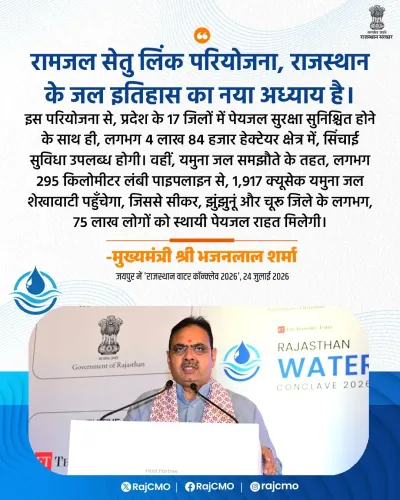
Rajasthan CM Bhajan Lal Sharma on 22 July 2026 spotlighted three water projects — Ramjal Setu, Yamuna water agreement, and Narmada expansion — as historic steps by the double engine government to ease water scarcity and boost agriculture, industry, and development across the state.
Key Takeaways
Rajasthan CM Bhajan Lal Sharma on 22 July 2026 highlighted three water security projects in a published newspaper article shared on X.
The three initiatives are the Ramjal Setu Project , the Yamuna water agreement , and the Narmada water expansion project .
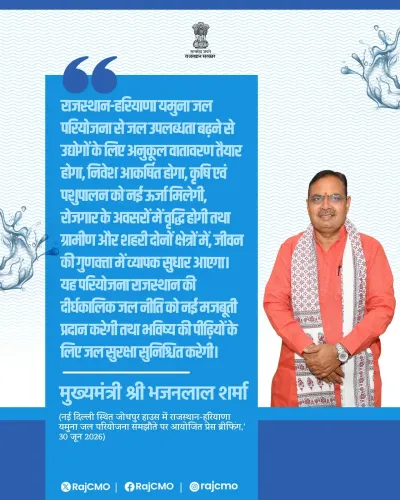
Sharma stated the projects will improve water availability and give 'new momentum to agriculture, industry, and overall development' in Rajasthan .
The Yamuna water agreement builds on the foundational 1994 inter-state Yamuna water-sharing pact among riparian states.
Farmers, industries , and households across Rajasthan are the primary beneficiary groups cited.
Exact funding, scope, and timelines for the three projects have not been confirmed in verified public records as of this report.
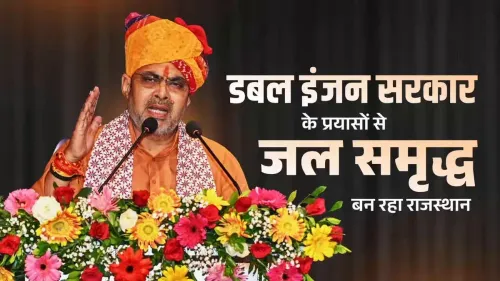
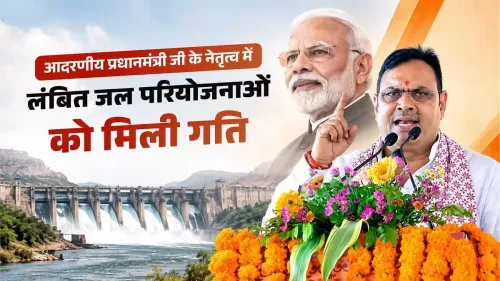
Rajasthan Chief Minister Bhajan Lal Sharma on Wednesday, 22 July 2026, highlighted three major water security initiatives — the Ramjal Setu Project, the Yamuna water agreement, and the Narmada water expansion project — as cornerstones of the state's effort to address its chronic water deficit. Writing in a newspaper column, Sharma credited the 'double engine government' of aligned BJP administrations at the Centre and in Rajasthan for driving what he called historic progress on water availability.
Context
In his article, Sharma wrote: 'राजस्थान में जल सुरक्षा की दिशा में डबल इंजन सरकार निरंतर ऐतिहासिक कार्य कर रही है' ['The double engine government is continuously doing historic work in the direction of water security in Rajasthan']. He stated that the three projects would 'make the lives of the people of the state easier' and give 'new momentum to agriculture, industry, and the overall development of the state.' The post shared an image of the published article.
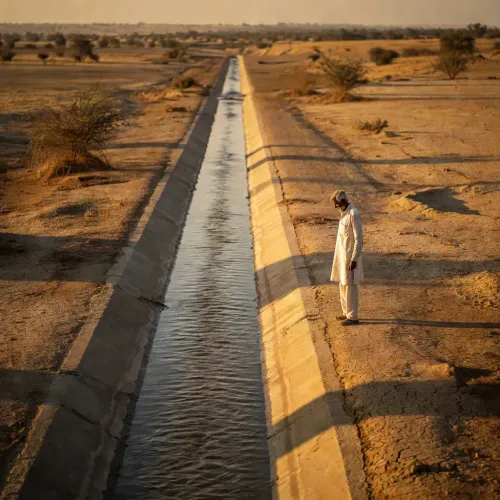
Rajasthan is among India's most water-stressed states, with large swathes of its arid and semi-arid geography dependent on inter-basin transfers and monsoon-fed reservoirs. Drinking water access, irrigation for farmers, and industrial water supply have historically been constrained by the state's geography.
Policy Backdrop
The Yamuna water agreement builds on the foundational 1994 inter-state Yamuna water-sharing pact among riparian states, of which Rajasthan is a signatory. That agreement allocated shares of Yamuna flows to participating states; subsequent efforts have sought to actualise and expand those allocations for end-use in the state. The Narmada water expansion project represents an effort to extend the reach of Narmada basin water to additional districts beyond those already served, deepening an inter-basin transfer framework that has been central to western India's water planning for decades.
The Ramjal Setu Project is cited by the state government as a dedicated water security initiative for Rajasthan. BJP governments at the Centre and in water-deficit states have broadly prioritised inter-basin transfer schemes and river-linking concepts as a long-term answer to regional water imbalances. Coordination between state and central agencies, as well as with neighbouring states, is essential to the execution of all three initiatives.
Stakeholders and Impact
Farmers stand to gain from expanded irrigation potential if the projects deliver on their stated objectives, reducing dependence on erratic monsoon patterns in a state where agriculture is the primary livelihood for a large share of the population. Industries operating in Rajasthan — including textiles, mining, and emerging manufacturing clusters — face recurring water availability constraints that expanded supply could ease.
Urban and rural households across the state, particularly in districts that currently rely on tanker supply or seasonal sources, represent the broadest constituency for any improvement in water infrastructure. The political significance of water delivery in Rajasthan is well established, with successive state governments having made it a central campaign and governance issue.
What's Next
Concrete progress on all three projects will hinge on budgetary allocations in forthcoming state and Union budgets, as well as the signing and ratification of memoranda of understanding with neighbouring states where inter-state water sharing is involved. Implementation timelines and the precise scope of each project have not been publicly detailed in verified official documents as of this report.
Observers will watch for formal announcements on project phases, tendering, and inter-governmental coordination meetings as indicators of whether the political commitment translates into on-ground execution in the near term.
Point of View
A pattern common in governance communication in large, water-stressed states. The reliance on inter-basin transfers reflects a structural reality: Rajasthan cannot meet its water needs from within its own boundaries, making inter-state diplomacy as critical as engineering. Whether these projects move from political articulation to verified implementation will be the true test of the double engine claim.
NationPress
20 Oct 2026
Frequently Asked Questions
What is the Ramjal Setu Project in Rajasthan?
The Ramjal Setu Project is a water security initiative cited by the Rajasthan state government aimed at improving water availability across the state. Detailed scope and timelines have not been confirmed in publicly verified documents as of July 2026.
What is the Yamuna water agreement for Rajasthan?
The Yamuna water agreement refers to inter-state arrangements — rooted in the 1994 Yamuna water-sharing pact — that allocate a share of Yamuna river flows to Rajasthan. The current government has cited efforts to actualise and expand these allocations for use in the state.
What is the Narmada water expansion project in Rajasthan?
The Narmada water expansion project is an effort to extend Narmada basin water to additional districts of Rajasthan beyond those already served, deepening an existing inter-basin transfer framework.
What did Rajasthan CM Bhajan Lal Sharma say about water projects?
On 22 July 2026, CM Bhajan Lal Sharma wrote in a newspaper article that the double engine government is doing historic work on water security in Rajasthan, and that the Ramjal Setu, Yamuna, and Narmada projects will benefit agriculture, industry, and overall development.
How is the double engine government helping Rajasthan's water crisis?
The term 'double engine government' refers to BJP being in power both at the Centre and in Rajasthan. CM Sharma argues this alignment enables faster clearances, funding, and inter-state coordination for large water infrastructure projects.