Amit Shah Backs ₹4,317 Cr VISTAR Scheme for Stats Overhaul
Synopsis
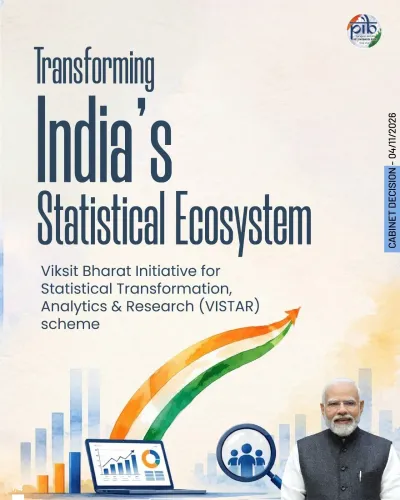
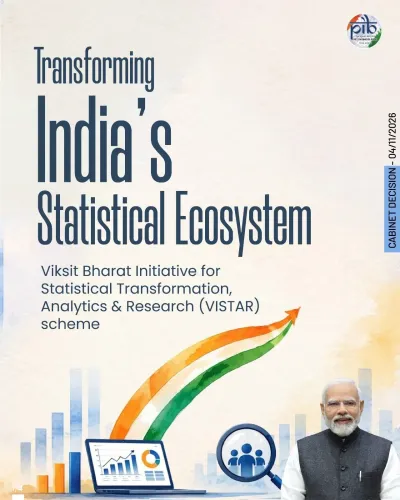
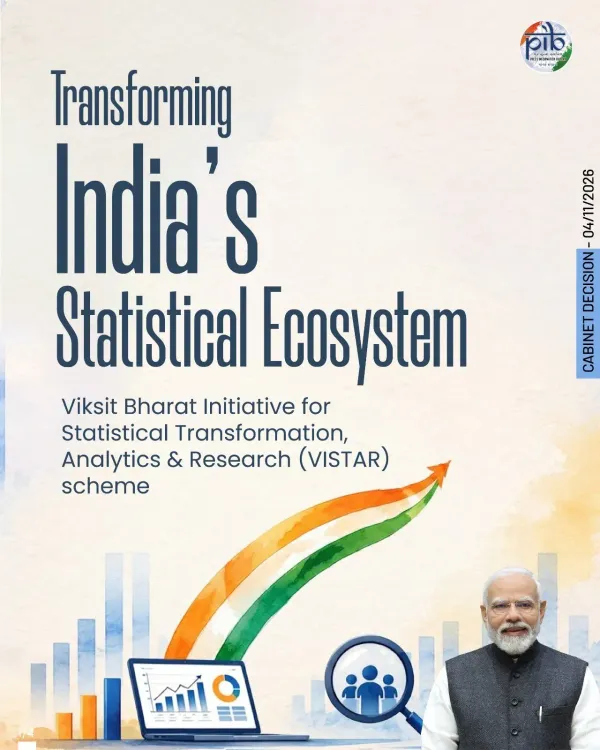
The Union Cabinet has approved the ₹4,317.10 crore VISTAR scheme to overhaul India's statistical infrastructure. Union Home Minister Amit Shah says the initiative will make India's data architecture future-ready and strengthen evidence-based governance under the Viksit Bharat 2047 vision.
Key Takeaways
The Union Cabinet approved the VISTAR (Viksit Bharat Initiative for Statistical Transformation, Analytics and Research) scheme with an outlay of ₹4,317.10 crore .
Union Home Minister Amit Shah called the scheme a step toward making India's statistical architecture 'future-ready.' VISTAR is designed to integrate modern analytics and real-time data capabilities into India's official statistical systems.
The scheme aligns with the government's Viksit Bharat 2047 roadmap, which treats credible data as foundational to development planning.
India's National Statistical Office and broader official data infrastructure have been targets of periodic reform since the 2010s, with VISTAR representing the most capitalised push yet.
India's statistical backbone is about to get a serious upgrade. Union Home Minister Amit Shah on Wednesday, November 4, 2026, threw his weight behind the Union Cabinet's approval of the ₹4,317.10 crore Viksit Bharat Initiative for Statistical Transformation, Analytics and Research (VISTAR), calling it a move that will make India's statistical architecture 'future-ready' and sharpen the tools of good governance.
What VISTAR promises India's data ecosystem
VISTAR is not a routine departmental allocation. With an outlay of ₹4,317.10 crore, it represents one of the most ambitious investments in official statistics the country has seen — aimed squarely at integrating modern analytics and real-time data capabilities into the machinery of the Indian state. Shah framed it plainly: 'Modern statistical insights to guide development in the Modi era.'
The ambition maps directly onto the government's Viksit Bharat 2047 roadmap — the overarching vision to transform India into a developed nation by its centenary of independence. Good targets require good data. That logic is the foundation VISTAR is built on.
A statistical system long overdue for modernisation
India's official statistics infrastructure, anchored by the National Statistical Office (NSO), has undergone periodic reform since the 2010s under successive National Policy on Official Statistics frameworks. But critics and policymakers alike have flagged persistent gaps: lag times in data release, inconsistencies across state and central agencies, and limited use of administrative data for real-time policy signals.
VISTAR, as framed by the Cabinet approval, is designed to close those gaps — pushing the system toward faster, more granular, and analytically richer outputs. The integration of advanced analytics into what has traditionally been a survey-and-census-driven architecture would mark a structural shift in how the government measures its own performance.
Data as a governance instrument under Modi
Prime Minister Narendra Modi's government has consistently positioned data-driven decision-making as a core governance philosophy — from the Direct Benefit Transfer architecture to the PM Gati Shakti national infrastructure planning platform. VISTAR slots into that lineage as the supply-side fix: better statistical inputs for every ministry and scheme that depends on credible numbers to allocate resources and measure outcomes.
The scale of the investment signals that the government is treating statistical reform not as a housekeeping exercise but as infrastructure — as foundational to the next phase of development as roads or broadband.
When the numbers get better, every policy built on them gets sharper. That is the bet VISTAR is placing — and at ₹4,317 crore, it is a substantial one.
Point of View
317 crore to the exercise, the Cabinet is signalling that the Viksit Bharat 2047 target cannot be credibly tracked without first fixing the measurement tools. For Amit Shah, backing this initiative also reinforces the BJP's broader 'good governance' narrative ahead of the political cycle. The real test will be whether VISTAR delivers faster, more granular data releases and genuine integration with state-level agencies — improvements that past reform rounds promised but only partially delivered.
NationPress
4 Nov 2026
Frequently Asked Questions
What is the VISTAR scheme approved by the Union Cabinet?
VISTAR stands for Viksit Bharat Initiative for Statistical Transformation, Analytics and Research. The Union Cabinet approved it with an outlay of ₹4,317.10 crore to modernise India's official statistical systems by integrating advanced analytics and real-time data capabilities.
What is the budget allocated for the VISTAR scheme?
The Union Cabinet approved ₹4,317.10 crore for the VISTAR scheme.
How does VISTAR relate to the Viksit Bharat 2047 vision?
VISTAR is positioned as the statistical backbone for the Viksit Bharat 2047 roadmap, providing the credible, real-time data that policymakers need to plan and measure India's development goals through to the country's centenary of independence.
What agency will implement the VISTAR scheme?
VISTAR is expected to work through India's official statistical machinery, including the National Statistical Office. Specific implementation timelines and integration details are yet to be publicly announced.
Why did Amit Shah comment on the VISTAR scheme?
As a senior Union Cabinet minister and a key voice of the BJP government, Amit Shah posted on X to endorse the Cabinet's approval of VISTAR, framing it as a tool to enhance data-driven governance during the Modi era.