Kishan Reddy Hails NALCO's Record H1 FY27 Output
Synopsis
Union Mines Minister G. Kishan Reddy on November 4 highlighted NALCO's record first-half FY 2026-27 production and sales performance, backed by improved profitability, as evidence of Atmanirbhar Bharat's industrial self-reliance goals advancing in India's aluminium sector.
Key Takeaways
NALCO posted its best-ever first-half performance in FY 2026-27 , recording record production and sales figures.
The record was accompanied by improved profitability , indicating margin gains alongside volume growth.
Union Mines Minister G.
Kishan Reddy attributed the milestone to PM Narendra Modi 's leadership and the Atmanirbhar Bharat Abhiyan launched in May 2020 .
NALCO is a Navratna PSU under the Ministry of Mines, operating an integrated bauxite-to-aluminium chain.
The minister framed the performance as a step toward 'a stronger aluminium ecosystem for Viksit Bharat .' Full-year FY 2026-27 results and potential fresh capex announcements from the Ministry of Mines are the next key milestones to watch.
A Navratna PSU quietly built over decades just posted its best first-half numbers ever — and Union Coal and Mines Minister G. Kishan Reddy wants India to know what that means for the country's industrial ambitions. On Wednesday, November 4, 2026, the minister took to X to highlight National Aluminium Company Limited (NALCO)'s record production and sales performance for the first half of FY 2026-27, framing it as direct evidence of Atmanirbhar Bharat taking root in the metals sector.
NALCO's H1 FY27 Milestone and What It Signals
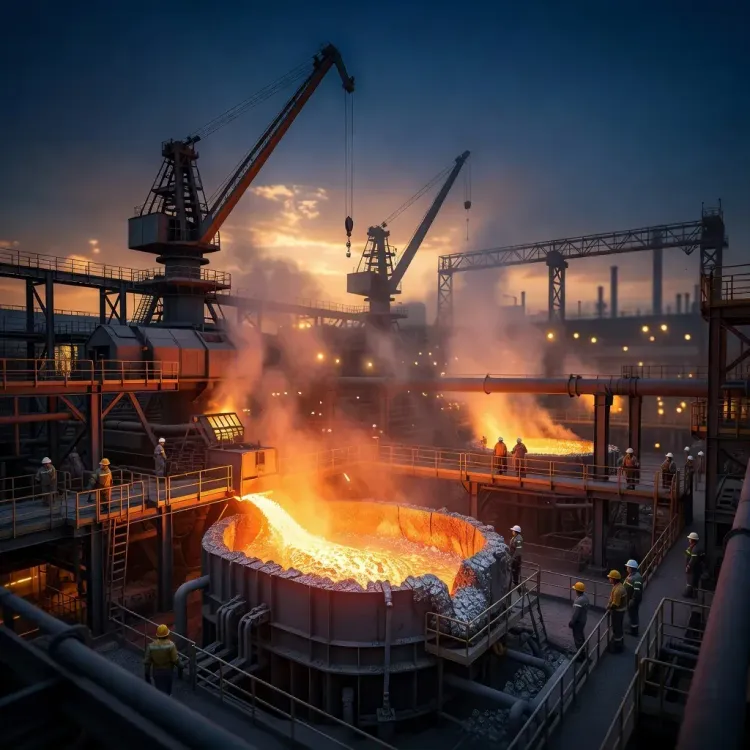
NALCO, a Navratna PSU under the Ministry of Mines, operates an integrated chain spanning bauxite mining, alumina refining, and aluminium smelting — making it one of the most strategically positioned companies in India's raw-materials landscape. Reddy noted that the record H1 performance was 'backed by improved profitability,' signalling that the gains are not merely volumetric but are flowing through to the bottom line. That combination — higher output and stronger margins — is precisely the kind of industrial health policymakers point to when arguing that domestic capacity-building is working.
The specific production and sales figures have not yet been officially disclosed in full detail, but the minister's framing leaves little ambiguity: the first six months of the current financial year represent a high-water mark for the company. For a PSU whose fortunes track global aluminium prices and domestic bauxite availability, hitting record numbers in the same window that global commodity markets remain volatile is notable.
Atmanirbhar Bharat's Bet on Domestic Metals
Prime Minister Narendra Modi launched the Atmanirbhar Bharat Abhiyan in May 2020, with aluminium and other critical metals explicitly in its frame. The logic was straightforward: India sits on significant bauxite reserves, yet had long remained a net importer of value-added aluminium products. Closing that gap required expanding domestic smelting and refining capacity — the kind of capital-intensive, long-gestation work that PSUs like NALCO are structured to undertake. Reddy's post places NALCO's H1 performance squarely within that six-year arc, calling it evidence of 'growing industrial strength and operational excellence.'
Successive administrations have cited NALCO's modernisation and expansion cycles as milestones in India's self-reliance journey in non-ferrous metals. The current run, however, comes at a moment when downstream manufacturers — from aerospace component makers to electric-vehicle battery enclosure producers — are increasingly hungry for domestically sourced primary aluminium. A record-producing NALCO, in that context, is not just a headline for the PSU; it is a supply-chain signal for a broad swathe of Indian industry.
The Viksit Bharat Aluminium Ecosystem Play
Reddy closed his post with a pointed phrase: 'Building a stronger aluminium ecosystem for a Viksit Bharat' — a reference to the government's Viksit Bharat 2047 vision of a fully developed India by the centenary of independence. The word 'ecosystem' is deliberate. It acknowledges that NALCO's production numbers are only one node; the fuller picture involves bauxite-rich states, refinery capacity, power availability for energy-intensive smelting, and the downstream industries that consume the metal.
What to watch now: NALCO's full-year FY 2026-27 results, and whether the Ministry of Mines follows up with fresh capital expenditure or capacity-expansion announcements. A strong H1 often precedes guidance upgrades — and in a PSU context, that can translate into fresh project sanctions or modernisation outlays that extend the momentum well beyond a single financial year.
For a sector that runs on long investment cycles, one strong half-year is a data point. Two strong halves make a trend — and that is the number India's aluminium industry will be watching.
Point of View
Highlighted by Minister Kishan Reddy, fits into a broader government effort to position PSU metals companies as anchors of India's industrial self-reliance narrative ahead of the Viksit Bharat 2047 deadline. By coupling volume growth with profitability improvement, the milestone strengthens the case that state-owned enterprises in the non-ferrous metals space can compete on efficiency, not just scale. The timing matters: downstream sectors — from EVs to aerospace — are intensifying their demand for domestically sourced primary aluminium, giving NALCO's output gains direct industrial-policy significance. If the full-year FY27 numbers hold, they could accelerate Ministry of Mines decisions on the next round of capacity expansion or modernisation funding.
NationPress
4 Nov 2026
Frequently Asked Questions
What is NALCO and which ministry does it fall under?
NALCO (National Aluminium Company Limited) is a Navratna PSU under India's Ministry of Mines . It operates an integrated chain of bauxite mining, alumina refining, and aluminium smelting, making it the country's largest integrated aluminium producer in the public sector.
What did NALCO achieve in the first half of FY 2026-27?
According to Union Mines Minister G. Kishan Reddy 's post on November 4, 2026 , NALCO recorded its best-ever first-half production and sales figures in FY 2026-27 , alongside improved profitability. Specific figures have not yet been officially released in full detail.
What is Atmanirbhar Bharat and how does it relate to aluminium?
Atmanirbhar Bharat Abhiyan is PM Narendra Modi 's self-reliance initiative launched in May 2020 , which includes expanding domestic production of strategic materials including aluminium to reduce India's dependence on imports across the metals value chain.
What is Viksit Bharat and why did Kishan Reddy mention it?
Viksit Bharat is the Indian government's vision of becoming a fully developed nation by 2047 , the centenary of independence. Minister Reddy cited NALCO's performance as a building block for 'a stronger aluminium ecosystem' that supports this long-term national development goal.
Why does NALCO's aluminium output matter for Indian industry?
Primary aluminium from NALCO feeds downstream industries including electric vehicles, aerospace, construction, and packaging. As India scales up manufacturing under Atmanirbhar Bharat , a domestically strong aluminium PSU reduces import dependence and strengthens the country's overall industrial supply chain.