Rijiju: Cabinet clears ₹2,814 cr critical minerals scheme
Synopsis
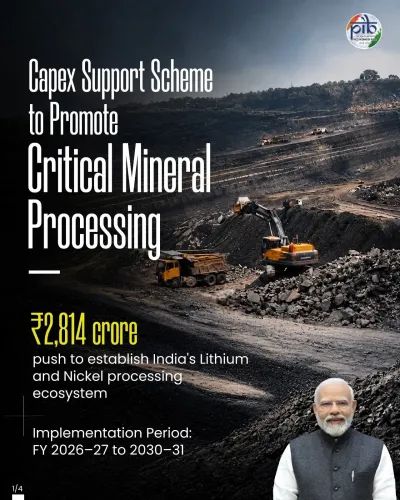
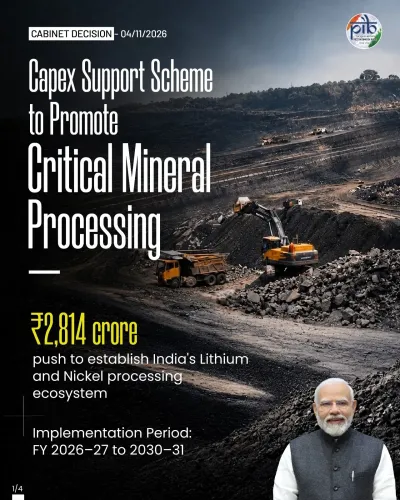
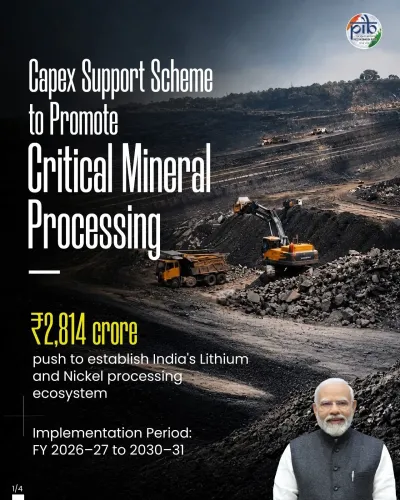
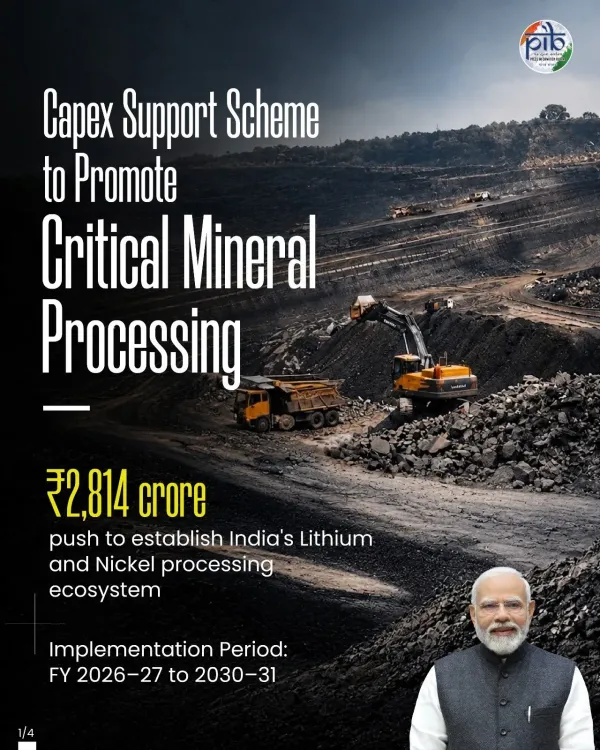
The Union Cabinet has approved the Capex Support Scheme to Promote Critical Mineral Processing, allocating ₹2,814 crore over five years from FY 2026–27 to 2030–31, aiming to build domestic refining capacity for minerals critical to EVs, batteries, and clean-energy supply chains.
Key Takeaways
The Union Cabinet approved the Capex Support Scheme to Promote Critical Mineral Processing on November 4, 2026 .
Financial outlay is ₹2,814 crore over five years ( FY 2026–27 to 2030–31 ).
The scheme provides capital expenditure support to domestic mineral processing firms, targeting the refining gap in India's critical minerals value chain.
Key beneficiaries include EV manufacturers, battery cell makers, and electronics companies dependent on processed critical mineral inputs.
The move builds on the Mines and Minerals (Development and Regulation) Amendment Act, 2023 , which opened critical mineral block auctions to private players.
India aims to reduce its dependence on China for processing of lithium, cobalt, nickel, and rare earth elements.
India just placed a serious bet on owning its own clean-energy supply chain. Union Parliamentary Affairs Minister Kiren Rijiju announced on Wednesday, November 4, 2026, that the Union Cabinet, under Prime Minister Narendra Modi, has approved the Capex Support Scheme to Promote Critical Mineral Processing — a ₹2,814 crore central sector scheme running from FY 2026–27 to 2030–31.
A ₹2,814 crore signal to the market
The five-year capital expenditure support scheme is designed to do one thing: pull domestic processing capacity for critical minerals out of the ground and into industrial scale. For years, India has mined or imported raw critical minerals — lithium, cobalt, nickel, rare earths — only to send them abroad for processing, then buy them back at a steep premium embedded in EV batteries, electronics, and clean-energy hardware. This scheme directly targets that leakage point.
The ₹2,814 crore outlay will flow as capex support to processing firms, reducing the upfront capital barrier that has historically kept private players from building refining infrastructure at home. Project selection guidelines and the first tranche of approvals are expected ahead of the FY 2026–27 rollout.
The policy lineage: from auction reform to downstream push
This approval does not emerge in a vacuum. The Mines and Minerals (Development and Regulation) Amendment Act, 2023 cracked open critical mineral block auctions to the private sector — blocks that had previously been the exclusive domain of state-owned enterprises. That upstream reform created the expectation of more domestic ore supply. The Capex Support Scheme is the downstream answer: if India is finally mining more at home, it now needs the refining muscle to match.
India's strategic anxiety is well-documented — an overwhelming share of global critical mineral processing currently runs through China, a single-country dependency that sits uncomfortably against New Delhi's supply-chain diversification goals, particularly as the EV and battery manufacturing sector scales rapidly.
Who stands to gain — and what comes next
The immediate beneficiaries are mineral processing companies and, further down the value chain, EV manufacturers, battery cell makers, and electronics firms that have been forced to source processed inputs from abroad. A credible domestic processing base would compress input costs and reduce forex outflow on a category of imports that only grows as India's green transition accelerates.
The critical question now is execution: how quickly will project selection criteria be notified, and which processing technologies — hydrometallurgy, pyrometallurgy, or solvent extraction — will qualify for support? The answers will determine whether the ₹2,814 crore catalyses a genuine industrial shift or settles into the slower rhythm of government disbursement.
India has the ambition, the upstream reform, and now the downstream capital commitment. The race to build a critical minerals processing corridor — independent of any single foreign supplier — has formally begun.
Point of View
But domestic processing capacity has remained negligible. By injecting ₹2,814 crore in capex support, the Cabinet is essentially subsidising the industrial infrastructure that private capital alone has been reluctant to fund. The timing is deliberate — as global EV adoption accelerates and the geopolitics of critical minerals intensifies, New Delhi is signalling to both domestic manufacturers and foreign partners that it intends to be a processing destination, not merely an ore supplier. Whether the scheme's execution matches its ambition will be the defining test of India's clean-energy industrial policy in this decade.
NationPress
4 Nov 2026
Frequently Asked Questions
What is the Capex Support Scheme to Promote Critical Mineral Processing?
It is a five-year central sector scheme approved by the Union Cabinet on November 4, 2026, with a financial outlay of ₹2,814 crore for FY 2026–27 to 2030–31, designed to provide capital expenditure support to companies building domestic processing capacity for critical minerals such as lithium, cobalt, nickel, and rare earths.
Why is critical mineral processing important for India?
India currently imports most processed critical minerals — especially from China — for use in EV batteries, electronics, and clean-energy equipment. Building domestic processing capacity reduces import dependence, cuts costs for manufacturers, and strengthens India's strategic supply-chain security.
Who will benefit from the critical minerals capex scheme?
Direct beneficiaries include mineral processing firms that receive capital support. Downstream beneficiaries are EV manufacturers, battery cell producers, and electronics companies that rely on processed critical mineral inputs, potentially at lower costs once domestic capacity scales up.
How does this scheme connect to earlier mining reforms?
The Mines and Minerals (Development and Regulation) Amendment Act, 2023, opened critical mineral block auctions to private players, addressing the upstream supply side. The Capex Support Scheme addresses the downstream side — ensuring that ore mined in India can also be processed domestically rather than exported for refining.
What happens next after the Cabinet approval?
The government is expected to notify detailed project selection guidelines and disburse the first tranche of approvals ahead of the FY 2026–27 rollout. The criteria for which processing technologies and projects qualify for support will be closely watched by industry.