Cabinet Clears ₹2,814 Cr Capex Scheme for Critical Minerals
Synopsis
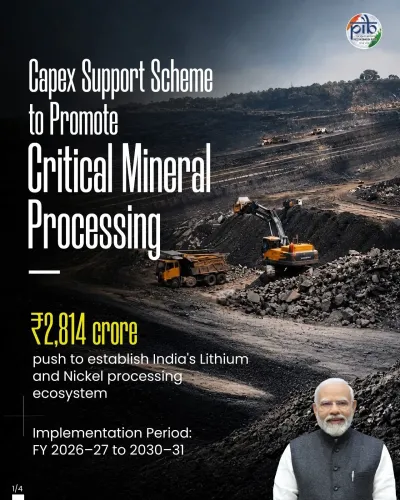
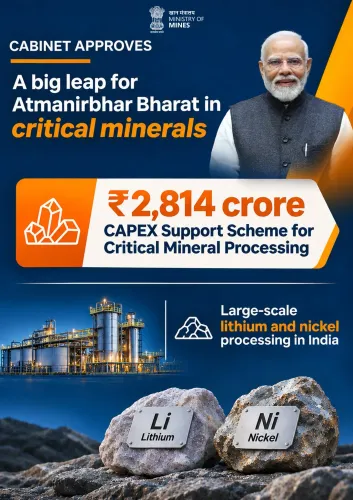
The Union Cabinet has cleared a ₹2,814 crore Capex Support Scheme to promote domestic critical mineral processing over five years (FY 2026-27 to 2030-31), announced by Minister Pralhad Joshi as a step toward Aatmanirbhar Bharat and clean-energy supply chain security.
Key Takeaways
The Union Cabinet approved the Capex Support Scheme to Promote Critical Mineral Processing on 4 November 2026 .
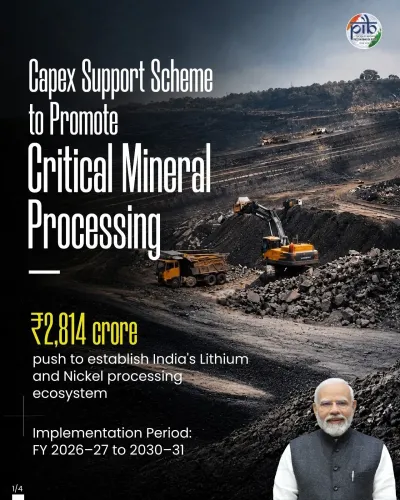
The scheme carries a financial outlay of ₹2,814 crore spread over five years (FY 2026-27 to FY 2030-31) .
The objective is to build domestic refining and processing capacity for minerals critical to EVs, clean energy and electronics.
The scheme follows the 2023 amendment to the Mines and Minerals Act that fast-tracked critical mineral auctions and mirrors earlier Capex/PLI models for semiconductors and solar equipment.
Key beneficiaries include mining companies, EV and battery manufacturers, and renewable energy industries.
Detailed guidelines and first project approvals are expected post the FY 2026-27 Union Budget.
India just placed a serious bet on its own mineral future. The Union Cabinet, chaired by Prime Minister Narendra Modi, has approved the Capex Support Scheme to Promote Critical Mineral Processing — a ₹2,814 crore initiative running across five years from FY 2026–27 to 2030–31 — signalling New Delhi's intent to stop outsourcing the processing of the minerals that power electric vehicles, clean energy infrastructure and next-generation electronics.
Union Minister Pralhad Joshi, announcing the decision on Wednesday, 4 November 2026, framed the scheme as a cornerstone of the Aatmanirbhar Bharat vision, posting in both English and Kannada: 'ಈ ಐತಿಹಾಸಿಕ ಯೋಜನೆ' ('this landmark initiative') will 'strengthen India's critical mineral ecosystem, promote domestic processing capabilities.'
Why India's mineral processing gap matters now
Critical minerals — think lithium, cobalt, graphite and rare earths — are the raw material of the energy transition. Without the ability to refine and process them domestically, even a country sitting on mineral deposits remains dependent on foreign supply chains. That dependency carries real strategic risk: a single chokepoint can stall an entire EV or solar supply chain overnight.
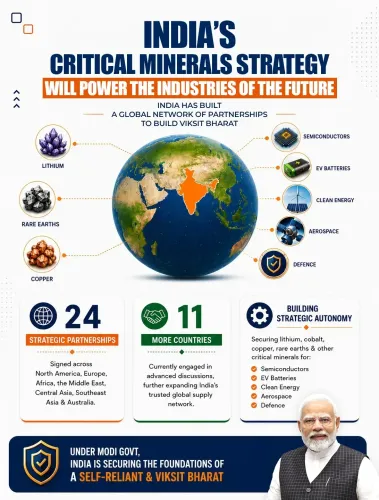
India has been acutely aware of the gap. In 2023, Parliament amended the Mines and Minerals (Development and Regulation) Act to carve out critical and strategic minerals into a dedicated Part D, unlocking faster auctions and exploration. The state-backed entity KABIL has simultaneously pursued overseas mineral asset acquisitions. The Capex Support Scheme is the next logical move — using capital expenditure incentives to build the actual refining muscle onshore.
The ₹2,814 crore logic: Capex over PLI
The choice of a capital expenditure support model — rather than a production-linked incentive — is deliberate. Processing facilities for critical minerals require enormous upfront investment in specialised plants and equipment; the returns take years to materialise. A Capex subsidy de-risks that upfront commitment for private players, lowering the barrier for mining companies, battery manufacturers and electronics firms to co-invest in domestic refining infrastructure.
The design echoes the architecture of earlier schemes in semiconductors, solar photovoltaic manufacturing and advanced chemistry cells — a pattern of using public capital to crowd in private investment in sectors where import dependence had become a vulnerability. The critical minerals scheme now extends that playbook to the upstream segment of the clean-energy supply chain.
Who stands to gain — and what comes next
The immediate beneficiaries will be mining companies looking to move up the value chain, EV and battery manufacturers who need reliable domestic material supply, and renewable energy and electronics industries that currently import processed mineral inputs. Detailed scheme guidelines, project selection criteria and the first tranche of project approvals are expected after the FY 2026–27 Union Budget.
The scheme's five-year window — ending in FY 2030–31 — is calibrated to India's own clean-energy and EV growth trajectory, a period when domestic demand for processed critical minerals is projected to surge sharply. If the processing infrastructure gets built on time, India could shift from being a buyer of refined minerals to a credible supplier within the region.
India's mineral supply chain has long been its clean-energy Achilles heel. With ₹2,814 crore and a five-year clock, New Delhi is now racing to fix it before the demand wave arrives.
Point of View
The government is following a template it has refined through semiconductors and solar manufacturing, now extending it to the upstream clean-energy supply chain. The five-year window ending in 2030-31 is tightly aligned with India's own EV and renewable energy demand surge, suggesting a deliberate effort to build supply-side capacity before import dependency deepens. The scheme also sits within a broader diplomatic-industrial complex — combining domestic incentives with outbound mineral asset acquisition — that positions India as a future mid-tier processor rather than a perpetual raw-material importer.
NationPress
4 Nov 2026
Frequently Asked Questions
What is the Capex Support Scheme for Critical Mineral Processing?
It is a Union Cabinet-approved scheme with a ₹2,814 crore outlay over five years (FY 2026-27 to 2030-31) designed to provide capital expenditure support to companies setting up domestic critical mineral processing and refining facilities in India.
Which minerals does the critical mineral processing scheme cover?
The scheme targets minerals classified as critical or strategic under India's Mines and Minerals Act, which include lithium, cobalt, graphite and rare earth elements — inputs essential for EV batteries, clean energy infrastructure and advanced electronics.
Who will benefit from India's critical minerals capex scheme?
Primary beneficiaries include domestic mining companies, EV and battery manufacturers, renewable energy producers and the electronics industry — sectors that currently depend heavily on imported processed mineral inputs.
How does this scheme relate to Aatmanirbhar Bharat?
The scheme is explicitly framed as part of the Aatmanirbhar Bharat self-reliance initiative launched in 2020, aiming to reduce India's dependence on imported critical mineral processing and build an end-to-end domestic supply chain for clean energy and defence technologies.
When will the critical mineral processing scheme's guidelines be announced?
Detailed scheme guidelines, project selection criteria and first tranche approvals are expected after the FY 2026-27 Union Budget, following the Cabinet's formal approval of the scheme in November 2026.