Centre clears ₹2,814 crore scheme for critical mineral processing, eyes lithium and nickel plants
Synopsis
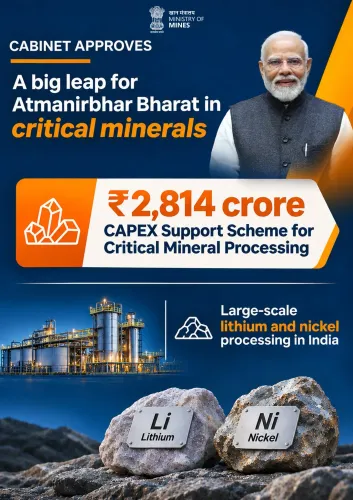
India's Union Cabinet has approved a ₹2,814 crore scheme to fund four domestic critical mineral processing plants — two for lithium and two for nickel — with a 30% capital subsidy and milestone-linked disbursements. The move directly targets India's near-total dependence on imports for refined lithium and nickel, materials that sit at the heart of the EV, battery, and defence electronics supply chains.
Key Takeaways
The Union Cabinet approved the Capex Support Scheme to Promote Critical Mineral Processing on 4 November 2026 , with an outlay of ₹2,814 crore over five years.
The scheme funds four processing plants : two lithium plants (minimum 30 kt capacity each) and two nickel plants (minimum 50 kt capacity each).
A 30% capital subsidy will be provided, capped at ₹500 crore per lithium beneficiary and ₹900 crore per nickel beneficiary.
Beneficiaries will be selected via a two-stage process — technical qualification followed by least-cost financial bidding.
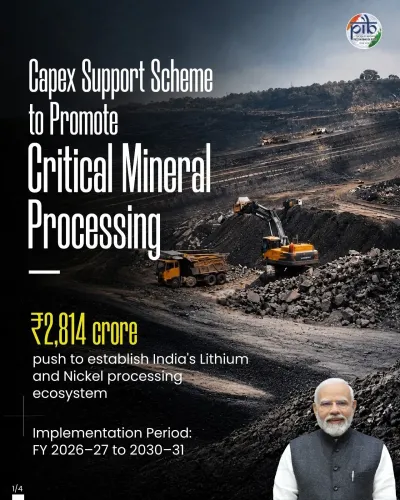
Incentives will be disbursed in three tranches tied to specified milestones; scheme runs from FY 2026-27 to 2030-31 .
India currently imports the bulk of refined lithium , nickel , and cobalt due to limited domestic processing infrastructure.
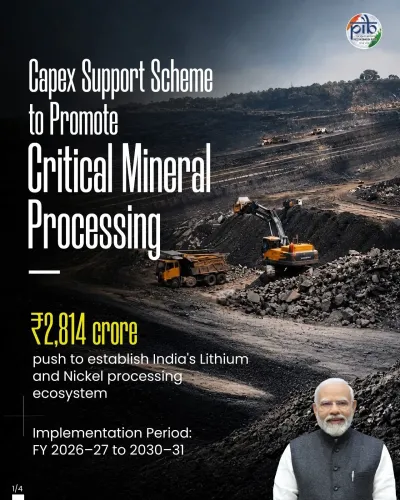
The Union Cabinet, chaired by Prime Minister Narendra Modi, on 4 November 2026 approved the Capex Support Scheme to Promote Critical Mineral Processing, with a financial outlay of ₹2,814 crore spread over five years from FY 2026-27 to 2030-31. The scheme is designed to build domestic processing capabilities for critical minerals, reduce India's dependence on imports, and anchor value addition within the country.
What the Scheme Covers
Under the scheme, a capital subsidy of 30% of eligible investment will be extended to set up four critical mineral processing plants — comprising two lithium processing plants (minimum capacity of 30 kt each) and two nickel processing plants (minimum capacity of 50 kt each). The maximum capital support is capped at ₹500 crore per lithium beneficiary and ₹900 crore per nickel beneficiary, according to an official Cabinet statement.
How Beneficiaries Will Be Selected
The selection of beneficiaries will follow a two-stage process. In the first stage, applications will be assessed for technical qualification; only technically qualified applicants will proceed to the second stage of financial bidding. For each mineral, two beneficiaries will be selected based on the least-cost criterion — that is, the lowest capital expenditure support sought by the bidder. Incentives will be disbursed in three tranches, linked to the achievement of specified milestones.
Why India Needs This Now
India currently remains substantially dependent on imports for refined intermediates and high-purity materials in critical minerals, including lithium, nickel, and cobalt — a consequence of the nascent stage of domestic beneficiation and processing infrastructure. Commercial-scale projects have faced hurdles including high capital requirements, limited access to suitable technologies, and constrained raw-material supply chains. This comes amid a global scramble for critical mineral security, with the United States, European Union, and China all accelerating their own processing capacities to anchor clean-energy supply chains.
Broader Strategic Context
The approval fits into a wider policy thrust to develop end-to-end critical mineral value chains in India. Notably, it follows the government's earlier push on the Khanij Bidesh India Limited (KABIL) framework for overseas mineral asset acquisition, suggesting a two-pronged strategy of securing raw material access abroad while building processing capacity at home. The scheme is expected to have downstream implications for electric vehicles (EVs), battery storage, defence electronics, and renewable energy sectors, all of which rely heavily on refined lithium and nickel compounds.
What Happens Next
With the scheme period running through FY 2030-31, the government is expected to notify the application and bidding process in the coming months. Industry stakeholders in the battery and EV ecosystem will be watching the technical qualification criteria closely, as eligibility thresholds will effectively determine which domestic and foreign-partnered firms can participate. The success of this scheme could meaningfully reduce India's import bill and strengthen its position in the global critical minerals race.
Point of View
814 crore scheme is a necessary but belated response to a vulnerability India has carried for years — near-total import dependence for the refined minerals that power its EV and clean-energy ambitions. The least-cost bidding mechanism is a sensible safeguard against rent-seeking, but the scheme's real test will be whether the technical qualification stage is designed tightly enough to attract credible operators rather than under-capitalised entrants. Four plants across two minerals is a modest beginning given the scale of global competition; the larger question is whether this is a standalone announcement or the opening tranche of a much larger critical minerals industrial policy that links KABIL's overseas sourcing to domestic refining in a coherent value chain.
NationPress
4 Nov 2026
Frequently Asked Questions
What is the Capex Support Scheme to Promote Critical Mineral Processing?
It is a five-year government scheme approved by the Union Cabinet on 4 November 2026, with a ₹2,814 crore outlay to fund four domestic critical mineral processing plants — two for lithium and two for nickel. The scheme offers a 30% capital subsidy on eligible investment, capped per beneficiary, to build India's domestic processing capacity and reduce import dependence.
Which minerals does the scheme target, and what are the capacity requirements?
The scheme targets lithium and nickel. Each of the two lithium processing plants must have a minimum capacity of 30 kt, while each of the two nickel processing plants must have a minimum capacity of 50 kt.
How will beneficiaries be selected under the scheme?
Selection follows a two-stage process: first, applicants are assessed for technical qualification; those who qualify then participate in financial bidding. For each mineral, the two beneficiaries offering the lowest capital expenditure support — the least-cost criterion — will be selected.
Why is critical mineral processing important for India?
India is heavily import-dependent for refined lithium, nickel, and cobalt — materials essential for electric vehicles, battery storage, defence electronics, and renewable energy. Domestic processing capacity will reduce import costs, support value addition, and strengthen India's position in global clean-energy supply chains.
When will the scheme be implemented and how will funds be released?
The scheme runs from FY 2026-27 to FY 2030-31. Incentives will be disbursed in three tranches, each linked to the achievement of specified project milestones, ensuring accountability in fund utilisation.