Amit Shah: Cabinet clears ₹2,814 cr critical minerals scheme
Synopsis
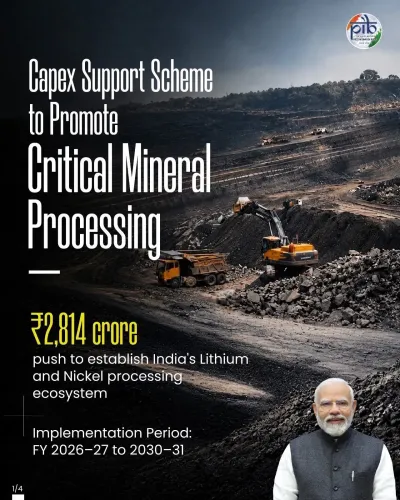
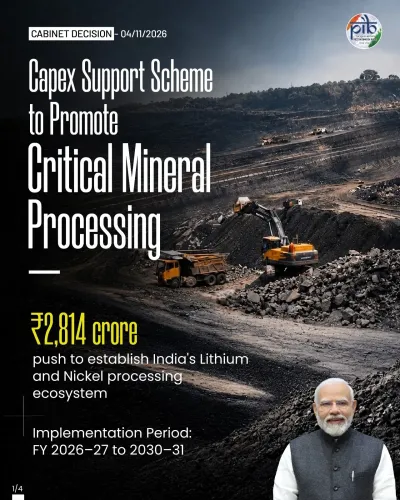
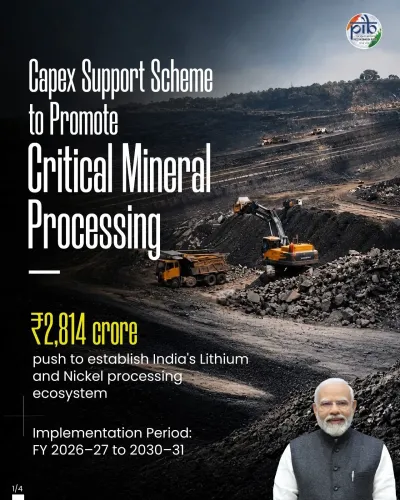
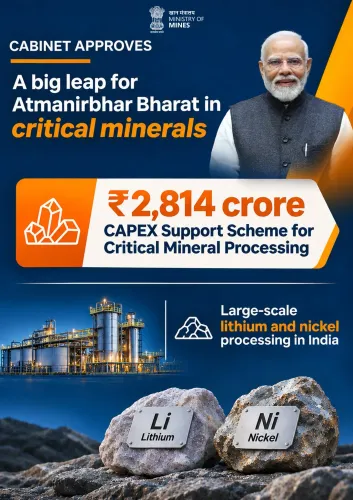
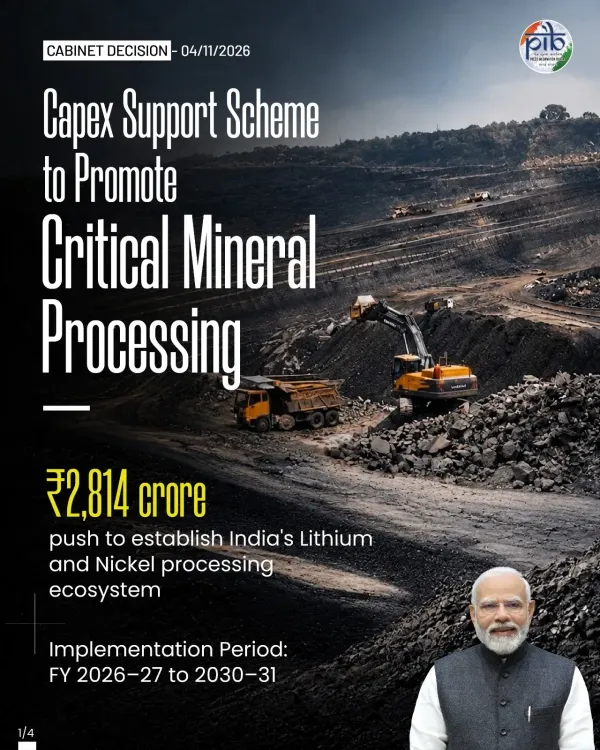
The Union Cabinet has approved a ₹2,814 crore Capex Support Scheme to build domestic critical mineral processing capacity, Union Home Minister Amit Shah announced on November 4, 2026. The scheme targets value addition for the EV, battery, electronics, and defence sectors under India's self-reliance push.
Key Takeaways
The Union Cabinet approved the ₹2,814 crore Capex Support Scheme to Promote Critical Mineral Processing , announced on November 4, 2026 .
The scheme provides capital expenditure support to build domestic processing infrastructure for critical minerals, targeting indigenisation of supply.
Key beneficiary sectors include EVs, batteries, electronics, and defence .
The move builds on the Mines and Minerals Amendment Act 2023 , which first enabled critical mineral block auctions in India.
The scheme closes the gap between upstream mineral auctions and downstream battery and defence manufacturing under the Atmanirbhar Bharat framework.
Progress will hinge on the pace of Ministry of Mines project approvals and greenfield capacity coming online.
India's push to break free from import dependence in the minerals that power electric vehicles, batteries, and defence systems just received a Cabinet-level stamp of approval. Union Home Minister Amit Shah announced on Wednesday, November 4, 2026 that the Union Cabinet has approved the ₹2,814 crore Capex Support Scheme to Promote Critical Mineral Processing — a direct state investment in building domestic capacity to refine and process the minerals India's future economy cannot do without.
What the ₹2,814 crore scheme actually does
The scheme provides capital expenditure support to entities setting up domestic critical mineral processing infrastructure — turning raw or semi-processed ore into refined material usable by industry. The stated aim is to meet India's demand for processed critical minerals indigenously, eliminating the middleman role currently played by a handful of dominant global suppliers. Shah framed the approval as 'a decisive step' that will 'accelerate India's growth by strengthening the EV, battery, electronics and defence sectors through domestic processing and value addition.'
Critical minerals — a category that includes lithium, cobalt, nickel, graphite, and rare earths — sit at the chokepoint of virtually every clean-energy and high-technology supply chain. Countries that can refine them domestically hold enormous strategic leverage. Countries that cannot are exposed to price shocks and geopolitical supply disruptions from concentrated processing hubs, particularly in East Asia.
The policy arc behind the announcement
This approval does not arrive in isolation. The Mines and Minerals (Development and Regulation) Amendment Act, 2023 unlocked auctions of critical mineral blocks in India for the first time, creating the upstream supply that a downstream processing scheme now needs to serve. Before that, the Production Linked Incentive scheme for Advanced Chemistry Cells, launched in 2021, attempted to seed domestic battery manufacturing — but was constrained by India's near-total dependence on imported processed minerals as feedstock.
The Capex scheme is designed to close that gap. By funding the processing layer — the step between mined ore and battery-grade or defence-grade material — the government is building the missing middle of a domestic critical minerals value chain. Under Prime Minister Narendra Modi's Atmanirbhar Bharat framework, this positions India to supply its own EV manufacturers, battery producers, and defence contractors rather than routing that value through third countries.
Why EV, battery, and defence industries are watching closely
India's EV sector is growing rapidly, and battery manufacturers have repeatedly flagged their exposure to volatile global supply chains for processed lithium and cobalt. A domestic processing base would stabilise input costs and reduce lead times. For the defence sector, the strategic calculus is even sharper — several critical minerals are classified materials whose import in a crisis scenario could be restricted by supplier nations.
The immediate next test for the scheme is the pace of project approvals under the Ministry of Mines and whether capital actually flows to greenfield processors within the scheme's operational timeline. Capacity targets and project pipelines are yet to be detailed publicly.
India has the geology, the policy scaffolding, and now the capital commitment. The question is whether the processing plants get built fast enough to match the demand curve that is already accelerating.
Point of View
But processing, where global leverage actually resides. By funding the refining layer, the Modi government is attempting to convert geological assets into strategic independence rather than exporting raw ore and reimporting value-added material at a premium. The timing, following the 2023 mineral block auction framework, suggests a sequenced industrial policy rather than a one-off announcement. Whether the scheme delivers will depend on execution speed and private sector appetite for capital-intensive, long-gestation processing plants — a track record India is still building.
NationPress
4 Nov 2026
Frequently Asked Questions
What is the Capex Support Scheme for Critical Mineral Processing?
It is a ₹2,814 crore government scheme approved by the Union Cabinet to provide capital expenditure support for setting up domestic critical mineral processing facilities in India, reducing dependence on imports.
Which sectors will benefit from the critical mineral processing scheme?
The scheme primarily targets the electric vehicle, battery, electronics, and defence sectors , all of which depend heavily on processed critical minerals such as lithium, cobalt, and rare earths.
How does this scheme relate to India's Atmanirbhar Bharat policy?
The scheme is a direct extension of Atmanirbhar Bharat , aiming to build an end-to-end domestic value chain for critical minerals so India can supply its own strategic and clean-energy industries without relying on a small number of global processing hubs.
What earlier policy steps laid the ground for this scheme?
The Mines and Minerals (Development and Regulation) Amendment Act, 2023 first enabled auctions of critical mineral blocks in India, while the Production Linked Incentive scheme for Advanced Chemistry Cells (2021) sought to promote domestic battery manufacturing — both upstream and downstream pillars that this processing scheme now connects.
Who announced the Cabinet approval of the critical minerals scheme?
Union Home Minister Amit Shah announced the Cabinet's approval on November 4, 2026 , posting the details on his official X account.