CM Bhajanlal Calls on Rajasthan's Public to Lead Water Conservation Drive
Synopsis
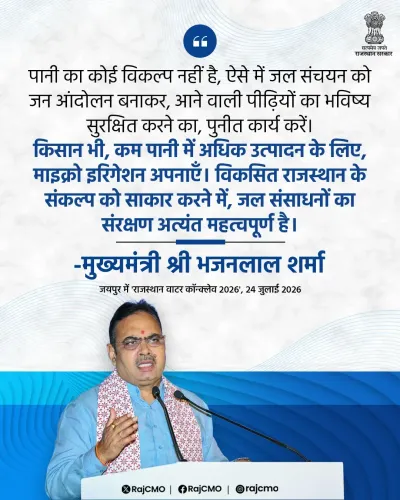
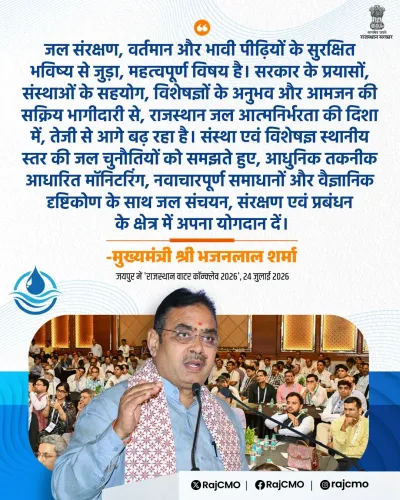
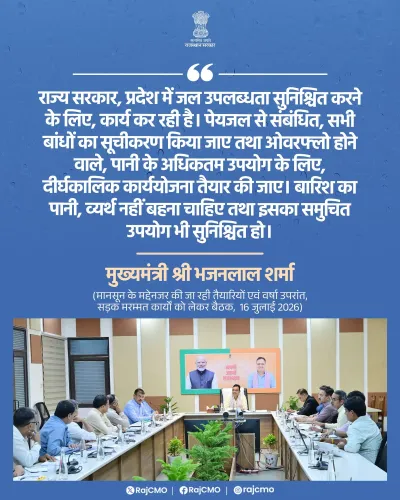
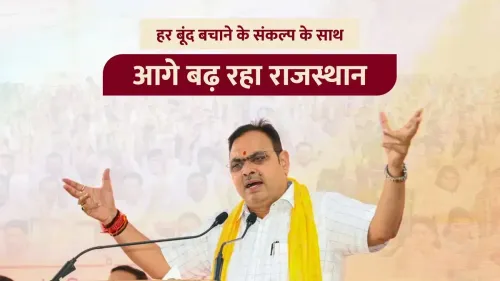
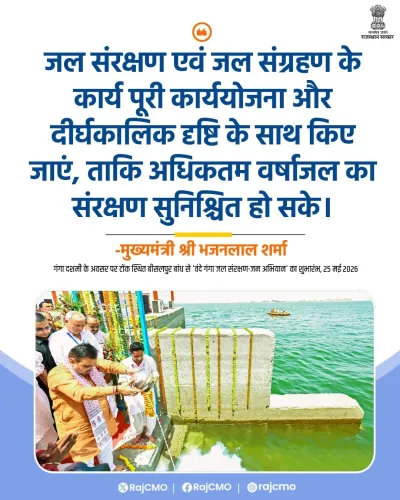
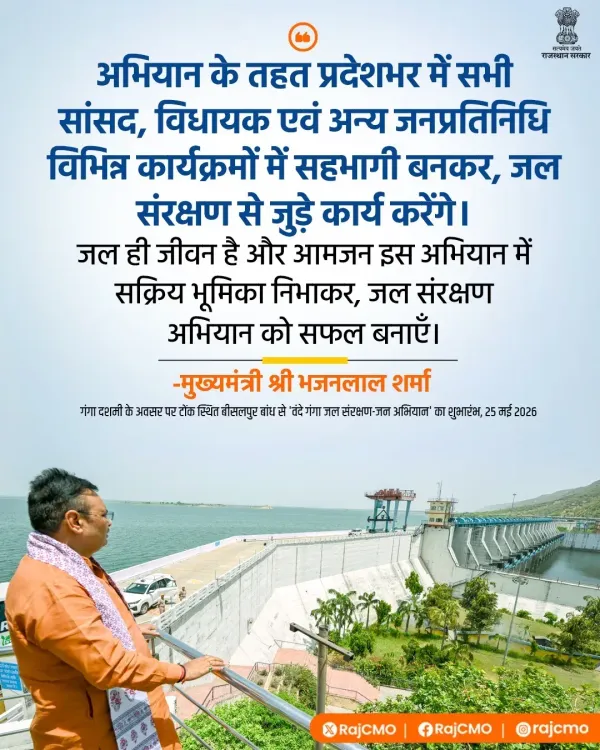
The Chief Minister's Office of Rajasthan, citing Chief Minister Bhajan Lal Sharma, has called on citizens to actively drive a water conservation campaign, invoking the principle that water is life and urging public participation to make the initiative a success ahead of Monsoon 2026.
Key Takeaways
The Chief Minister's Office of Rajasthan posted a public appeal on 26 May 2026 urging citizens to actively participate in a water conservation campaign.
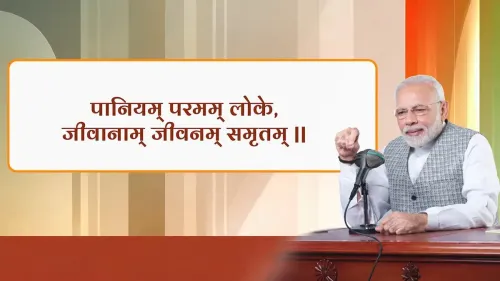
Chief Minister Bhajan Lal Sharma anchored the message with the principle 'Jal hi jeevan hai' — 'Water is life.' Rajasthan is India's largest state by area and among its most water-stressed, making pre-monsoon conservation mobilisation a critical annual priority.
The state's water conservation policy architecture includes the Mukhya Mantri Jal Swavalamban Abhiyan (2016), the Jal Shakti Abhiyan (2019), and the Atal Bhujal Yojana (2020).
The appeal targets farmers, rural households , and water-stressed communities as primary stakeholders in the campaign.
District-level targets and budgetary allocations linked to the campaign are expected to be announced as Monsoon 2026 approaches.
The Chief Minister's Office of Rajasthan on Tuesday, 26 May 2026, issued a public appeal in the name of Chief Minister Bhajan Lal Sharma, urging citizens across the state to take an active role in a water conservation campaign, underscoring the message that water is the foundation of life.
The post, shared at 9:00 AM IST, carried the Hindi message 'Jal hi jeevan hai' ('Water is life'), calling on ordinary people — aamjan — to participate actively and make the water conservation drive a success. The hashtag #AapnoAgraniRajasthan ('Our Leading Rajasthan') framed the appeal within the BJP government's broader state-development narrative.
Context
Rajasthan is India's largest state by area and one of its most water-stressed, with vast arid and semi-arid zones that depend heavily on monsoon rains and traditional water bodies. Groundwater levels in several districts have declined sharply over decades, making pre-monsoon conservation mobilisation a recurring priority for state administrations. The timing of the appeal — weeks ahead of the 2026 southwest monsoon — aligns with the critical window for preparing rainwater harvesting structures and recharge pits.
Policy Backdrop
Rajasthan has a layered architecture of water conservation programmes. The Mukhya Mantri Jal Swavalamban Abhiyan, launched in 2016, anchored community participation in watershed development and village-level water self-reliance through works converged with MGNREGA. At the national level, the Jal Shakti Abhiyan, initiated in 2019, brought focused campaigns to water-stressed districts across the country, with Rajasthan among the most active participating states.
The Atal Bhujal Yojana, rolled out from 2020 in select Rajasthan blocks, added a panchayat-level groundwater management layer, reinforcing the state's tradition of combining classical structures — johads and talabs — with modern watershed science. Chief Minister Bhajan Lal Sharma, who took office in December 2023, has continued this convergence approach, situating water security within the BJP government's development agenda.
Stakeholders and Impact
The appeal directly targets farmers, rural households, and water-stressed communities — the constituencies most exposed to seasonal water scarcity in Rajasthan's western and central districts. Community-driven conservation works, when mobilised before the monsoon, can significantly improve groundwater recharge and reduce dependence on tanker supply during lean months. The call for aamjan participation signals an intent to build public ownership of the campaign rather than treating it as a purely administrative exercise.
Urban residents and local self-government bodies are also implicitly addressed, as rooftop rainwater harvesting and urban lake rejuvenation have featured in recent state conservation drives.
What's Next
Attention will now turn to whether the government follows the social-media appeal with district-level targets, fresh budgetary allocations, or convergence orders linking the campaign to existing scheme funds. Monsoon 2026 preparedness assessments and any formal launch events tied to the water conservation drive will be closely watched by civil society groups and panchayati raj institutions working on water security across Rajasthan. The government's ability to translate public mobilisation into measurable outcomes — such as the number of water structures built or recharged — will determine the campaign's lasting impact.
Point of View
The messaging attempts to shift accountability onto communities, which can be both empowering and a way of softening expectations around state delivery. The hashtag #AapnoAgraniRajasthan ties the water drive to a broader brand of competitive state development that the Sharma government has cultivated since December 2023. Whether this translates into measurable outcomes will hinge on follow-through with district-level targets and convergence funding — the gap between social-media campaigns and on-ground impact has been a persistent critique of water conservation drives in the state.
NationPress
20 Sept 2026
Frequently Asked Questions
What is the water conservation campaign launched by Rajasthan CM Bhajan Lal Sharma?
The Chief Minister's Office of Rajasthan has called on citizens to actively participate in a water conservation campaign, framed around the message that 'water is life.' The campaign builds on existing state schemes such as the Mukhya Mantri Jal Swavalamban Abhiyan and aligns with the central government's Jal Shakti Abhiyan.
What is the Mukhya Mantri Jal Swavalamban Abhiyan in Rajasthan?
The Mukhya Mantri Jal Swavalamban Abhiyan is a Rajasthan state scheme launched in 2016 to promote rainwater harvesting, watershed development, and village-level water self-reliance through community works, often converged with MGNREGA funding.
Why is water conservation so important for Rajasthan?
Rajasthan is India's largest state by area and covers vast arid and semi-arid zones, making it highly dependent on monsoon rains. Decades of groundwater decline and recurrent drought have made water conservation a critical policy priority for successive state governments.
What is the Jal Shakti Abhiyan and how does it relate to Rajasthan?
The Jal Shakti Abhiyan is a central government campaign launched in 2019 targeting water-stressed districts across India. Rajasthan, with its large number of water-stressed areas, has been one of the most actively involved states in the campaign.
Who is Bhajan Lal Sharma and when did he become Chief Minister of Rajasthan?
Bhajan Lal Sharma is the Chief Minister of Rajasthan, representing the BJP. He assumed office in December 2023 and has continued the state's layered approach to water conservation, linking it to his government's broader development agenda.