Rajasthan CM Office: 1,686 km Optical Fibre Network Expanded
Synopsis
Rajasthan's Chief Minister's Office announced the expansion of 1,686 kilometres of optical fibre network connecting thousands of government buildings, marking eleven years of the Digital India programme and signalling the state's push for stronger e-governance infrastructure ahead of NCeG2026.
Key Takeaways
1,686 kilometres of optical fibre network has been expanded across Rajasthan , according to the Chief Minister's Office.
The expansion connects thousands of government buildings to high-speed fibre infrastructure.
The announcement was made on 2 July 2026 , marking 11 years of the Digital India programme launched in July 2015.
Chief Minister Bhajanlal Sharma , in office since December 2023 , was tagged in the official post, underlining the state government's ownership of the initiative.
The post referenced NCeG2026 , the national e-governance conference, positioning Rajasthan's progress within the broader national digital governance agenda.
The expansion aligns with the BharatNet framework for central-state collaboration on last-mile optical fibre connectivity.
The Chief Minister's Office of Rajasthan announced on 2 July 2026 that the state has expanded its optical fibre network by 1,686 kilometres, connecting thousands of government buildings as part of efforts to strengthen digital infrastructure. The post, shared on the occasion of #11YearsOfDigitalIndia, also tagged Chief Minister Bhajanlal Sharma and referenced the upcoming NCeG2026 national e-governance conference.
Context
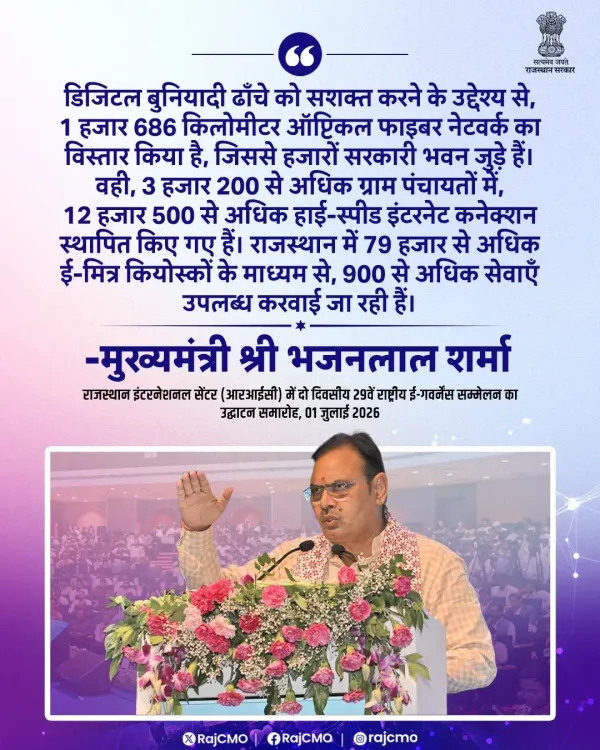
The official post stated: 'डिजिटल बुनियादी ढाँचे को सशक्त करने के उद्देश्य से, 1 हजार 686 किलोमीटर ऑप्टिकल फाइबर नेटवर्क का विस्तार किया है जिससे हजारों सरकारी भवन जुड़े हैं' ('With the aim of strengthening digital infrastructure, 1,686 kilometres of optical fibre network has been expanded, connecting thousands of government buildings'). The announcement was timed to mark eleven years of the Digital India programme, which was launched in July 2015 by the central government.
Rajasthan has been among the states actively reporting incremental additions to its fibre network under the broader national framework. The state's participation aligns with periodic milestones that state administrations highlight ahead of national e-governance events.
Policy Backdrop
The Digital India programme, launched in 2015, identified digital infrastructure as one of its three core pillars, aiming to deliver high-speed broadband and enable paperless governance across the country. Complementing this, the BharatNet project — initiated in 2011 and renamed in 2015 — laid optical fibre to gram panchayats, with state governments responsible for augmenting last-mile connectivity to public institutions.
Rajasthan has been executing its share of this central-state collaborative model, with the 1,686-km expansion representing the state's reported contribution to connecting government offices to high-speed fibre links. Such incremental reporting forms a recurring pattern across states as they demonstrate compliance with and progress under national digital mandates.
Stakeholders and Impact
The primary beneficiaries of the expanded network are state government offices and public buildings now linked to the fibre backbone, enabling faster, more reliable internet connectivity for administrative functions. Citizens interacting with government services — including e-governance portals, digital documentation, and online grievance systems — stand to benefit from the improved back-end infrastructure.
For Chief Minister Bhajanlal Sharma, who has been in office since December 2023, the announcement serves as a visible marker of the state administration's digital governance agenda. The reference to NCeG2026 suggests Rajasthan is positioning this expansion as part of its contribution to the national e-governance dialogue.
What's Next
Attention will now turn to how the newly connected government buildings integrate with central e-governance portals and whether the fibre links translate into measurable improvements in service delivery. Further state reports are expected on the remaining government buildings yet to be connected and the pace of last-mile rollout to rural administrative units.
The NCeG2026 conference is likely to serve as a platform where states including Rajasthan present their digital infrastructure progress. Outcome documents and policy commitments emerging from that event will indicate the next phase of targets for states under the Digital India framework.
Point of View
686-km optical fibre expansion, timed to the eleventh anniversary of Digital India, is a textbook example of how state governments use national milestones to surface incremental infrastructure progress. For Chief Minister Bhajanlal Sharma, it reinforces a governance narrative centred on digital delivery — a priority the BJP has consistently foregrounded at both the central and state levels. The reference to NCeG2026 signals that Rajasthan is keen to be seen as an active participant in the national e-governance conversation, not merely a passive recipient of central mandates. Whether the fibre additions translate into citizen-facing service improvements will be the more consequential metric to watch.
NationPress
2 Jul 2026
Frequently Asked Questions
How much optical fibre network has Rajasthan expanded?
Rajasthan has expanded its optical fibre network by 1,686 kilometres , according to an announcement by the Chief Minister's Office on 2 July 2026.
What is the Digital India programme and when was it launched?
Digital India is a national programme launched in July 2015 to deliver high-speed broadband, digital infrastructure, and e-governance services across India. The Rajasthan announcement marked its eleventh anniversary.
What is BharatNet and how is Rajasthan connected to it?
BharatNet is a central government project initiated in 2011 to lay optical fibre to gram panchayats. Rajasthan has been expanding its own fibre network in alignment with this central-state collaborative framework.
Who is the Chief Minister of Rajasthan in 2026?
Bhajanlal Sharma of the BJP has been the Chief Minister of Rajasthan since December 2023 and was tagged in the CMO's digital infrastructure post.