CM Bhajan Lal Pushes Digital Infrastructure for Viksit Rajasthan 2047
Synopsis
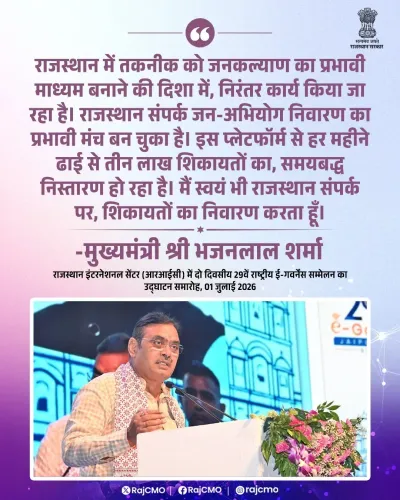
The Chief Minister's Office of Rajasthan on 2 July 2026 announced the state is building digital infrastructure to fulfil the Viksit Bharat – Viksit Rajasthan 2047 vision under PM Modi, coinciding with eleven years of the Digital India programme and the upcoming NCeG2026 conference.
Key Takeaways
The Rajasthan CMO on 2 July 2026 announced active development of digital infrastructure in the state.
The effort is framed under the Viksit Bharat – Viksit Rajasthan 2047 vision led by PM Narendra Modi .
The post marks 11 years of the Digital India programme , launched in July 2015 .
Chief Minister Bhajan Lal Sharma is the state-level face of this digital governance push.
The announcement is timed ahead of the National Conference on e-Governance 2026 (NCeG2026) .
Rajasthan citizens and state departments are the primary stakeholders expected to benefit from improved digital service delivery.
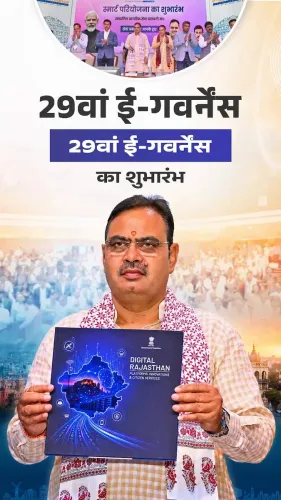
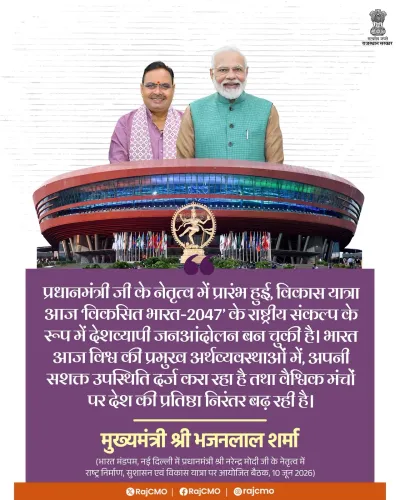
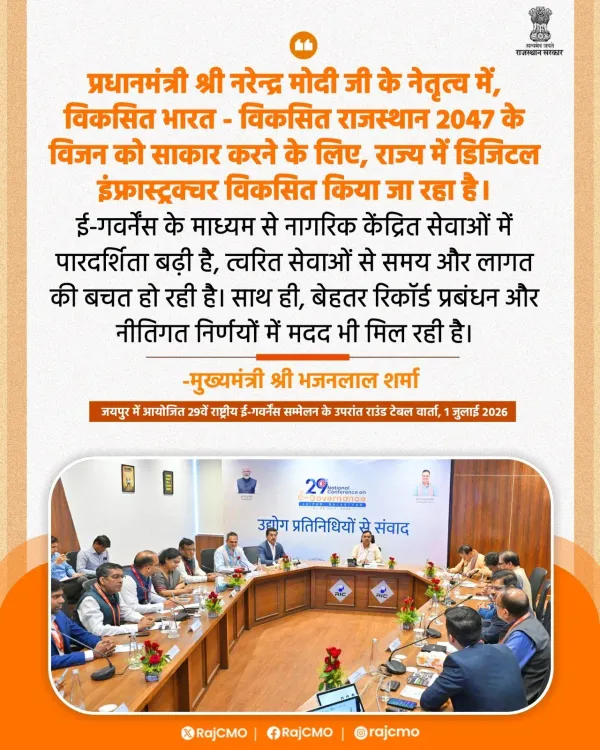
The Chief Minister's Office of Rajasthan on 2 July 2026 highlighted the state government's push to build digital infrastructure across Rajasthan, framing the effort as part of the Viksit Bharat – Viksit Rajasthan 2047 vision under the leadership of Prime Minister Narendra Modi. The post, shared ahead of the National Conference on e-Governance 2026 (NCeG2026), signals the state's alignment with the decade-long Digital India programme.
Context
The CMO's post, written in Hindi, states: 'Pradhan Mantri Shri Narendra Modi ji ke netritva mein, Viksit Bharat – Viksit Rajasthan 2047 ke vision ko sakar karne ke liye, rajya mein digital infrastructure viksit kiya ja raha hai' — translating to: 'Under the leadership of Prime Minister Shri Narendra Modi, digital infrastructure is being developed in the state to realise the vision of Viksit Bharat – Viksit Rajasthan 2047.' The post tags Chief Minister Bhajan Lal Sharma and carries the hashtags #11YearsOfDigitalIndia and #NCeG2026.
The #11YearsOfDigitalIndia hashtag marks the completion of eleven years since the Digital India programme was launched in July 2015, a flagship initiative of the central government aimed at building nationwide digital infrastructure, expanding e-services, and promoting digital literacy.
Policy Backdrop
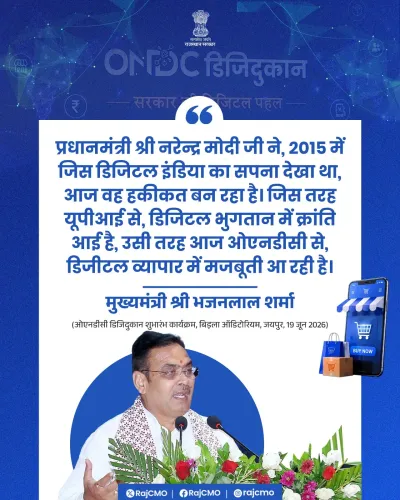
Digital India, launched under Prime Minister Modi in 2015, has since underpinned a sweeping expansion of digital public infrastructure — encompassing Aadhaar, UPI, DigiLocker, and state-level data centres. States across the country have been directed to localise these national technology stacks within their own e-governance architectures.
Rajasthan has progressively integrated these platforms into its administrative systems. The Viksit Bharat 2047 vision — a long-term national target for India to achieve developed-economy status by the centenary of independence — has been adopted by states including Rajasthan as a framework for planning investments in infrastructure, governance, and public services.
Stakeholders and Impact
The primary beneficiaries of an expanded digital infrastructure in Rajasthan are the state's citizens, who stand to gain faster, more accessible government services through digital channels. State government departments are simultaneously expected to improve administrative efficiency and reduce dependence on paper-based processes.
Chief Minister Bhajan Lal Sharma, who represents the BJP and has aligned the state's governance agenda closely with central government priorities, is the political face of this implementation effort. The NCeG2026 conference provides a national platform for Rajasthan to showcase its digital governance progress alongside other states.
What's Next
Attention will now turn to concrete project timelines and state budget allocations earmarked for digital infrastructure in Rajasthan, particularly those announced in the lead-up to or at the NCeG2026 conference. The conference is expected to serve as a key milestone for states to present e-governance achievements and roadmaps aligned with the 2047 target.
As the Digital India programme enters its second decade, Rajasthan's ability to translate policy announcements into measurable on-ground outcomes — in connectivity, service delivery, and digital literacy — will determine how effectively the state advances the Viksit Rajasthan 2047 agenda.
Point of View
The 'Viksit Bharat 2047' arc that the BJP has made central to its long-term electoral identity. By invoking PM Modi's leadership and the Digital India anniversary simultaneously, the communication serves a dual purpose: reinforcing the BJP's continuity narrative at the centre while positioning CM Bhajan Lal Sharma as a credible implementer at the state level. The NCeG2026 hashtag suggests the government is building a visible record of digital governance ahead of a national platform, where inter-state comparisons will be unavoidable. The real test will be whether Rajasthan's infrastructure announcements translate into verifiable metrics — broadband penetration, service delivery timelines, and digital literacy rates — before the 2047 horizon.
NationPress
30 Sept 2026
Frequently Asked Questions
What is the Viksit Rajasthan 2047 vision?
Viksit Rajasthan 2047 is Rajasthan's state-level adoption of the national 'Viksit Bharat 2047' goal, which aims for India to become a developed economy by 2047 — the centenary of independence. Rajasthan has aligned its infrastructure and governance plans, including digital development, with this long-term target.
What is Digital India and how many years old is it?
Digital India is a flagship national programme launched in July 2015 by PM Narendra Modi to build digital infrastructure, expand e-governance services, and promote digital literacy across India. As of July 2026, the programme has completed eleven years.
What is Rajasthan doing for digital infrastructure?
According to the Chief Minister's Office of Rajasthan, the state is actively developing digital infrastructure as part of the Viksit Bharat – Viksit Rajasthan 2047 vision. This includes integrating national digital platforms such as Aadhaar, UPI, and DigiLocker into the state's e-governance architecture.
Who is Bhajan Lal Sharma?
Bhajan Lal Sharma is the Chief Minister of Rajasthan representing the BJP. He is responsible for implementing central government digital and development schemes at the state level and has aligned Rajasthan's governance agenda with the Viksit Bharat 2047 framework.