Rajasthan CM Office Backs Railways as Key to Viksit Bharat 2047
Synopsis
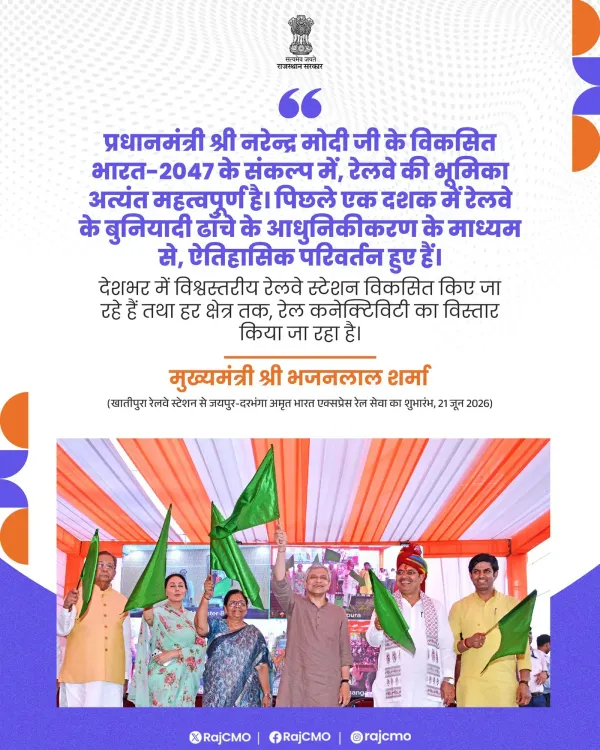
The Rajasthan Chief Minister's Office on 22 June 2026 posted that Indian Railways is 'extremely important' to PM Modi's Viksit Bharat 2047 vision, tagging CM Bhajan Lal Sharma and signalling the state's alignment with the Centre's long-term infrastructure roadmap.
Key Takeaways
The Rajasthan CMO posted on 22 June 2026 emphasising railways as central to Viksit Bharat 2047 .
Viksit Bharat 2047 is PM Modi 's national development framework targeting milestones by India's centenary of independence.
The National Rail Plan 2030 , released in 2021 , underpins the railway modernisation agenda linked to this vision.
Rajasthan is served by segments of the Western Dedicated Freight Corridor , a flagship rail logistics project.
CM Bhajan Lal Sharma was tagged in the post, signalling direct state leadership alignment with the Centre's infrastructure push.
The hashtag #आपणो_अग्रणी_राजस्थान ('Our Leading Rajasthan') frames the state as a proactive development partner.
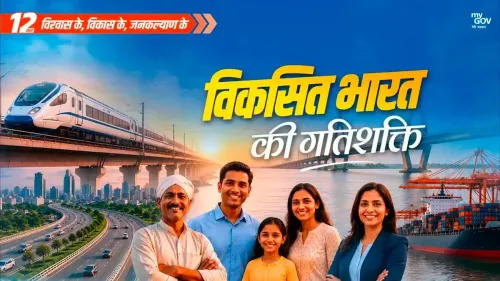
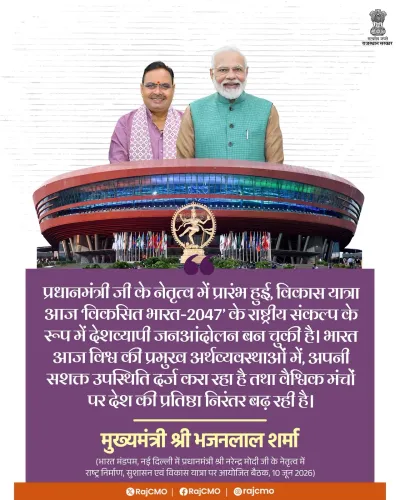
The Chief Minister's Office of Rajasthan on Monday, 22 June 2026 underscored the central role of Indian Railways in realising Prime Minister Narendra Modi's Viksit Bharat 2047 vision, tagging Chief Minister Bhajan Lal Sharma in a post that aligns the state's infrastructure agenda with the national development roadmap.
The post, shared under the hashtag #आपणो_अग्रणी_राजस्थान ('Our Leading Rajasthan'), stated: 'In Prime Minister Narendra Modi's resolve for a Developed India by 2047, the role of railways is extremely important.' The message is a clear signal from the state's ruling establishment that Rajasthan intends to position itself as a proactive partner in the Centre's long-term infrastructure push.
Context
Viksit Bharat 2047 is a national development framework articulated by Prime Minister Modi, targeting economic and infrastructure milestones by the centenary of India's independence. The vision was prominently outlined during the 2023 Independence Day address and has since become a recurring reference point for both central ministries and state governments seeking to frame local projects within a pan-India narrative. Railways occupy a structural position in this framework. The National Rail Plan 2030, released in 2021, laid out a blueprint for capacity expansion, freight corridor development, and passenger network modernisation — all of which feed directly into the broader Viksit Bharat targets.Policy Backdrop
Indian Railways has been a consistent centrepiece of the Centre's infrastructure investment cycle. Rajasthan is directly served by segments of the Western Dedicated Freight Corridor, a flagship project designed to decongest rail lines and cut logistics costs for industry. Station redevelopment, new lines, and electrification drives have all been integrated into the state's rail agenda under the BJP government led by CM Bhajan Lal Sharma. The hashtag #आपणो_अग्रणी_राजस्थान — a Rajasthani-language phrase meaning 'Our Leading Rajasthan' — is a recurring brand used by the Rajasthan CMO to signal the state's ambition to lead on development indicators, echoing the Centre's competitive federalism approach to infrastructure delivery.Stakeholders and Impact
For Rajasthan's residents, rail connectivity carries outsized significance. The state is geographically large with dispersed population centres, making railways critical for passenger mobility, agricultural freight, and industrial logistics. Ongoing and planned rail investments — from new lines in underserved districts to freight corridor linkages — have direct implications for employment, trade, and regional economic integration. The BJP's political calculus is also visible: by aligning state messaging tightly with PM Modi's flagship vision, the CM Sharma administration reinforces its credentials as a reliable delivery arm of the national government's infrastructure agenda ahead of future electoral cycles.What's Next
Attention will now turn to the progress of Western Dedicated Freight Corridor segments passing through Rajasthan, as well as any new rail projects or allocations announced in the next Union Railway Budget. How effectively the state translates this rhetorical alignment into on-ground project execution will determine whether Rajasthan can credibly claim the 'leading' tag its government is promoting. Faster clearances for land acquisition and inter-departmental coordination will be the operational test of this stated commitment.Point of View
The messaging serves a dual purpose: it keeps the state visible in the Centre's infrastructure priority queue while reinforcing the BJP's national-state policy coherence narrative. The railway focus is strategically sound given Rajasthan's geographic scale and the freight corridor investments already under way. The real test, however, lies in project delivery timelines rather than alignment rhetoric.
NationPress
22 Jun 2026
Frequently Asked Questions
What is Viksit Bharat 2047?
Viksit Bharat 2047 is Prime Minister Narendra Modi's national development vision targeting economic and infrastructure milestones by 2047, the centenary of India's independence. It was prominently outlined during the 2023 Independence Day address.
What did the Rajasthan CMO post about railways?
The Rajasthan Chief Minister's Office posted on 22 June 2026 that 'the role of railways is extremely important' in PM Modi's Viksit Bharat 2047 vision, tagging CM Bhajan Lal Sharma.
What is the Western Dedicated Freight Corridor and how does it affect Rajasthan?
The Western Dedicated Freight Corridor is a flagship rail infrastructure project designed to decongest mainline tracks and reduce logistics costs. Segments of the corridor pass through Rajasthan, directly benefiting the state's industrial and agricultural freight movement.
Who is Bhajan Lal Sharma?
Bhajan Lal Sharma is the Chief Minister of Rajasthan and a BJP leader. He was tagged in the CMO's post aligning the state's infrastructure priorities with the Centre's Viksit Bharat 2047 framework.
What is the National Rail Plan 2030?
The National Rail Plan 2030 is a blueprint released in 2021 by the Indian government to guide railway capacity expansion, freight corridor development, and passenger network modernisation through the year 2030, supporting broader national development goals.