Rajasthan CM Bhajan Lal Sharma pitches $350-billion economy, unveils Viksit Rajasthan-2047 at NITI Aayog
Synopsis
At the NITI Aayog Governing Council, Rajasthan CM Bhajan Lal Sharma unveiled a sweeping 'Viksit Rajasthan-2047' plan targeting a $350-billion economy by 2029. With ₹35 lakh crore in signed MoUs, a 10.24% GSDP growth rate, and national rankings in farm insurance and solar energy, Rajasthan is positioning itself as one of India's most ambitious state-level growth stories.
Key Takeaways
Rajasthan CM Bhajan Lal Sharma presented the 'Viksit Rajasthan-2047' roadmap at the 11th NITI Aayog Governing Council meeting on 11 June in New Delhi.
The state targets a $350-billion economy by 2029 , supported by a GSDP growth rate of 10.24 per cent .
Investment MoUs worth more than ₹35 lakh crore signed; groundbreaking completed for projects exceeding ₹9 lakh crore .
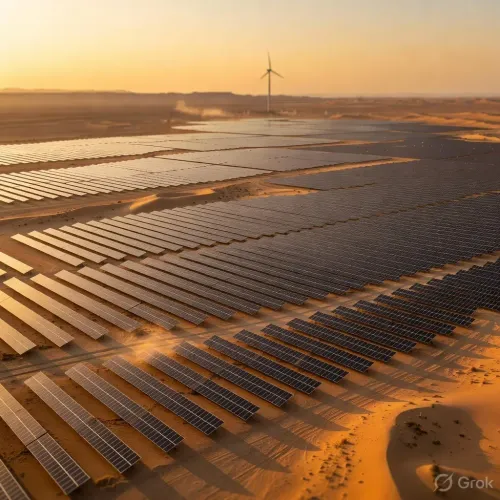
Rajasthan ranks first nationally under PM Fasal Bima Yojana ( 2.19 crore policies ) and PM-KUSUM Component-A ( 723 MW solar capacity).
The Sampark Portal has halved grievance redressal time from 28 days to 14 days , with over 98 per cent resolution rate.
State has planted nearly 20 crore saplings toward a 50-crore target over five years.
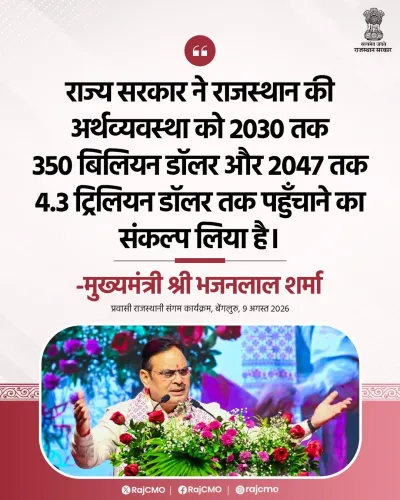
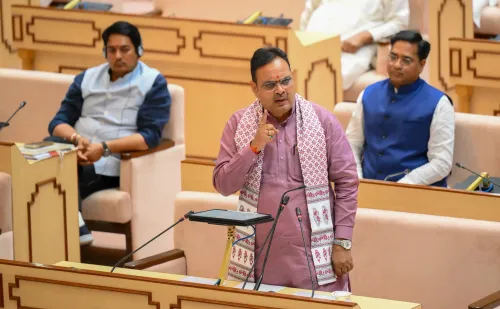
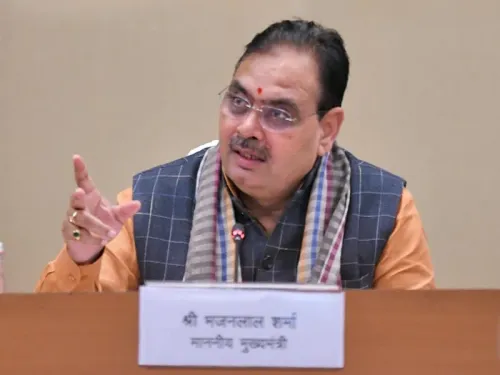
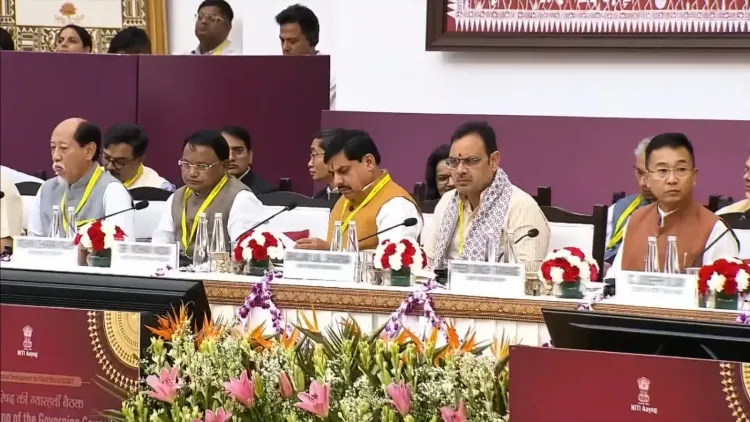
Rajasthan Chief Minister Bhajan Lal Sharma on Thursday, 11 June presented the state's comprehensive development blueprint at the 11th NITI Aayog Governing Council meeting chaired by Prime Minister Narendra Modi at Rashtrapati Bhavan in New Delhi. Sharma outlined the 'Viksit Rajasthan-2047' roadmap, anchored by a target to build Rajasthan into a $350-billion economy by 2029, backed by a current GSDP growth rate of 10.24 per cent.
Key Targets and Economic Ambitions
At the heart of Sharma's presentation was Rajasthan's investment momentum. The state has signed investment MoUs worth more than ₹35 lakh crore, with groundbreaking ceremonies already completed for projects exceeding ₹9 lakh crore. A modern 9 MMTPA refinery has been described by the Chief Minister as a 'landmark step in Rajasthan's industrial transformation.' The state has also introduced more than 35 new policies to foster an investor-friendly ecosystem and accelerate industrial growth.
Youth, Skills and Employment
Sharma highlighted that nearly 63 per cent of Rajasthan's population comprises youth, positioning them as the primary engine of future growth. The state ranks second nationally under Prime Minister Modi's 'My Bharat' initiative, with 18 lakh registered youth participants. Rajasthan has aligned its Skill Policy, Youth Policy and Employment Policy with national programmes including the Skill India Mission and Pradhan Mantri Kaushal Vikas Yojana. Additional employment avenues are being created through cooperative development, dairy expansion and the One District-One Product programme.
Agriculture, Farmers and Women-Led Growth
The Chief Minister stated that the government is committed to transforming farmers from 'Annadata' to 'Urjadata' and entrepreneurs. Rajasthan ranks first nationally under the Pradhan Mantri Fasal Bima Yojana, with 2.19 crore insurance policies issued, and also leads the country under PM-KUSUM Component-A, with 496 solar projects totalling a combined capacity of 723 MW established. On women's empowerment, Sharma cited schemes such as Lakhpati Didi and Drone Didi as vehicles for economic self-reliance. Rajasthan has topped the country for two consecutive years under the Pradhan Mantri Poshan Yojana and ranks second under the Pradhan Mantri Matru Vandana Yojana.
Governance, Grievance Redressal and Infrastructure
Sharma outlined governance innovations inspired by the Centre's PRAGATI platform. Through the state's 'Raj Unnati' platform, 42 major projects worth more than ₹2 lakh crore are being monitored in real time. The Sampark Portal has cut the average grievance redressal period from 28 days to 14 days, with more than 98 per cent of complaints resolved. The Chief Minister also noted that Neemrana Block secured second position nationally in NITI Aayog's Aspirational Blocks Programme rankings for Q3 of 2025-26. Gram Vikas Raths reached nearly two crore people, including 51 lakh direct participants, to raise awareness of welfare schemes.
Heritage, Environment and Water Conservation
On cultural preservation, Sharma highlighted the Shekhawati Haveli Conservation Scheme, under which more than 660 heritage havelis in Jhunjhunu, Churu and Sikar districts are being developed as tourism units. The state has set a target of planting 50 crore saplings over five years, with nearly 20 crore already planted under the 'Ek Ped Maa Ke Naam' campaign. Water conservation drives — 'Catch the Rain', 'Jal Sanchay Janbhagidari' and 'Karmabhumi se Matrubhumi' — are also reporting measurable results across the state.
Sharma concluded by reaffirming that Rajasthan's development trajectory is aligned with India's broader goal of becoming a developed nation by 2047, with inclusive growth and accountable governance as its twin pillars. The state's next milestones will be closely watched as groundbreaking projects move from MoU to execution.
Point of View
But only ₹9 lakh crore has reached groundbreaking, and actual capital deployed will be a fraction of even that. Rajasthan's genuine bright spots — leading ranks in crop insurance uptake and solar deployment under PM-KUSUM — suggest execution capacity exists in agri-linked programmes. The real test for 'Viksit Rajasthan-2047' is whether industrial investment translates into durable employment, or whether the state repeats the pattern of impressive summits followed by sluggish absorption.
NationPress
23 Sept 2026
Frequently Asked Questions
What is the 'Viksit Rajasthan-2047' blueprint?
'Viksit Rajasthan-2047' is Rajasthan's long-term development roadmap presented by Chief Minister Bhajan Lal Sharma at the NITI Aayog Governing Council on 11 June. It outlines the state's strategy across investment, agriculture, youth employment, women's empowerment and governance to align with India's 'Viksit Bharat-2047' goal.
What is Rajasthan's $350-billion economy target?
Chief Minister Sharma has set a target of making Rajasthan a $350-billion economy by 2029, supported by the state's current GSDP growth rate of 10.24 per cent. The state has signed investment MoUs worth more than ₹35 lakh crore to support this ambition.
How is Rajasthan performing under central government schemes?
Rajasthan ranks first nationally under the Pradhan Mantri Fasal Bima Yojana with 2.19 crore insurance policies, and leads under PM-KUSUM Component-A with 496 solar projects totalling 723 MW. The state has also topped the Pradhan Mantri Poshan Yojana rankings for two consecutive years.
What governance reforms has Rajasthan introduced?
Rajasthan has launched the 'Raj Unnati' platform for real-time monitoring of 42 major projects worth over ₹2 lakh crore. The Sampark Portal has reduced grievance redressal time from 28 days to 14 days, with more than 98 per cent of complaints resolved.
Who attended the NITI Aayog Governing Council meeting?
The 11th NITI Aayog Governing Council meeting was chaired by Prime Minister Narendra Modi at Rashtrapati Bhavan in New Delhi on 11 June. Rajasthan Chief Minister Bhajan Lal Sharma was among the state leaders who presented their development vision at the meeting.