CM Bhajan Lal Hails India's 7.7% GDP Growth Under Modi
Synopsis
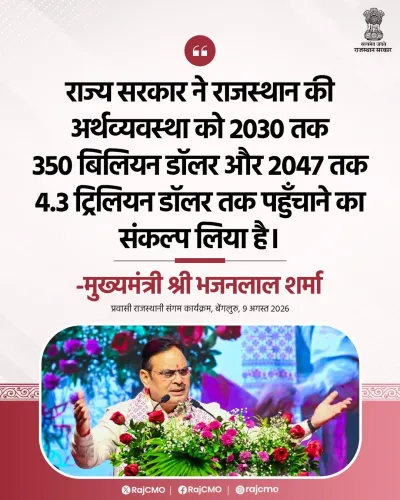
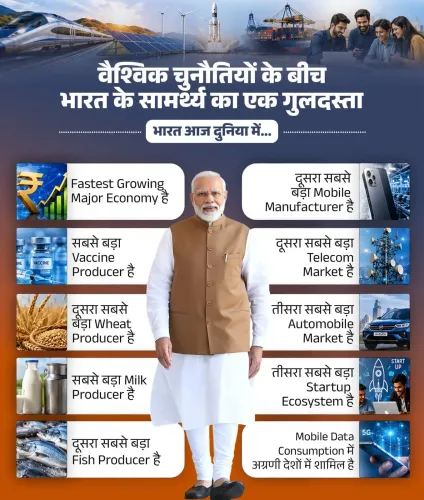
Rajasthan Chief Minister Bhajan Lal Sharma lauded PM Narendra Modi's economic leadership on 5 June 2026, citing India's 7.7% GDP growth for FY 2025-26 and 7.8% in Q4 as proof of the country's rise as a global economic powerhouse under the Viksit Bharat @ 2047 vision.
Key Takeaways
Rajasthan CM Bhajan Lal Sharma credited PM Narendra Modi with driving India's economic growth on 5 June 2026 .
India recorded 7.7% GDP growth for FY 2025-26 and 7.8% in the fourth quarter, as cited in the post.
Sharma invoked the Viksit Bharat @ 2047 vision and Amrit Kaal framework as the overarching goals guiding current reforms.
He highlighted Ease of Living and Ease of Doing Business as twin pillars delivering inclusive development to 140 crore Indians .
India's World Bank ease-of-doing-business rank improved from 142nd in 2014 to 63rd by 2020 under the central reform programme.
Final FY 2025-26 GDP data and the Union Budget 2026-27 will be the next key tests of the government's growth narrative.
Rajasthan Chief Minister Bhajan Lal Sharma on Friday, 5 June 2026 praised Prime Minister Narendra Modi's economic stewardship, citing India's 7.7 per cent GDP growth for FY 2025-26 and a 7.8 per cent expansion in the fourth quarter as evidence of the country's accelerating rise as a global economic force.
Context
Sharma's post, written in Hindi, credits Modi's 'illustrious and far-sighted leadership' — yashasvi evam doordarshi netritva — for establishing what he describes as new dimensions of confidence, innovation and development. He frames the GDP figures not merely as statistics but as 'a reflection of the hard work and collective resolve of 140 crore Indians.'
The statement comes as the Union government prepares the Union Budget 2026-27 and awaits finalised full-year national accounts, making the growth narrative politically significant for the ruling Bharatiya Janata Party (BJP).
Policy Backdrop
Sharma's remarks are anchored in the Viksit Bharat @ 2047 vision — the central government's roadmap to achieve developed-economy status by the centenary of Indian independence. The vision was first prominently outlined in the Union Budget 2022-23 and has since been referenced across multiple Independence Day addresses and state-level policy frameworks.
He specifically invokes two reform pillars: 'Ease of Living', which the government says has simplified daily services for ordinary citizens, and 'Ease of Doing Business', under which India improved its World Bank ranking from 142nd in 2014 to 63rd by 2020. Structural enablers cited in the broader policy record include the nationwide rollout of the Goods and Services Tax in July 2017, the Make in India initiative launched in September 2014, and the Digital India programme from July 2015 that expanded digital public infrastructure and Aadhaar-linked service delivery.
The post also references Amrit Kaal — the 25-year window from 2022 to 2047 framed by the central government as the decisive period for India's transformation into a self-reliant, prosperous nation.
Stakeholders and Impact
The growth narrative directly concerns Indian citizens, the MSME sector, and private investors who watch GDP trajectory as a signal for employment and capital allocation. Sharma argues that reforms and good governance — sudhaaron aur sushasan — have ensured that development benefits reach 'the last person in the queue,' a phrase that echoes the government's inclusive-growth framing.
For Rajasthan, where Sharma's BJP government has aligned state schemes with central programmes, a buoyant national growth figure supports the case for continued infrastructure investment and investor confidence in the state's ongoing reform agenda.
What's Next
The release of final, audited FY 2025-26 GDP data and the tabling of the Union Budget 2026-27 will be the next major markers against which the government's growth claims will be tested. Any new state-level adoption of central ease-of-doing-business or digital-service benchmarks — particularly in large states like Rajasthan — will indicate how far the Viksit Bharat agenda is being operationalised beyond New Delhi. If the final numbers confirm the quarterly trend, India's positioning as the world's fastest-growing major economy is likely to remain a central plank of BJP's political messaging heading into the next electoral cycle.
Point of View
Bridging the gap between headline statistics and voter sentiment. Framing the numbers as a reflection of '140 crore Indians' collective resolve' is a well-tested rhetorical device that nationalises economic success while insulating the party from accusations of elite-centric growth. With the Union Budget 2026-27 approaching, such coordinated messaging from chief ministers is likely to intensify as the BJP seeks to consolidate its economic governance record.
NationPress
14 Sept 2026
Frequently Asked Questions
What GDP growth rate did India record for FY 2025-26 according to Bhajan Lal Sharma's post?
According to the post, India recorded a 7.7% GDP growth rate for the full financial year FY 2025-26 and a 7.8% growth rate in the fourth quarter of that year.
What is Viksit Bharat @ 2047?
Viksit Bharat @ 2047 is the central government's national vision to make India a fully developed economy by 2047, the centenary of Indian independence. It was first prominently outlined in the Union Budget 2022-23 .
How has India's Ease of Doing Business ranking changed under Modi?
India improved its World Bank ease-of-doing-business ranking from 142nd in 2014 to 63rd by 2020 , reflecting regulatory simplification and investment-climate reforms undertaken by the central government.
Why is Rajasthan CM Bhajan Lal Sharma commenting on national GDP data?
As a BJP chief minister , Sharma routinely aligns with and amplifies the central government's policy messaging. His statement connects Rajasthan's state-level reform agenda to the broader national growth story ahead of the Union Budget 2026-27 .