Rajasthan CM Office Forms Panel to Study Pay Scales, 8th Pay Commission
Synopsis
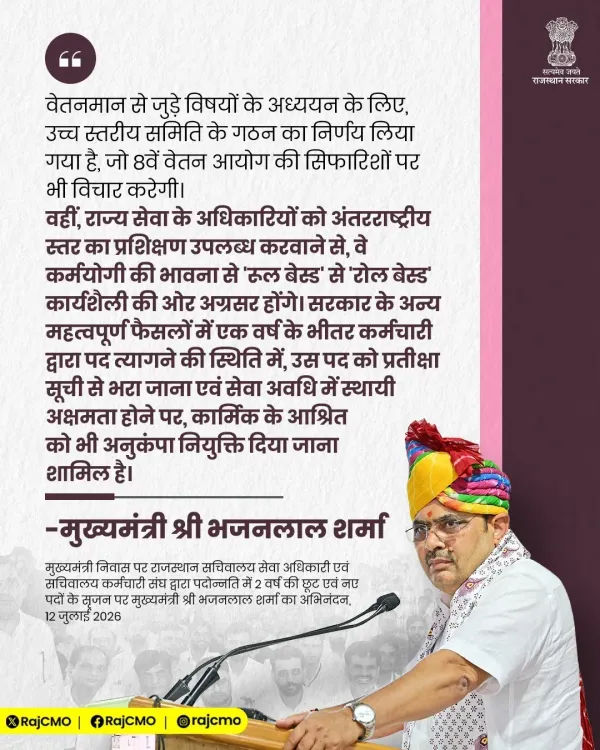
The Chief Minister's Office of Rajasthan has announced the formation of a high-level committee to study pay scale matters for state government employees, with a specific mandate to consider the recommendations of the 8th Pay Commission, signalling a structured approach to salary revision.
Key Takeaways
The Chief Minister's Office of Rajasthan announced on 13 July 2026 the formation of a high-level committee to study pay scale matters.
The committee will specifically consider the recommendations of the 8th Pay Commission .
Chief Minister Bhajanlal Sharma was tagged in the official announcement on X.
The decision follows an established national pattern of states constituting expert panels before adopting central Pay Commission revisions.
Key watchpoints include the committee's composition, its reporting timeline, and the eventual impact on Rajasthan's state budget.
State government employees and state finances are the primary stakeholders of the committee's eventual recommendations.
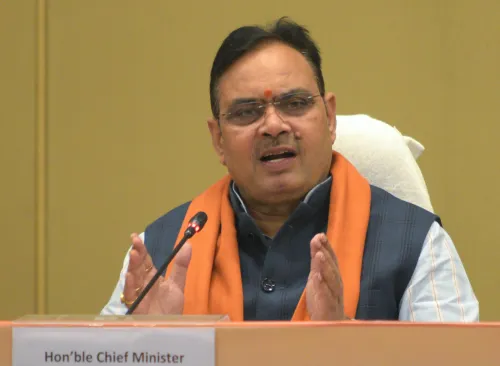
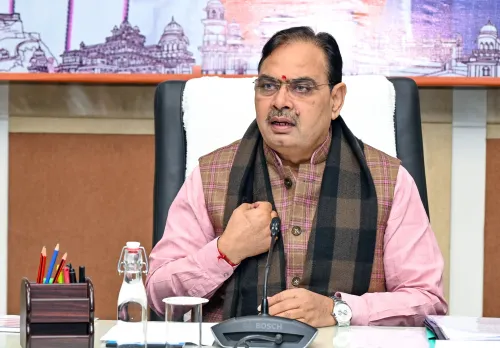
The Chief Minister's Office of Rajasthan announced on Monday, 13 July 2026 that the state government has decided to constitute a high-level committee to study matters related to pay scales, including an examination of the recommendations of the 8th Pay Commission. The announcement was made by the CMO on X, tagging Chief Minister Bhajanlal Sharma and carrying the hashtag #आपणो_अग्रणी_राजस्थान (Our Leading Rajasthan).
Context
The CMO's post stated: 'A decision has been taken to constitute a high-level committee to study matters related to pay scales, which will also consider the recommendations of the 8th Pay Commission.' The announcement signals that the Bhajanlal Sharma-led government is moving proactively to align state employee compensation with evolving central pay structures. The hashtag references the state government's broader governance campaign positioning Rajasthan as a leading, forward-looking state.
Policy Backdrop
Indian states have a well-established practice of forming expert panels after central Pay Commission reports to assess pay parity, inflation adjustments, and fiscal implications before revising their own pay matrices. Rajasthan followed this pattern after the 7th Central Pay Commission, whose recommendations were implemented from January 2016, prompting the state to revise its employee pay structure accordingly. The constitution of a high-level committee at this stage — ahead of any formal state-level adoption — reflects standard fiscal caution, allowing the government to study the financial burden before committing to revised scales.
The committee's mandate to specifically consider 8th Pay Commission recommendations underscores that the state intends to benchmark its revision against the latest central framework rather than proceed independently. This approach has been observed consistently across states following both the 6th and 7th commissions.
Stakeholders and Impact
Rajasthan's state government employees stand as the primary stakeholders of this decision, as the committee's eventual findings will directly shape their revised pay matrices and allowances. State finances are the other key variable — any upward revision in pay scales carries significant fiscal implications for the state budget, making the committee's role in assessing affordability critical. The formation of such a panel is typically welcomed by employee unions as a formal acknowledgement of their pay-related concerns.
What's Next
Attention will now turn to the composition of the high-level committee — specifically whether it will include serving bureaucrats, economists, or retired officials — and the timeline it is given to submit its report. The committee's recommendations will likely feed into future Rajasthan budget announcements or administrative notifications on pay revision. Any interim signals from the government on the scope of the revision or the employee categories covered will be closely watched by state government staff associations.
Point of View
Fiscally cautious posture — signalling responsiveness to employee demands while buying time to assess budgetary headroom. Framing the committee's mandate around the 8th Pay Commission gives the exercise a central-government anchor, lending it institutional credibility and deflecting pressure for an independent, potentially costlier state-level revision. The announcement fits a broader pattern of BJP-governed states using structured committee processes to manage employee expectations in the run-up to budget cycles. The outcome will be a key test of how the relatively new Sharma administration balances welfare commitments with Rajasthan's fiscal constraints.
NationPress
13 Jul 2026
Frequently Asked Questions
Why has Rajasthan formed a high-level committee on pay scales?
The Rajasthan government has constituted a high-level committee to study matters related to pay scales for state employees and to consider the recommendations of the 8th Pay Commission before deciding on any revision to the state's pay structure.
What is the 8th Pay Commission and how does it affect Rajasthan employees?
The 8th Pay Commission is the latest central body tasked with recommending revisions to pay scales for central government employees. States like Rajasthan typically examine its recommendations through their own expert committees before aligning state employee salaries accordingly.
Who is the Chief Minister of Rajasthan in 2026?
Bhajanlal Sharma of the BJP has been serving as the Chief Minister of Rajasthan since December 2023, following the state assembly elections.
What will the Rajasthan pay scale committee do?
The high-level committee will study pay scale-related matters for Rajasthan state government employees and factor in the 8th Pay Commission's recommendations, with its findings expected to inform future budget or administrative decisions on salary revision.
Has Rajasthan done this kind of pay review before?
Yes. Rajasthan has followed a similar process after previous Pay Commissions, including the 7th Central Pay Commission whose recommendations were implemented from January 2016, after which the state revised its own pay matrix for employees.