Rajasthan CMO: 25,000+ CCTV Cameras Deployed in Public Spaces
Synopsis
The Chief Minister's Office of Rajasthan announced on 2 July 2026 that over 25,000 surveillance cameras have been deployed in public spaces and educational institutions across the state, framing the move as a citizen-safety achievement under the Digital India programme's 11th anniversary.
Key Takeaways
The Rajasthan CMO announced the activation of more than 25,000 surveillance cameras in public spaces and educational institutions.
The deployment is framed as a citizen-safety initiative under Chief Minister Bhajanlal Sharma's BJP government, in office since December 2023 .
The announcement was timed to coincide with #11YearsOfDigitalIndia , the national programme launched in 2015 .
The post references NCeG2026 (National Conference on e-Governance 2026), signalling the state's intent to present this initiative on a national platform.
Questions around data governance, oversight, and privacy frameworks for the camera network remain unaddressed in the official announcement.
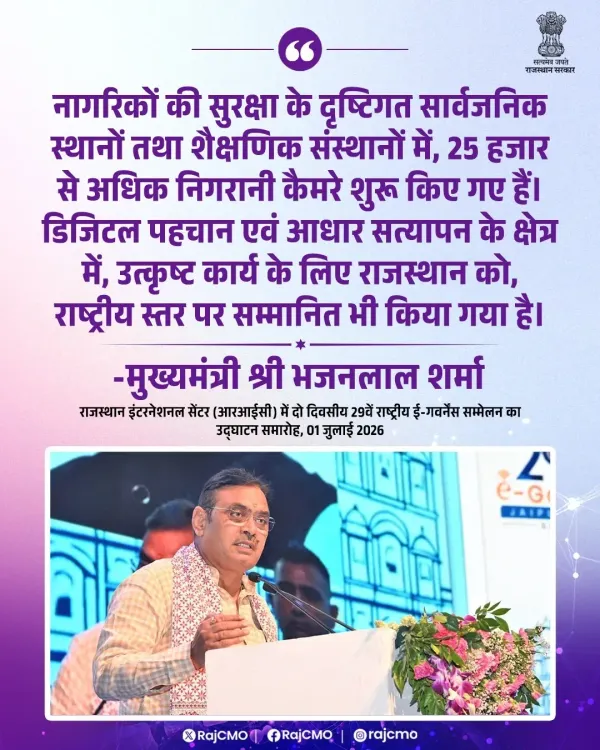
The Chief Minister's Office of Rajasthan announced on Thursday, 2 July 2026 that more than 25,000 surveillance cameras have been activated across public spaces and educational institutions in the state, citing citizen safety as the driving objective. The announcement was made in the context of #11YearsOfDigitalIndia and ahead of the National Conference on e-Governance 2026 (NCeG2026).
Context
The post, attributed to the CMO and tagging Chief Minister Bhajanlal Sharma (@BhajanlalBjp), states in Hindi: 'नागरिकों की सुरक्षा के दृष्टिगत सार्वजनिक स्थानों तथा शैक्षणिक संस्थानों में, 25 हजार से अधिक निगरानी कैमरे शुरू किए गए हैं' — ('With a view to citizen safety, more than 25 thousand surveillance cameras have been launched in public places and educational institutions'). The announcement is positioned as a milestone under the broader Digital India umbrella, which completed 11 years in 2026.
Policy Backdrop
Digital India, launched in 2015 by the central government, set out to expand digital infrastructure and e-governance services across all states, including Rajasthan. CCTV deployment in public areas and schools has been a recurring component of police modernisation and Smart City programmes across multiple Indian states since the mid-2010s. Rajasthan's current BJP government, which assumed office in December 2023 under Chief Minister Bhajanlal Sharma, has aligned several state-level initiatives with national digital governance goals.
The timing of the announcement — coinciding with #11YearsOfDigitalIndia commemorations and the upcoming NCeG2026 — signals the state's intent to showcase its digital security infrastructure at a national platform. Integration of state CCTV networks with central data-sharing frameworks is expected to be a subject of discussion at the conference.
Stakeholders and Impact
The primary beneficiaries identified by the government are the general public and students in educational institutions across Rajasthan. Surveillance infrastructure of this scale is typically intended to deter crime, aid law enforcement response, and provide evidentiary footage in legal proceedings. Schools and colleges represent a particularly sensitive category given ongoing national conversations around campus safety.
Civil society perspectives on large-scale surveillance deployments often raise questions around data governance, oversight mechanisms, and privacy safeguards — dimensions the state government has not addressed in this announcement.
What's Next
The National Conference on e-Governance 2026 (NCeG2026), referenced in the post's hashtag, is expected to be a key venue where Rajasthan's digital and surveillance initiatives may be presented as a model for other states. Details on operational protocols, the agencies managing the camera network, and any central-state data-sharing arrangements remain to be disclosed publicly. Observers will watch for whether the government outlines a formal privacy or data-retention framework to accompany the expanded surveillance footprint.
Point of View
A pattern common among BJP-governed states seeking to build the chief minister's profile. The absence of any mention of oversight mechanisms or privacy safeguards is notable, as large-scale surveillance deployments increasingly attract scrutiny from courts and civil liberties groups across India. How the state addresses data governance questions will determine whether this initiative is seen as a genuine public-safety upgrade or a political optics exercise.
NationPress
2 Jul 2026
Frequently Asked Questions
How many CCTV cameras has Rajasthan installed in public places?
The Rajasthan Chief Minister's Office announced that more than 25,000 surveillance cameras have been activated in public spaces and educational institutions across the state as of July 2026.
Who is the Chief Minister of Rajasthan in 2026?
Bhajanlal Sharma of the BJP is the Chief Minister of Rajasthan. He assumed office in December 2023 and has been associated with the state's digital and security governance initiatives.
What is Digital India and how long has it been running?
Digital India is a national programme launched in 2015 to expand digital infrastructure and e-governance services across India. It completed 11 years in 2026, which is the context for the Rajasthan government's CCTV announcement.
Are CCTV cameras being installed in schools in Rajasthan?
Yes, the Rajasthan government's announcement specifically includes educational institutions alongside general public spaces as locations where the more than 25,000 surveillance cameras have been deployed.