Kishan Reddy Hails India's 13th Rank in QS Future Skills Index
Synopsis
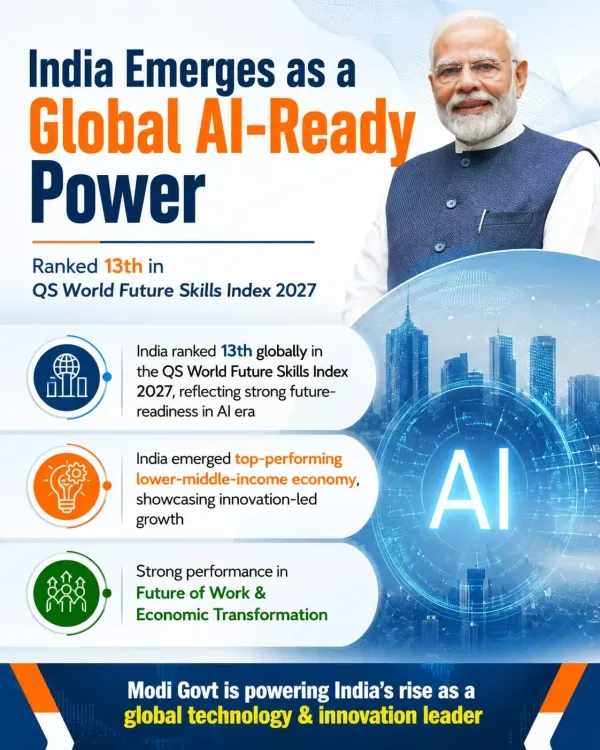
Union Minister G. Kishan Reddy has highlighted India's 13th-place finish in the QS World Future Skills Index 2027, attributing the result to PM Modi's push for digital transformation, AI readiness, and the Aatmanirbhar Bharat agenda built on a decade of skilling and innovation policies.
Key Takeaways
Union Coal and Mines Minister G.
Kishan Reddy posted on 2 July 2026 citing India's 13th rank in the QS World Future Skills Index 2027 .
The index, published by Quacquarelli Symonds , evaluates countries on AI, innovation, and future workforce preparedness.
Reddy linked the ranking to the Modi government's programmes including Digital India , Skill India , and the Aatmanirbhar Bharat framework.
Key policy milestones include the National Strategy for AI (2018) and the National Education Policy 2020 , which introduced AI and coding at the school level.
The ranking has implications for foreign investment , technology hiring , and India's positioning in the global AI talent competition.
Future Union Budget allocations for the National AI Mission and NEP implementation will be critical to sustaining the ranking.
Union Coal and Mines Minister G. Kishan Reddy on Thursday, 2 July 2026, credited the leadership of Prime Minister Narendra Modi for India securing the 13th position in the QS World Future Skills Index 2027, calling it a reflection of the country's growing strength in artificial intelligence, innovation, and future-ready talent.
Context
The QS World Future Skills Index, published by global higher education analysts Quacquarelli Symonds, assesses countries on their preparedness in emerging skill domains including AI, digital technology, and workforce adaptability. India's placement at 13th in the 2027 edition positions it among the leading nations in this assessment, ahead of several established economies.
Reddy described the ranking as 'a proud testament to the Modi Government's unwavering commitment to building an Aatmanirbhar and future-ready Bharat,' linking the result directly to the government's decade-long investment in digital and skilling infrastructure.
Policy Backdrop
The ranking arrives against the backdrop of a series of flagship programmes initiated since 2014. The Skill India Mission, launched in 2015, set out to train millions of young Indians in industry-relevant and emerging technology competencies. In the same year, the Digital India programme was rolled out to expand broadband connectivity, build digital public infrastructure, and foster innovation ecosystems across the country.
The National Strategy for Artificial Intelligence, released in 2018 under the banner #AIforAll, laid out a roadmap for responsible AI development and domestic talent creation. The National Education Policy 2020 further embedded coding and AI literacy into school-level curricula, targeting the pipeline of future technology workers. Together, these initiatives form the policy lineage that the government points to when citing improvements in global competitiveness indices.
The Aatmanirbhar Bharat framework, announced in 2020, brought these strands together under a self-reliance umbrella, emphasising technology indigenisation, digital public goods, and reduced external dependence in critical sectors.
Stakeholders and Impact
The primary beneficiaries of the policies underpinning this ranking are Indian youth and the broader technology industry workforce. A higher global skills ranking can influence foreign direct investment decisions, multinational technology firms' hiring strategies, and the attractiveness of Indian talent in global labour markets.
For Telangana and other technology-intensive states, such rankings carry additional significance as they compete to attract data centres, AI research hubs, and global capability centres. As BJP Telangana state president, Reddy's amplification of the index also carries a regional political dimension, signalling the party's intent to claim credit for technology-sector momentum in the state.
What's Next
Parliamentary discussions on the implementation of the National Education Policy and budget allocations for the National AI Mission are expected to be key forums where this ranking will be cited. Subsequent editions of the QS index and comparable global assessments will be closely watched to determine whether India's position consolidates or improves.
With global competition among emerging economies intensifying to build AI-ready talent pools, India's ability to sustain and advance this ranking will depend on continued investment in skilling infrastructure, research capacity, and digital public goods — areas that are likely to feature prominently in upcoming Union Budget deliberations.
Point of View
Rather than a domestic metric, signals the BJP's intent to frame its technology agenda in internationally legible terms, lending it credibility beyond partisan audiences. By invoking Aatmanirbhar Bharat alongside an outward-facing ranking, the messaging neatly bridges the self-reliance narrative with global competitiveness, a rhetorical pairing the party has refined since 2020. The post also positions Reddy — whose primary portfolio is coal and mines — as a broader voice on national development, consistent with the BJP's practice of deploying state presidents and senior ministers as amplifiers of the party's governance record.
NationPress
1 Oct 2026
Frequently Asked Questions
What is the QS World Future Skills Index?
The QS World Future Skills Index is a ranking published by Quacquarelli Symonds that evaluates countries on their preparedness in emerging skill areas such as artificial intelligence, digital technology, and future workforce adaptability.
What rank did India get in the QS World Future Skills Index 2027?
India ranked 13th in the QS World Future Skills Index 2027, according to Union Minister G. Kishan Reddy's post on 2 July 2026.
What is Aatmanirbhar Bharat and how does it relate to technology?
Aatmanirbhar Bharat , or Self-Reliant India, is a programme launched in 2020 that encompasses technology indigenisation, digital public goods, and skilling initiatives aimed at reducing India's external dependence in critical sectors.
What government schemes contributed to India's technology skills ranking?
Key schemes include the Skill India Mission (2015) , Digital India (2015) , the National Strategy for AI (2018) , and the National Education Policy 2020 , which together form the foundation of India's push for a future-ready workforce.
Who is G. Kishan Reddy?
G. Kishan Reddy is the Union Minister of Coal and Mines in the Government of India and also serves as the BJP's Telangana state president.