Rajasthan CMO: FTAs with 40 nations open markets for Make in India
Synopsis
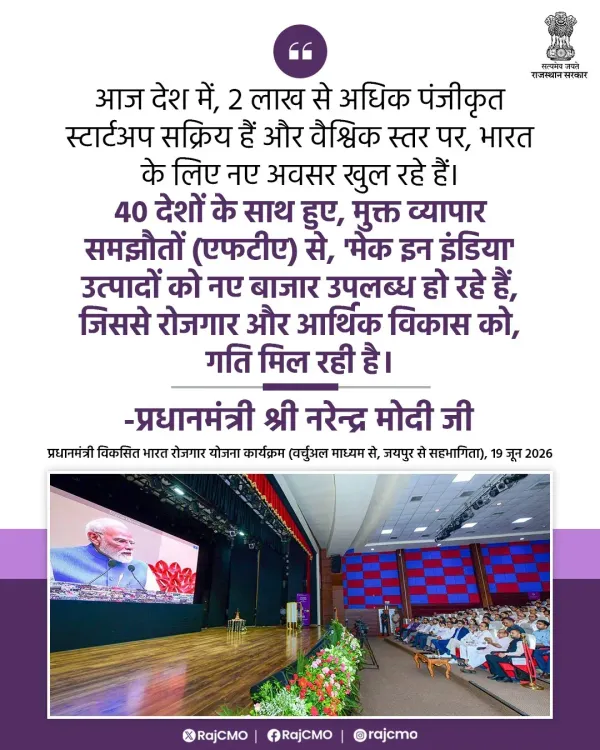
The Chief Minister's Office of Rajasthan on 20 June 2026 highlighted that free trade agreements with 40 countries are creating new export markets for Make in India products, endorsing PM Modi's national manufacturing and trade agenda under the 'Our Leading Rajasthan' campaign.
Key Takeaways
The Rajasthan CMO posted on 20 June 2026 that FTAs with 40 countries are opening markets for Make in India products.
Make in India was launched in September 2014 to boost domestic manufacturing, exports, and foreign investment.
Key concluded agreements include CEPAs with the UAE (February 2022) and Australia (December 2022) , plus earlier pacts with ASEAN, Japan, and South Korea .
Rajasthan's post reflects state-level endorsement of the central government's FTA-driven trade strategy under the hashtag #आपणो_अग्रणी_राजस्थान .
Pending FTA negotiations with the UK and EU remain the next major milestones to watch.
The Chief Minister's Office of Rajasthan on Saturday, 20 June 2026 highlighted that free trade agreements concluded with 40 countries are opening new international markets for products manufactured under the Make in India initiative, tagging Prime Minister Narendra Modi in the post under the hashtag #आपणो_अग्रणी_राजस्थान ('Our Leading Rajasthan').
Context
The post, shared in Hindi, states: '40 देशों के साथ हुए, मुक्त व्यापार समझौतों (एफटीए) से, Make in India उत्पादों को नए बाजार उपलब्ध हो रहे हैं' — 'Free trade agreements concluded with 40 countries are making new markets available for Make in India products.' The Rajasthan CMO's message signals state-level alignment with the central government's trade and manufacturing agenda.
The hashtag #आपणो_अग्रणी_राजस्थान ('Our Leading Rajasthan') is used by the state government to project Rajasthan as a front-runner in adopting national economic programmes. By tagging PM Modi directly, the post reinforces the state's endorsement of Union-level policy.
Policy Backdrop
Make in India was launched in September 2014 to raise the manufacturing sector's share of GDP, attract foreign investment, and boost exports. Since then, the central government has pursued an active free trade agreement agenda to diversify export destinations and integrate Indian firms into global value chains.
Among the landmark agreements, India concluded a Comprehensive Economic Partnership Agreement (CEPA) with the UAE in February 2022 and the India-Australia Economic Cooperation and Trade Agreement (ECTA), which entered into force in December 2022. Earlier foundational pacts include those with ASEAN (2010), Japan (2011), and South Korea (2010). These agreements complement production-linked incentive (PLI) schemes designed to scale domestic manufacturing output across sectors.
Stakeholders and Impact
Indian manufacturers and exporters are the primary beneficiaries cited in the broader policy framework. Reduced tariffs under these agreements are intended to make Indian goods more price-competitive in partner markets, supporting sectors ranging from textiles and electronics to pharmaceuticals and auto components — all areas where Rajasthan has a production base.
For Rajasthan specifically, the state has aligned its industrial policy with national manufacturing and export goals. The state's endorsement of FTA-driven market access reflects an effort to position local producers — particularly in textiles, gems and jewellery, and agro-processing — as beneficiaries of expanded trade corridors.
What's Next
Attention in trade policy circles remains on pending negotiations with the United Kingdom and the European Union, both of which represent large, high-value markets for Indian exporters. Conclusion of those agreements would significantly expand the network beyond currently active pacts.
Export performance data under recently concluded FTAs will be a key indicator of whether the market-access gains translate into on-the-ground growth for manufacturers. State governments like Rajasthan are likely to continue amplifying the national trade narrative as industrial investment and export targets are reviewed.
Point of View
The post weaves together trade diplomacy and domestic manufacturing into a single electoral-friendly narrative. The 'Our Leading Rajasthan' hashtag frames the state as an active participant in, rather than a passive recipient of, national economic ambition. This pattern of state-level amplification is likely to intensify as India's FTA pipeline with the UK and EU moves closer to conclusion.
NationPress
19 Sept 2026
Frequently Asked Questions
What did the Rajasthan CMO say about Make in India and FTAs?
The Rajasthan Chief Minister's Office stated on 20 June 2026 that free trade agreements concluded with 40 countries are opening new markets for products manufactured under the Make in India initiative.
How many FTAs has India signed under Make in India?
India has concluded several free trade and comprehensive economic partnership agreements, including pacts with ASEAN (2010), Japan (2011), South Korea (2010), the UAE (2022), and Australia (2022), among others. The Rajasthan CMO's post references a figure of 40 countries.
What is the Make in India scheme?
Make in India is a manufacturing promotion initiative launched by Prime Minister Narendra Modi in September 2014, aimed at raising the sector's share of GDP, attracting investment, and boosting exports.
What does #आपणो_अग्रणी_राजस्थान mean?
The hashtag translates from Hindi/Rajasthani as 'Our Leading Rajasthan' and is used by the state government to highlight Rajasthan's progress in adopting national economic and development programmes.
Which major FTAs is India still negotiating?
India is currently in negotiations for free trade agreements with the United Kingdom and the European Union, both of which represent significant potential markets for Indian exporters.