Rajasthan CMO backs Modi's strike-first security doctrine
Synopsis
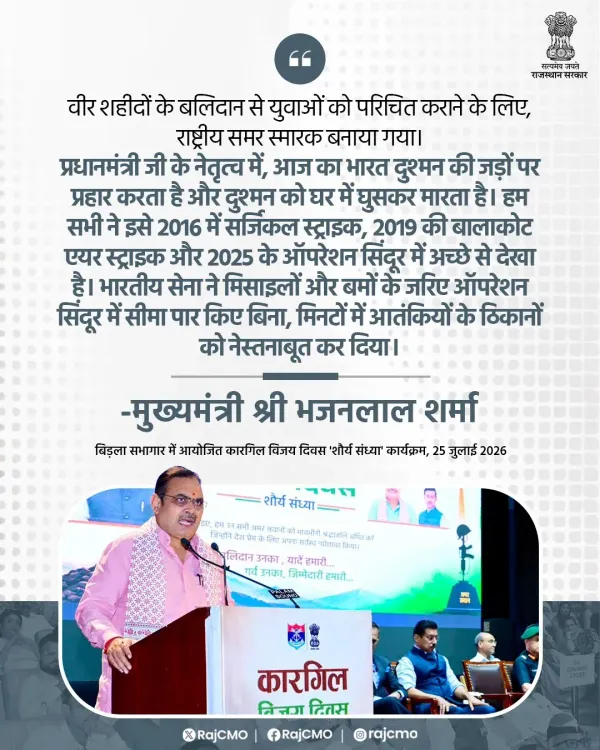
The Chief Minister's Office of Rajasthan publicly endorsed PM Narendra Modi's assertive counter-terrorism doctrine on 26 July 2026, declaring that today's India 'strikes at the roots of the enemy and enters their home to kill' — echoing the political framing used after the 2016 surgical strikes and 2019 Balakot airstrikes.
Key Takeaways
The Rajasthan CMO posted on 26 July 2026 backing PM Narendra Modi 's counter-terrorism posture.
The Hindi post declares India now 'strikes at the roots of the enemy and kills the enemy by entering their home.' The language directly echoes political framing used after India's 2016 surgical strikes and 2019 Balakot airstrikes .
The post tags CM Bhajan Lal Sharma 's personal handle and uses the state branding hashtag #आपणो_अग्रणी_राजस्थान .
Rajasthan shares a significant border with Pakistan, giving national security messaging particular local relevance.
No specific operational event has been officially confirmed as the trigger for this statement.
The Chief Minister's Office of Rajasthan on Sunday, 26 July 2026, posted a pointed statement on X endorsing the central government's assertive counter-terrorism posture, invoking Prime Minister Narendra Modi's leadership as the force behind India's shift to proactive military action against hostile elements.
The post, attributed to the office of Chief Minister Bhajan Lal Sharma, declared in Hindi: 'Pradhanmantri ji ke netritva mein aaj ka Bharat dushman ki jadon par prahar karta hai aur dushman ko ghar mein ghuskar maarta hai' — 'Under the leadership of the Prime Minister, today's India strikes at the roots of the enemy and kills the enemy by entering their home.' The language is an unmistakable echo of the political rhetoric that followed India's cross-border military operations in recent years.
Context
The statement is a public alignment by a state government with the national security doctrine championed by the BJP-led central government. The phrase 'entering their home to kill' is a direct reference to the political framing used after India's 2016 surgical strikes across the Line of Control following the Uri attack, and the 2019 Balakot airstrikes conducted after the Pulwama attack that killed 40 Central Reserve Police Force personnel.
The post tags @BhajanlalBjp, the personal handle of Chief Minister Bhajan Lal Sharma, and carries the hashtag #आपणो_अग्रणी_राजस्थान ('Our Leading Rajasthan'), a branding phrase the state government uses to position Rajasthan as a front-runner in development and governance.
Policy Backdrop
Since 2014, India's counter-terrorism posture has undergone a documented shift — from strategic restraint to what defence analysts describe as calibrated, pre-emptive response. The Uri surgical strikes of September 2016 and the Balakot airstrike of February 2019 became landmark events in this evolution, each followed by intense political messaging from both the central and state governments.
State governments led by the BJP have consistently amplified central government narratives on national security, particularly around anniversaries of these operations and during periods of heightened tensions on India's borders. The Rajasthan CMO's post follows this established pattern of coordinated political communication.
Stakeholders and Impact
Rajasthan shares a long international border with Pakistan, making national security messaging particularly resonant for the state's border communities. The state is home to key defence installations and has historically contributed significantly to the Indian armed forces.
The post is directed at a domestic audience and serves to reinforce the ruling party's security credentials at the state level. Defence forces and border-district communities in Rajasthan remain the primary stakeholders in any policy or operational development that follows such public statements.
What's Next
No specific triggering operational event has been officially confirmed in connection with this post. Observers will watch for follow-up statements from the Ministry of Defence, parliamentary debates on India's defence posture, or official briefings that may have prompted state-level amplification of the security narrative.
As India's political calendar fills with state and national events, messaging around national security is expected to remain a central pillar of BJP communication strategy — with state governments like Rajasthan playing an active role in that chorus.
Point of View
And its deployment here suggests a deliberate alignment with a broader communication cycle rather than a response to a specific new event. For CM Bhajan Lal Sharma, associating Rajasthan's identity with national security assertiveness is strategically rational given the state's long Pakistan border and large defence-community voter base. The post reflects how national security has become a permanent, not episodic, pillar of BJP state-level messaging.
NationPress
26 Jul 2026
Frequently Asked Questions
What did the Rajasthan CMO post about PM Modi on 26 July 2026?
The Rajasthan Chief Minister's Office posted a Hindi statement saying that under PM Modi's leadership, India now 'strikes at the roots of the enemy and kills the enemy by entering their home,' endorsing India's assertive counter-terrorism doctrine.
What are India's surgical strikes that the Rajasthan CMO post refers to?
India conducted surgical strikes across the Line of Control in September 2016 after the Uri attack, and carried out airstrikes on a facility in Balakot, Pakistan in February 2019 after the Pulwama attack. These operations are the basis for the political phrase 'entering the enemy's home.'
Who is Bhajan Lal Sharma and why is he tagged in the post?
Bhajan Lal Sharma is the BJP Chief Minister of Rajasthan. He is tagged via his personal X handle @BhajanlalBjp because the post originates from his office and is attributed to his government's position.
What does #आपणो_अग्रणी_राजस्थान mean?
The hashtag translates from Rajasthani/Hindi as 'Our Leading Rajasthan.' It is a branding phrase used by the Rajasthan state government to project the state as a front-runner in governance and development.
Is there a specific military operation that triggered the Rajasthan CMO's post?
No specific operational event has been officially confirmed as the trigger. The post appears to be part of the BJP's ongoing national security communication strategy rather than a response to a confirmed new military action.