Rajasthan CMO touts NEP, Skill India for youth empowerment
Synopsis
The Chief Minister's Office of Rajasthan highlighted PM Modi's trio of youth-empowerment schemes — NEP 2020, Skill India Mission, and PMKVY — as part of the Seva Sankalp Abhiyan, underscoring Rajasthan BJP's drive to amplify central human-development programmes at the state level.
Key Takeaways
Three schemes named: National Education Policy 2020, Skill India Mission, and Pradhan Mantri Kaushal Vikas Yojana were cited by the Rajasthan CMO as central to youth empowerment.
NEP history: Approved in July 2020 , NEP replaced India's 1986 education policy — the first major overhaul in over three decades.
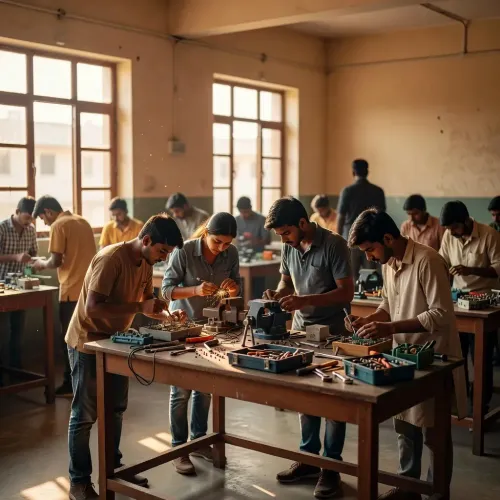
Skill India scale: The mission, launched in 2015 , set a target of training more than 400 million people in short-term and long-term skill programmes.
PMKVY mandate: Also launched in 2015 , PMKVY provides standardised training, assessment, and certification to youth seeking formal employment.
Seva Sankalp Abhiyan: The post is part of a Rajasthan BJP campaign to promote central government schemes at the state level, with CM Bhajanlal Sharma tagged directly.
What to watch: District-wise enrollment and placement data in Rajasthan under NEP and PMKVY, expected in upcoming annual skill reports.
Three flagship central-government programmes — a once-in-a-generation education overhaul, a mass skilling drive, and a certification scheme reaching millions of young Indians — are at the heart of a fresh outreach push by the Chief Minister's Office of Rajasthan, which posted a pointed reminder of their scope on Saturday, 26 September 2026.
The post, shared under the Seva Sankalp Abhiyan banner and tagging Chief Minister Bhajanlal Sharma, credited Prime Minister Narendra Modi with launching 'several schemes including the National Education Policy, Skill India Mission, and Pradhan Mantri Kaushal Vikas Yojana to empower the youth of the country.' It is a compact three-line message, but the programmes it names carry considerable weight in India's human-capital story.
What NEP 2020 actually changed — and why it mattered
The National Education Policy (NEP), approved by the Union Cabinet in July 2020, was the first comprehensive rewrite of India's education framework in more than three decades, replacing a policy that dated to 1986. Its architects pushed for multidisciplinary learning, mother-tongue instruction in early grades, and — critically — a formal bridge between academic education and vocational training. For a country whose workforce demography is among the youngest in the world, that bridge was the whole point.
Skill India and PMKVY: the numbers behind the ambition
Two years before NEP, Skill India Mission was launched in July 2015 by the Ministry of Skill Development and Entrepreneurship with an extraordinary stated target: train more than 400 million people across short-term and long-term programmes by 2022. Running in parallel, the Pradhan Mantri Kaushal Vikas Yojana (PMKVY) — also launched in 2015 — became the mission's operational flagship, providing standardised short-term training, assessment, and certification to youth seeking entry into the formal labour market. Subsequent phases of PMKVY extended both the training targets and the sector coverage, deepening reach into states like Rajasthan where large rural youth populations remain underserved by traditional degree pathways.
Rajasthan's role in the Seva Sankalp Abhiyan
The post is explicitly linked to the Seva Sankalp Abhiyan — a Rajasthan BJP campaign designed to amplify central government welfare and development schemes at the state level. Under CM Bhajanlal Sharma, the state has positioned itself as an active implementation partner for New Delhi's human-development agenda. Rajasthan's district-wise enrollment and placement data under NEP and PMKVY will be a key measure of whether that partnership translates into on-the-ground outcomes — numbers that are expected to feature in upcoming annual skill reports.
The three schemes referenced form a sequential logic: NEP redesigns what schools and colleges teach, Skill India creates the institutional machinery to train those who step outside traditional education, and PMKVY certifies the skills acquired — giving employers a verifiable signal. Put together, they represent the most systematic attempt India has made to connect its demographic dividend to the labour market. Whether Rajasthan's outreach push accelerates local enrollment is the question the next skills audit will have to answer.
Point of View
Skill India, and PMKVY in a single message under the Seva Sankalp Abhiyan banner, the Rajasthan CMO signals alignment with New Delhi's electoral and policy narrative on youth employability. The stakes are real: Rajasthan's young, largely rural demographic is precisely the constituency these schemes target, and state-level implementation quality will ultimately determine whether the amplification is backed by results. The next district-level skills audit is where the political messaging will meet its accountability test.
NationPress
26 Sept 2026
Frequently Asked Questions
What is the Seva Sankalp Abhiyan in Rajasthan?
Seva Sankalp Abhiyan is a Rajasthan BJP outreach campaign aimed at promoting central government welfare and development schemes among citizens at the state level.
What is the National Education Policy 2020?
NEP 2020 was approved by the Union Cabinet in July 2020 as India's first major education overhaul since 1986, emphasising multidisciplinary learning, mother-tongue instruction, and integration of vocational training.
What is the Skill India Mission and its target?
Skill India Mission was launched in July 2015 with the ambitious target of training more than 400 million people across short-term and long-term skill programmes to boost youth employability.
What does Pradhan Mantri Kaushal Vikas Yojana do?
PMKVY, launched in 2015, provides standardised short-term training, assessment, and government-recognised certification to youth, helping them access formal employment opportunities.
Who is Bhajanlal Sharma and what is his role in Rajasthan's education push?
Bhajanlal Sharma is the Chief Minister of Rajasthan from the BJP, whose office is actively promoting central government education and skilling schemes under the Seva Sankalp Abhiyan campaign.