Rajasthan CMO cites JAM trinity in Urban Service Camps push
Synopsis
The Chief Minister's Office of Rajasthan on 21 June 2026 credited PM Modi's JAM (Jan-Dhan, Aadhaar, Mobile) framework for enabling transparent welfare delivery, tying the model to the state's Urban Service Camps 2026 under CM Bhajanlal Sharma.
Key Takeaways
The Chief Minister's Office of Rajasthan posted on 21 June 2026 crediting PM Narendra Modi 's JAM trinity for transparent welfare delivery.
The JAM framework combines Pradhan Mantri Jan Dhan Yojana , Aadhaar biometric authentication, and mobile connectivity to route benefits directly to beneficiaries.
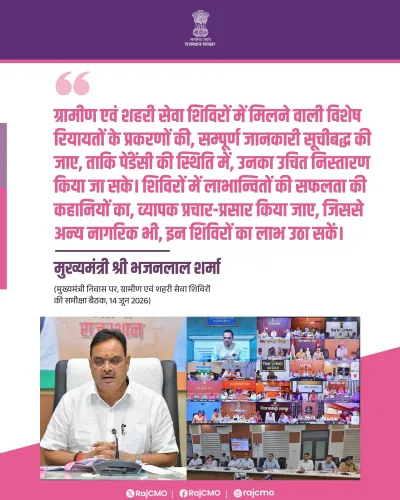
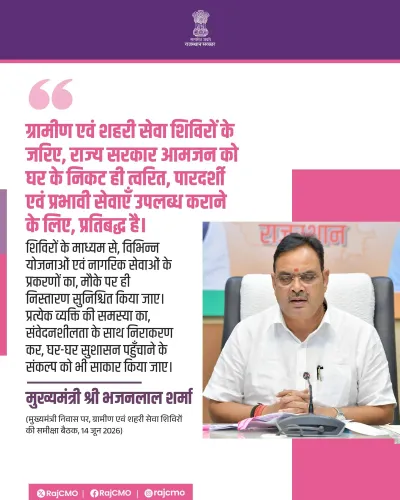
The post is linked to the Urban Service Camps 2026 (#ShahriSevaShivir2026) initiative being run under Chief Minister Bhajanlal Sharma .
Rajasthan has aligned state schemes with the central Direct Benefit Transfer (DBT) architecture since 2014 .
The campaign hashtag #AapnoAgraniRajasthan frames the initiative as part of a broader 'pioneering Rajasthan' governance brand.
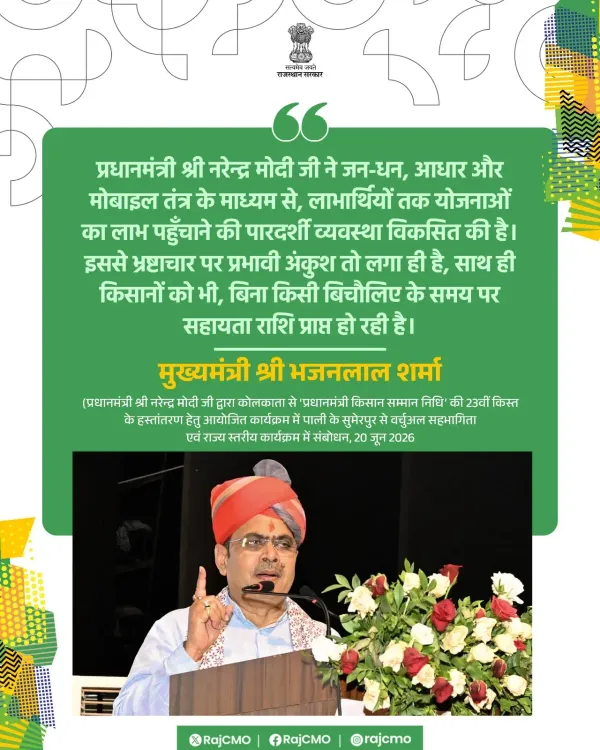
The Chief Minister's Office of Rajasthan on Sunday, 21 June 2026 highlighted Prime Minister Narendra Modi's JAM (Jan-Dhan, Aadhaar, Mobile) framework as the backbone of transparent welfare delivery, linking the model to the state's ongoing Urban Service Camps 2026 initiative under Chief Minister Bhajanlal Sharma.
Context
The post, shared from the official @RajCMO account, states in Hindi: 'Pradhan Mantri Shri Narendra Modi ji ne Jan-Dhan, Aadhaar aur Mobile tantra ke madhyam se, labhartiyon tak yojanaon ka labh pahunchane ki pardarshi vyavastha viksit ki hai' — translating to: 'Prime Minister Narendra Modi has developed a transparent system to deliver the benefits of schemes to beneficiaries through the Jan-Dhan, Aadhaar and Mobile mechanism.' The message is tagged to Chief Minister @BhajanlalBjp and carries the hashtags #ShahriSevaShivir2026 (Urban Service Camps 2026) and #AapnoAgraniRajasthan (Our Pioneering Rajasthan).
The post situates Rajasthan's urban outreach camps within the broader national digital-governance model that the central government has built since 2014, signalling that the state intends to use the same infrastructure to extend welfare reach to urban households.
Policy Backdrop
The JAM trinity — Pradhan Mantri Jan Dhan Yojana (PMJDY), Aadhaar, and mobile connectivity — was assembled by the Modi government beginning in August 2014 when PMJDY was launched to open bank accounts for previously unbanked households. Aadhaar-linked biometric authentication was layered on top to verify beneficiaries and eliminate duplicate or ghost entries from welfare rolls.
The Direct Benefit Transfer (DBT) mission, which predates 2014 but expanded significantly thereafter, routes subsidies, pensions, and scholarship payments directly into verified bank accounts, bypassing intermediaries. Rajasthan aligned its own state schemes with this central architecture after 2014, enabling it to draw on central platforms and reduce administrative overheads.
Stakeholders and Impact
The primary beneficiaries of this framework are welfare recipients across Rajasthan's urban centres — households dependent on food subsidies, pension transfers, and other government entitlements. By anchoring the Urban Service Camps 2026 to the JAM infrastructure, the state government signals an intent to enrol or re-verify urban residents and ensure their entitlements flow without leakage.
For the Bhajanlal Sharma administration, the communication also serves a political purpose: aligning Rajasthan's governance narrative with the BJP's national digital-welfare brand ahead of future electoral cycles. Urban service delivery has historically been a weaker link in welfare outreach compared with rural programmes, making the camps a visible corrective step.
What's Next
Specifics of the Urban Service Camps 2026 — including their schedule, coverage districts, and the schemes on offer — are expected to be detailed through official state communications and camp announcements. Observers will watch whether Rajasthan issues new orders linking additional state schemes to the central DBT portal as part of this initiative. The success of the camps will likely be measured by enrolment numbers and the volume of pending grievances resolved on-site, metrics the CMO has signalled it will track under the #AapnoAgraniRajasthan banner.
Point of View
The Bhajanlal Sharma administration positions the Urban Service Camps 2026 as an extension of proven national infrastructure rather than a standalone state initiative — a framing that deflects accountability questions while borrowing political capital from PM Modi's welfare brand. The emphasis on 'transparency' is pointed: it implicitly contrasts the current delivery model with older, leakage-prone systems. Whether the urban camps translate the JAM promise into measurable outcomes for Rajasthan's city-dwelling poor will determine whether the slogan 'Aapno Agrani Rajasthan' carries substantive weight.
NationPress
21 Jun 2026
Frequently Asked Questions
What is the JAM trinity and how does it work in Rajasthan?
The JAM trinity stands for Jan-Dhan bank accounts, Aadhaar biometric identity, and Mobile connectivity. Together they allow the government to transfer welfare benefits directly into verified bank accounts, reducing leakage and duplication. Rajasthan has integrated this framework into its state schemes in line with central guidelines.
What are the Urban Service Camps 2026 in Rajasthan?
The Urban Service Camps 2026 (#ShahriSevaShivir2026) are an outreach initiative by the Rajasthan government under Chief Minister Bhajanlal Sharma aimed at delivering welfare scheme benefits to urban residents. The CMO announced the camps on 21 June 2026, linking them to the JAM digital-governance framework.
What is Pradhan Mantri Jan Dhan Yojana?
Pradhan Mantri Jan Dhan Yojana (PMJDY) is a national financial inclusion scheme launched in August 2014 to open zero-balance bank accounts for unbanked households, enabling them to receive direct government transfers.
How does Aadhaar help in welfare delivery in Rajasthan?
Aadhaar provides biometric authentication that verifies the identity of beneficiaries, eliminating duplicate or ghost entries from welfare rolls. Rajasthan uses Aadhaar-linked systems to ensure that subsidies and pensions reach genuine recipients through the Direct Benefit Transfer mechanism.
Who is Bhajanlal Sharma?
Bhajanlal Sharma is the Chief Minister of Rajasthan from the Bharatiya Janata Party (BJP). His government's official CMO account posted the message on 21 June 2026 highlighting PM Modi's JAM framework in the context of the Urban Service Camps 2026.