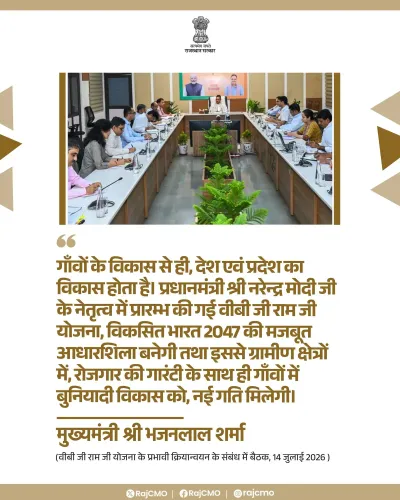
Rajasthan CMO: VB G Ram Ji Yojana a pillar of Viksit Bharat 2047
Synopsis
The Chief Minister's Office of Rajasthan on 15 July 2026 positioned the VB G Ram Ji Yojana, launched under PM Narendra Modi, as a cornerstone of the Viksit Bharat 2047 vision, signalling the state's alignment with India's long-term national development roadmap.
Key Takeaways
The Rajasthan CMO officially described the VB G Ram Ji Yojana as a 'strong cornerstone' of Viksit Bharat 2047 on 15 July 2026 .
The scheme is attributed to the leadership of Prime Minister Narendra Modi .
Chief Minister Bhajanlal Sharma was tagged in the post, underlining the state government's ownership of the messaging.
The Viksit Bharat 2047 vision was first articulated by PM Modi in his Independence Day address of 2023 .
Rajasthan has been in office under the BJP since December 2023 and has consistently aligned state programmes with central development goals.
Specific details of the scheme's scope, target beneficiaries and budget remain to be formally announced.
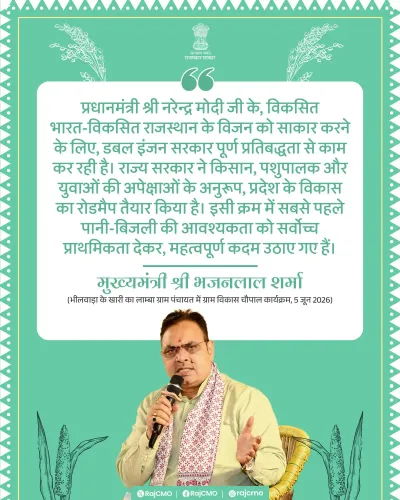
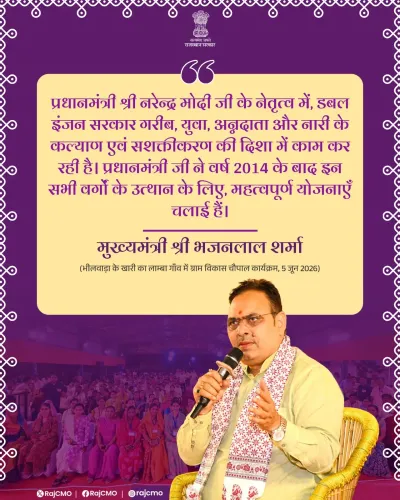
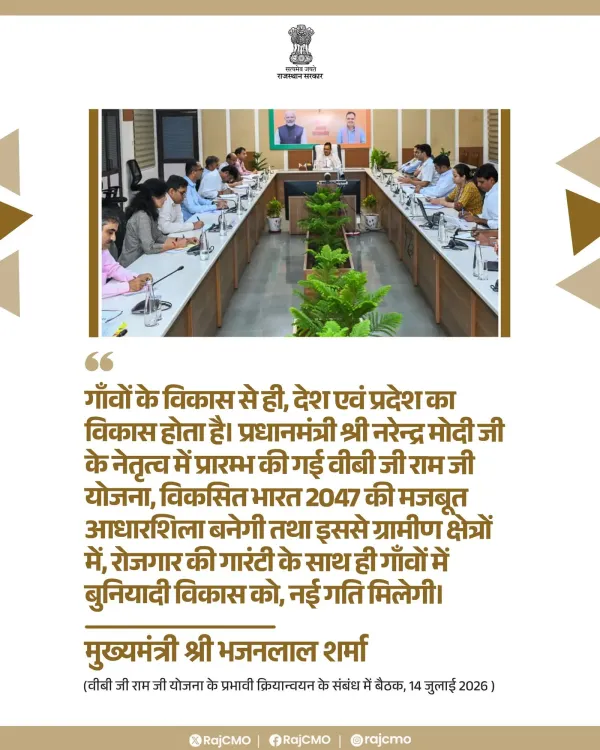
The Chief Minister's Office of Rajasthan on Wednesday, 15 July 2026 described the VB G Ram Ji Yojana — launched under the leadership of Prime Minister Narendra Modi — as a 'strong foundation' for the Viksit Bharat 2047 national development vision, tagging Chief Minister Bhajanlal Sharma in the official post.
Context
The post, shared from the official @RajCMO account, stated in Hindi: 'Pradhan Mantri Shri Narendra Modi ji ke netritva mein prarambh ki gayi VB G Ram Ji Yojana, Viksit Bharat 2047 ki mazboot aadharshila banegi' — meaning 'The VB G Ram Ji Yojana, initiated under the leadership of Prime Minister Shri Narendra Modi, will become a strong cornerstone of Viksit Bharat 2047.' The hashtag #AapnoAgraniRajasthan (Our Leading Rajasthan) was also used, a branding phrase associated with the Bhajanlal Sharma administration's outreach.
The post explicitly links a state-level scheme to the central government's long-term development roadmap, a communication pattern common in BJP-governed states that frame local programmes as contributions to national goals.
Policy Backdrop
Prime Minister Modi first elaborated the Viksit Bharat 2047 vision in his Independence Day address of 2023, calling for coordinated efforts across all states to achieve developed-economy status by the centenary of India's independence. The vision encompasses infrastructure expansion, welfare delivery, skills development and governance modernisation.
Rajasthan has historically aligned its state programmes with central missions in housing, skills and infrastructure. The Bhajanlal Sharma government, in office since December 2023, has consistently positioned state initiatives as contributions to this broader national roadmap, reflecting the model of cooperative federalism in which states implement or complement centrally conceptualised schemes.
Stakeholders and Impact
The primary beneficiaries of the VB G Ram Ji Yojana, as implied by the official communication, are residents of Rajasthan, though the specific scope, target population and operational details of the scheme have not been detailed in the post. State governments typically roll out such schemes through district-level machinery, with beneficiaries drawn from welfare-eligible households.
The framing of the scheme as foundational to Viksit Bharat 2047 signals that the Rajasthan government intends to position it prominently in both state and central review processes. Such alignment can also influence budget prioritisation and administrative focus in subsequent planning cycles.
What's Next
Watchers of Rajasthan governance will look for formal rollout announcements, budget allocations and performance benchmarks for the VB G Ram Ji Yojana in upcoming Rajasthan Assembly sessions or during central government reviews of Viksit Bharat 2047 progress. The scheme's placement within the national vision framework suggests it may be presented at joint Centre-state review meetings as a model initiative.
As India moves closer to the 2047 milestone, the degree to which state-level schemes translate into measurable development outcomes will be a critical test of the cooperative federalism model that both the central government and BJP-ruled states have publicly championed.
Point of View
Particularly around the electorally potent Viksit Bharat 2047 brand. By tagging Chief Minister Bhajanlal Sharma and deploying the hashtag 'Our Leading Rajasthan,' the communication simultaneously serves a national narrative and a local political identity. The absence of granular scheme details in the post suggests this is a positioning statement ahead of a formal launch or review, rather than a programme announcement. Analysts will watch whether the scheme generates verifiable outcomes that sustain this ambitious framing.
NationPress
15 Jul 2026
Frequently Asked Questions
What is the VB G Ram Ji Yojana?
The VB G Ram Ji Yojana is a scheme referenced by the Rajasthan Chief Minister's Office as having been launched under the leadership of Prime Minister Narendra Modi and positioned as a foundational contribution to the Viksit Bharat 2047 national development vision. Specific details of its scope and beneficiaries have not yet been formally announced.
What is Viksit Bharat 2047?
Viksit Bharat 2047 is a national long-term vision articulated by the central government, aiming for India to achieve developed-economy status by 2047 — the centenary of independence — through infrastructure, welfare and governance reforms. PM Modi first elaborated this vision in his Independence Day address of 2023.
Who is Bhajanlal Sharma?
Bhajanlal Sharma is the BJP Chief Minister of Rajasthan, in office since December 2023. His government has aligned state initiatives with central development programmes, including the Viksit Bharat 2047 roadmap.
Why did the Rajasthan CMO post about this scheme on X?
The Rajasthan Chief Minister's Office used its official X account to publicly link the VB G Ram Ji Yojana to the Viksit Bharat 2047 vision, a common communication strategy among BJP-governed states that frame local schemes as contributions to the national development agenda.
What is the hashtag AapnoAgraniRajasthan?
AapnoAgraniRajasthan, meaning 'Our Leading Rajasthan' in Rajasthani-Hindi, is a branding phrase used by the Bhajanlal Sharma administration in official communications to highlight the state's development ambitions and governance outreach.