Rajasthan CMO Flags Vehicle Modifications as Crime Evasion Tool
Synopsis
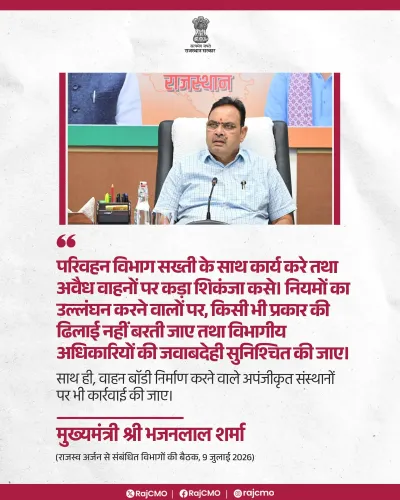
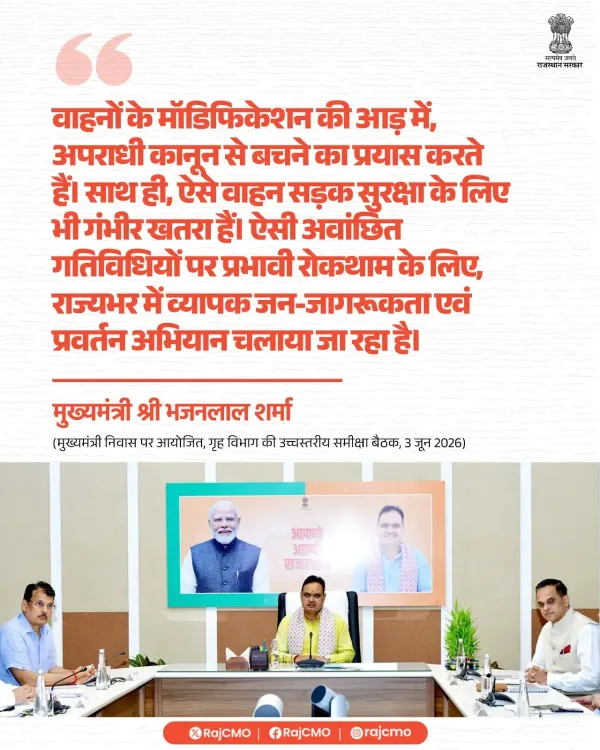
The Chief Minister's Office of Rajasthan on 4 June 2026 cited Chief Minister Bhajanlal Sharma warning that criminals exploit vehicle modifications to evade the law. The post, carrying the state's governance hashtag, signals sharper enforcement of Motor Vehicles Act provisions and hints at possible inspection drives across Rajasthan in the coming weeks.
Key Takeaways
The Rajasthan CMO on 4 June 2026 flagged vehicle modifications as a cover used by criminals to evade the law.
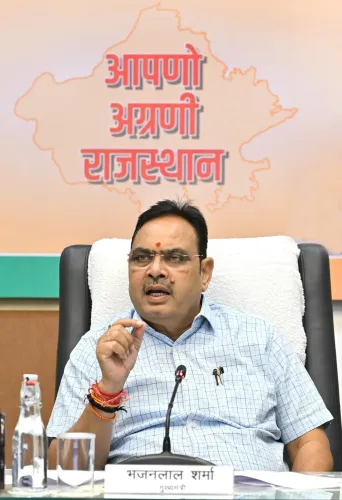
The post quoted Chief Minister Bhajanlal Sharma and used the hashtag #आपणो_अग्रणी_राजस्थान.
India's Motor Vehicles Act, 1988, amended in 2019, sharply increased penalties for unauthorised modifications.
The framing links traffic enforcement to broader crime-prevention strategy in BJP-governed states.
Watch for inspection drives, challan campaigns and possible tightening of state-level vehicle fitness rules.
The Chief Minister's Office of Rajasthan on 4 June 2026 amplified a message from Chief Minister Bhajanlal Sharma warning that criminals are increasingly using vehicle modifications as a cover to evade the law. The post, shared in Hindi from the official handle, signals a sharpened focus on enforcement of motor vehicle norms as part of the state's wider law-and-order agenda.
The post stated, in translation, 'Under the guise of vehicle modifications, criminals attempt to evade the law.' It tagged the Chief Minister and carried the campaign hashtag #आपणो_अग्रणी_राजस्थान (Our Leading Rajasthan), a slogan the state administration has used to frame governance messaging.
Context
The remark places vehicle modification — typically associated with cosmetic alterations, engine tuning, tinted windows, illegal sirens, fake number plates or altered chassis numbers — within a criminal-justice frame rather than a purely traffic-regulation one. The framing suggests that the Rajasthan government views such alterations as enabling getaway vehicles, identity masking and obstruction of surveillance.
Chief Minister Bhajanlal Sharma, a BJP leader who assumed office in December 2023, has repeatedly positioned his administration on planks of public safety, women's security and crackdowns on organised crime since taking charge.
Policy backdrop
India's principal statute governing vehicle alterations is the Motor Vehicles Act, 1988, which was significantly amended in 2019 to raise penalties for unauthorised modifications and related offences. The amended law restricts changes that deviate from the manufacturer's specifications, with violations attracting fines and the possibility of vehicle seizure.
Courts have also reinforced this position, with rulings that bar structural alterations affecting a vehicle's original engineering. Enforcement, however, has historically been uneven across states, often surfacing only during targeted drives or after high-profile incidents.
Stakeholders and impact
The message is directed primarily at two constituencies. The first is the law-enforcement machinery — the Rajasthan Police and the state Transport Department — which is being signalled to treat modified vehicles as a potential crime indicator rather than a routine traffic matter.
The second is the public, including private vehicle owners, automobile workshops and the aftermarket modification industry. Owners of vehicles with non-compliant tints, altered exhausts, unauthorised lighting, or modified registration plates could face heightened scrutiny if inspection drives follow.
Several Indian states have, in recent years, leaned on motor vehicle rules to disrupt criminal mobility, combining traffic policing with broader crime-prevention goals. Rajasthan's latest messaging fits within that pattern, and dovetails with the BJP's wider effort across states it governs to project visible regulatory action on public safety.
What's next
The post does not announce a specific operation, notification or rule change. However, such statements from the Chief Minister's Office have often preceded inspection drives, challan campaigns or coordinated checks by the Transport Department and police.
Observers will watch for follow-up directives on fitness checks, workshop audits and challan data from districts such as Jaipur, Jodhpur, Udaipur and Kota, where modification cultures around two-wheelers and SUVs are more pronounced. Any tightening of state-level rules on vehicle alterations, or memoranda linking transport enforcement to crime control, would mark the next concrete step.
For now, the post functions as a public warning and a political signal: that the Rajasthan administration intends to read vehicle modification not just as a regulatory lapse but as a potential gateway to criminal activity — a framing that could reshape how routine roadside checks are conducted across the state.
Point of View
And it builds a narrative groundwork for future inspection drives. Whether the messaging translates into sustained operational follow-through, rather than episodic crackdowns, will determine its credibility.
NationPress
21 Oct 2026
Frequently Asked Questions
What did the Rajasthan CMO say about vehicle modifications?
The Rajasthan CMO, on 4 June 2026, posted that criminals attempt to evade the law under the guise of vehicle modifications. The message was attributed to Chief Minister Bhajanlal Sharma and carried the state's governance hashtag.
Are vehicle modifications illegal in India?
Most structural and mechanical modifications that deviate from the manufacturer's specifications are restricted under the Motor Vehicles Act, 1988, as amended in 2019. Violations can attract fines and vehicle seizure, and certain cosmetic alterations like illegal tints, sirens and modified plates are routinely penalised.
Who is Bhajanlal Sharma?
Bhajanlal Sharma is a BJP leader serving as the Chief Minister of Rajasthan since December 2023. His administration has emphasised law and order, women's safety and action against organised crime.
What does the hashtag आपणो अग्रणी राजस्थान mean?
The hashtag translates roughly to 'Our Leading Rajasthan'. It is used by the state government as a slogan to frame its governance and development messaging.
Will Rajasthan launch a crackdown on modified vehicles?
The post itself does not announce a specific operation. However, such statements from the Chief Minister's Office have historically preceded coordinated checks by the police and Transport Department, and any formal drives or notifications would be the next step to watch.