Rajasthan CM Bhajan Lal directs crackdown on illegal vehicles
Synopsis
The Chief Minister's Office of Rajasthan on 10 July 2026 publicly directed the Transport Department to strictly enforce motor vehicle laws and crack down on illegal vehicles, tagging CM Bhajan Lal Sharma in a post under the 'Our Leading Rajasthan' governance brand.
Key Takeaways
The Chief Minister's Office of Rajasthan issued a public directive on 10 July 2026 ordering strict action against illegal vehicles.
CM Bhajan Lal Sharma was directly tagged in the post, signalling top-level accountability for the enforcement drive.
The Rajasthan Transport Department is tasked with clamping down on vehicles operating without valid permits, registration, or fitness certificates.
Rajasthan is a key inter-state transport corridor state with significant mining activity, making illegal vehicle operations a persistent problem.
The Central Motor Vehicles Act amendments of 2019 provide the legal backbone for enhanced penalties and electronic enforcement.
Follow-up action from the Transport Department — including seizure targets and joint operations with police — will determine the drive's real impact.
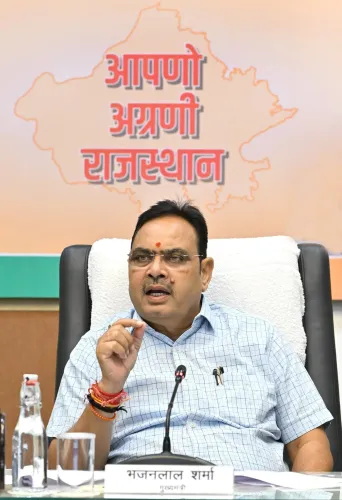
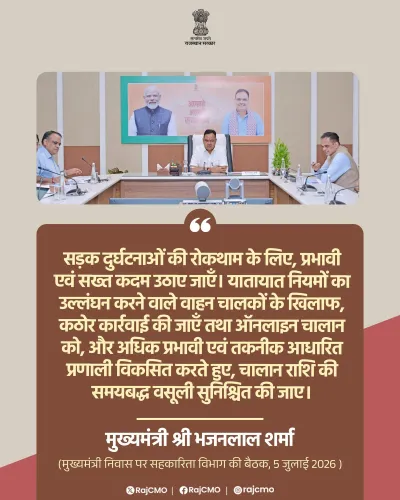
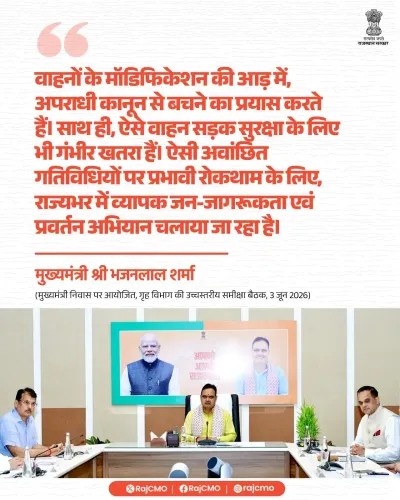
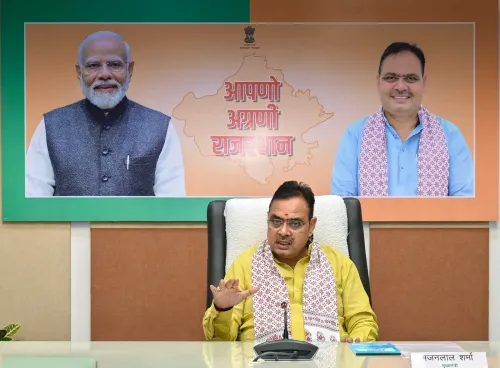
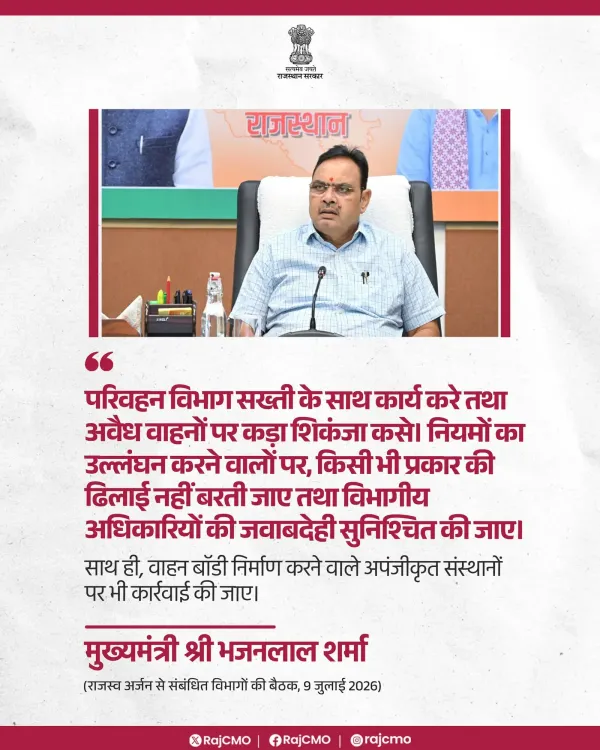
The Chief Minister's Office of Rajasthan on Friday, 10 July 2026, issued a public directive ordering the state's Transport Department to act firmly and tighten its grip on illegal vehicles operating across the state. The instruction, posted on the official CMO handle, also tagged Chief Minister Bhajan Lal Sharma, signalling direct accountability at the top of the government.
The post, written in Hindi, stated: 'परिवहन विभाग सख्ती के साथ कार्य करे तथा अवैध वाहनों पर कड़ा शिकंजा कसे' — meaning, 'The Transport Department must work with strictness and clamp down hard on illegal vehicles.' The directive was accompanied by the hashtag #आपणो_अग्रणी_राजस्थान ('Our Leading Rajasthan'), a recurring tag used by the CMO to brand governance initiatives.
Context
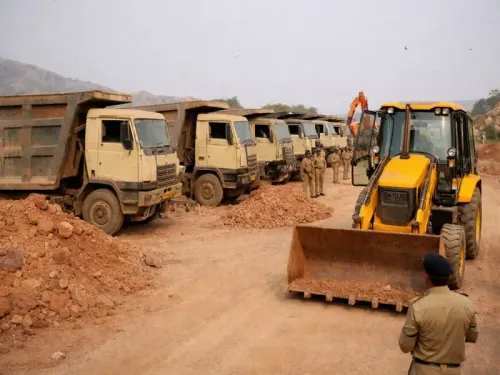
The Rajasthan Transport Department is the state agency responsible for vehicle registration, permits, fitness certification, and enforcement of motor vehicle laws. Illegal vehicles — those operating without valid permits, fitness certificates, or registration — have long been flagged as a source of revenue leakage for the state and a contributor to road accidents on Rajasthan's extensive highway network.
The state sits at the intersection of major inter-state road transport corridors and hosts significant mining activity, making it a critical zone for commercial vehicle movement. Unpermitted or overloaded vehicles linked to mineral transport have historically been a persistent enforcement challenge for successive governments.
Policy Backdrop
The directive draws on a well-established national regulatory framework. The Central Motor Vehicles Act amendments of 2019 introduced substantially higher penalties for traffic and vehicle violations and enabled electronic enforcement mechanisms, which states including Rajasthan subsequently adopted into their enforcement machinery.
State transport departments across India have periodically intensified drives against unpermitted and overloaded vehicles, particularly in states where mining and mineral logistics generate dense commercial traffic. The 10 July 2026 directive from the CMO continues this pattern of executive-level public instructions to line departments, placing the enforcement mandate firmly on record.
Stakeholders and Impact
The directive directly affects commercial vehicle operators, logistics companies, and transporters — particularly those moving goods without valid permits or in vehicles that have not passed mandatory fitness checks. Stricter enforcement is expected to translate into increased inspections, seizures, and fines on state and district highways.
For the state exchequer, a successful crackdown could recover revenue lost to illegal operations. Road safety advocates have consistently argued that unfit and unpermitted vehicles disproportionately contribute to fatal accidents on Rajasthan's roads, making enforcement a public-safety issue as much as a regulatory one.
What's Next
Attention will now turn to the Rajasthan Transport Department for follow-up orders, including any seizure targets, fine-collection benchmarks, or joint operations planned with police and mining authorities. The public nature of the CMO's directive — tagging CM Bhajan Lal Sharma directly — suggests the government intends this to be a visible, accountable enforcement push rather than a routine administrative circular.
If the department responds with measurable action, the drive could set a precedent for how the Bhajan Lal Sharma administration handles regulatory enforcement across other sectors where illegal operations have persisted.
Point of View
Increasingly common among BJP-governed states, uses social media as an accountability layer, making it harder for line departments to quietly shelve directives. The focus on illegal vehicles in Rajasthan also carries an implicit economic dimension: the state's mining belt has long been associated with unpermitted transport, and a credible crackdown would simultaneously address revenue leakage and road safety. Whether the directive translates into sustained enforcement or remains a one-time public posture will be the real test of the Bhajan Lal administration's governance intent.
NationPress
8 Oct 2026
Frequently Asked Questions
What did the Rajasthan CMO post about illegal vehicles?
The Rajasthan CMO on 10 July 2026 directed the state Transport Department to act strictly and clamp down hard on illegal vehicles, tagging CM Bhajan Lal Sharma in the post.
Who is Bhajan Lal Sharma?
Bhajan Lal Sharma is a BJP leader who has served as Chief Minister of Rajasthan since December 2023.
What is the legal basis for cracking down on illegal vehicles in Rajasthan?
The Central Motor Vehicles Act amendments of 2019 provide the primary legal framework, introducing higher penalties and enabling electronic enforcement mechanisms that Rajasthan has adopted.
Why is illegal vehicle enforcement a big issue in Rajasthan?
Rajasthan sits on major inter-state transport corridors and has significant mining activity, making it prone to unpermitted and overloaded commercial vehicles that cause revenue leakage and road accidents.
What should we watch for after the Rajasthan CMO's transport directive?
Follow-up orders from the Transport Department on seizure targets, fine collections, and any joint operations with police or mining authorities will indicate whether the directive leads to sustained enforcement.