Rajasthan CM Dedicates 423 Works Worth ₹256 Cr to Tribal Areas

Synopsis
Rajasthan's Chief Minister's Office announced on September 27, 2026, that 423 public works worth over ₹256 crore have been dedicated to tribal communities under the Seva Sankalp Abhiyan, with CM Bhajan Lal Sharma credited for the 'double engine' government push.
Key Takeaways
423 public convenience works worth more than ₹256 crore have been formally dedicated to communities in Rajasthan's tribal regions.
The announcement was made by the Chief Minister's Office of Rajasthan on September 27, 2026 , tagging CM Bhajan Lal Sharma .
The projects fall under the Seva Sankalp Abhiyan , the Rajasthan government's campaign for concentrated public-facility delivery.
The BJP's 'double engine' model — same-party alignment at the state and Centre — is cited as the enabling factor for the accelerated rollout.
Tribal regions in Rajasthan, home to large Scheduled Tribe populations , are the primary beneficiaries of the dedicated works.
Utilisation and maintenance of the handed-over assets will be the key measure of the initiative's real-world impact.
More than ₹256 crore in public infrastructure — spread across 423 separate projects — has been handed over to communities in Rajasthan's tribal regions, the Chief Minister's Office announced on Sunday, September 27, 2026, crediting coordinated action between the state and central governments under what the ruling BJP calls the 'double engine' model.
423 Projects, One Push into Tribal Heartland
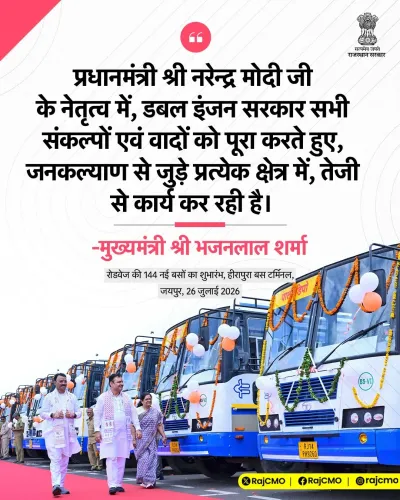
The post from the Chief Minister's Office declared that the 'double engine sarkar' — or double engine government — has 'janata ko samarpit' (dedicated to the people) a sweeping set of public convenience works across the state's Scheduled Tribe zones. The announcement is pegged to the #SevaSankalpAbhiyan, a Rajasthan government campaign focused on concentrated delivery of civic facilities to underserved communities. Chief Minister Bhajan Lal Sharma is tagged directly in the post, signalling personal ownership of the milestone.
What the 'Double Engine' Model Actually Means Here
The BJP has championed the 'double engine' framing since 2014 — the idea that when the same party governs at both the state and the Centre, development funds flow faster and schemes align without political friction. In Rajasthan, where Sharma's BJP government took office in December 2023, that argument is now being tested in real projects: roads, water points, community halls, and other civic amenities designed to close the infrastructure gap in tribal districts. The tribal belt across southern and eastern Rajasthan — home to significant Scheduled Tribe populations — has historically lagged urban centres on basic service metrics.
Seva Sankalp Abhiyan as the Delivery Vehicle
The Seva Sankalp Abhiyan is the administrative scaffolding behind this push — a campaign framework that batches multiple development works into single dedication events, maximising visibility and community participation. Dedicating completed works in bulk, rather than quietly commissioning them, is a deliberate governance-communication strategy: it puts beneficiaries at the centre and creates a measurable public record for the administration. With 423 works now formally handed over, the abhiyan has a concrete benchmark against which future phases will be judged.
The real test now is utilisation — whether roads get maintained, taps stay functional, and community assets serve the populations they were built for. Progress reports on that front will define whether the ₹256 crore translates from headlines into lasting impact.
Frequently Asked Questions
What is the Seva Sankalp Abhiyan in Rajasthan?
The Seva Sankalp Abhiyan is a Rajasthan government campaign focused on the concentrated delivery and public dedication of development and civic infrastructure works, particularly targeting underserved communities including tribal populations.
How many works were dedicated to tribal areas in Rajasthan in September 2026?
423 public works worth more than ₹256 crore were dedicated to tribal communities in Rajasthan, according to the Chief Minister's Office announcement on September 27, 2026.
Who is Bhajan Lal Sharma?
Bhajan Lal Sharma is a BJP politician who has served as the Chief Minister of Rajasthan since December 2023 . He is directly credited in the Seva Sankalp Abhiyan tribal works announcement.
What does 'double engine government' mean in Indian politics?
The 'double engine government' phrase, used frequently by the BJP, refers to the same political party governing both a state and the central government simultaneously, which the party argues enables faster, friction-free delivery of development funds and schemes.
Which tribal regions in Rajasthan benefit from these projects?
The works target Rajasthan's Scheduled Tribe-dominated regions, particularly in the southern and eastern parts of the state, which have historically faced gaps in basic civic infrastructure and public facilities.