CM Bhajanlal's Office Highlights Double Engine Governance in Rajasthan
Synopsis
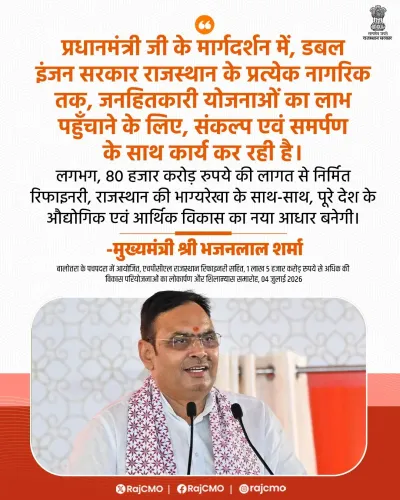
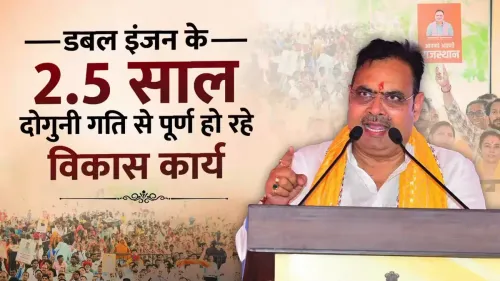
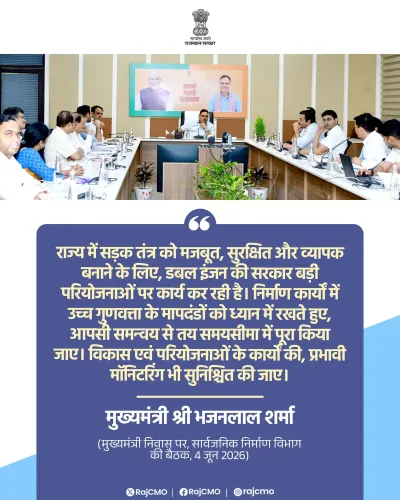
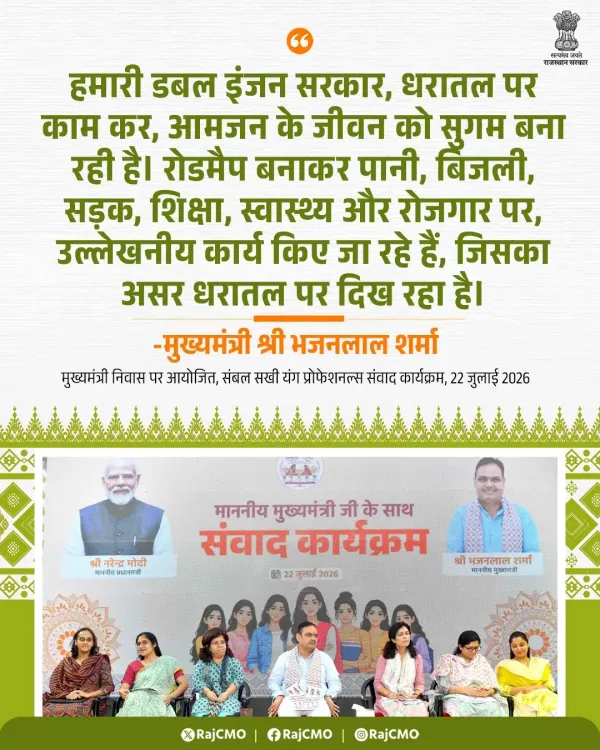
The Chief Minister's Office of Rajasthan credited the BJP's 'double engine' government on 23 July 2026 with delivering notable ground-level results across water, electricity, roads, education, health, and employment, under a structured roadmap led by CM Bhajanlal Sharma.
Key Takeaways
The Chief Minister's Office of Rajasthan posted on 23 July 2026 highlighting governance progress under CM Bhajanlal Sharma .
Six sectors were cited: water, electricity, roads, education, health, and employment .
The post invokes the BJP's 'double engine' governance model , referring to aligned central and state administrations.
Bhajanlal Sharma has been Chief Minister of Rajasthan since December 2023 , following the BJP's assembly election win.
Central schemes including Jal Jeevan Mission and PM Gram Sadak Yojana are operational in Rajasthan and align with the sectors mentioned.
The hashtag #आपणो_अग्रणी_राजस्थान ('Our Leading Rajasthan') frames the post within a broader BJP branding campaign for the state.
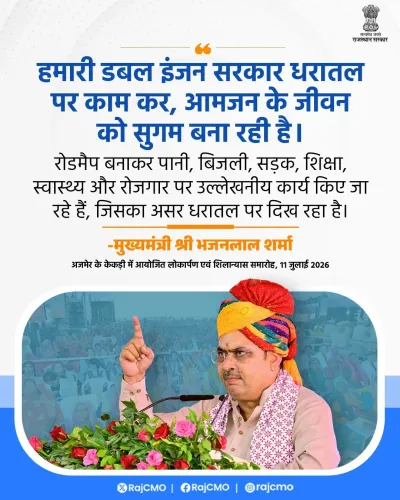
The Chief Minister's Office of Rajasthan on 23 July 2026 posted on X, highlighting the BJP-led state government's progress on core infrastructure and welfare sectors, citing water, electricity, roads, education, health, and employment as key focus areas under what it describes as a 'double engine' government.
Context
The post, attributed to Chief Minister Bhajanlal Sharma's office, states in Hindi: 'हमारी डबल इंजन सरकार, धरातल पर काम कर, आमजन के जीवन को सुगम बना रही है' — ('Our double engine government, working on the ground, is making the lives of ordinary people easier'). It further notes that a roadmap has been drawn and 'notable work is being done' across the six sectors, with results 'visible on the ground.'
The post is tagged with the hashtag #आपणो_अग्रणी_राजस्थान, which translates to 'Our Leading Rajasthan', a campaign phrase the Rajasthan BJP government has used to brand its governance agenda.
Policy Backdrop
Bhajanlal Sharma assumed office as Chief Minister of Rajasthan in December 2023, following the BJP's victory in the state assembly elections, succeeding the previous Congress administration. The 'double engine' formulation refers to aligned governance between the BJP-led central government and the state, a model the party has promoted across multiple states it controls since 2014.
Several central schemes are operational in Rajasthan that directly correspond to the sectors cited in the post. The Jal Jeevan Mission targets household tap-water connections in rural areas, while the PM Gram Sadak Yojana funds rural road connectivity. Rajasthan, India's largest state by area, has historically faced challenges in delivering these services to its vast arid and semi-arid rural belt.
Stakeholders and Impact
The primary beneficiaries of the governance push cited in the post are Rajasthan's rural households and the broader urban poor, who depend on state delivery of water, power, and social services. The state's large rural population makes infrastructure gaps in these sectors a persistent electoral and administrative concern.
Employment features prominently among the six sectors mentioned — a sensitive issue in Rajasthan, where youth unemployment and recruitment to state government jobs have been recurring points of political contention. The government's framing of a 'roadmap' suggests a structured, phased approach to addressing these gaps, though no specific metrics or scheme names were cited in the post.
What's Next
Progress on the sectors highlighted in the post is expected to be scrutinised in upcoming Rajasthan assembly sessions, where opposition parties are likely to seek data on actual delivery benchmarks. Budget allocations for water, roads, education, and health in the current fiscal year will be a key indicator of whether the stated roadmap translates into measurable outcomes on the ground.
With the hashtag campaign framing Rajasthan as a 'leading' state, the government appears to be building a narrative ahead of future political cycles, positioning its first full term under CM Bhajanlal Sharma as a period of visible, ground-level transformation.
Point of View
Designed to credit both the central and state governments simultaneously for welfare delivery — a framing that serves as a standing contrast to opposition-led state governments. By anchoring the message in six universally resonant sectors — water, power, roads, education, health, and employment — the Rajasthan CMO is building a governance narrative that is broad enough to appeal across constituencies while remaining difficult to contest on specifics. The absence of concrete metrics is notable; the post prioritises the sense of momentum over verifiable benchmarks. As CM Bhajanlal Sharma's government moves deeper into its first term, the pressure to back this narrative with measurable outcomes will intensify, particularly on employment, which remains the most politically volatile of the six sectors cited.
NationPress
21 Oct 2026
Frequently Asked Questions
What is the 'double engine' government the Rajasthan CMO refers to?
The 'double engine' government is a BJP phrase referring to the same party being in power at both the central government and a state government simultaneously, enabling coordinated policy and fund flows. In Rajasthan, this means the BJP-led central government and the BJP state government under CM Bhajanlal Sharma working in alignment.
Who is the Chief Minister of Rajasthan in 2026?
Bhajanlal Sharma is the Chief Minister of Rajasthan. He assumed office in December 2023 after the BJP won the Rajasthan assembly elections, succeeding the previous Congress government.
What sectors is the Rajasthan government focusing on?
According to the Chief Minister's Office, the Rajasthan government's roadmap covers six sectors: water, electricity, roads, education, health, and employment.
What is the Jal Jeevan Mission and does it apply to Rajasthan?
The Jal Jeevan Mission is a central government scheme aimed at providing tap water connections to every rural household in India. It has been active in Rajasthan since its launch and directly relates to the water access goals cited by the Rajasthan government.
What does the hashtag Aapno Agrni Rajasthan mean?
The hashtag #आपणो_अग्रणी_राजस्थान translates from Rajasthani and Hindi as 'Our Leading Rajasthan.' It is a branding phrase used by the Rajasthan BJP government to promote its governance agenda and position the state as a model of development.