Rajasthan Forms 5,279 New Cooperative Societies Under Central Scheme
Synopsis
Rajasthan has formed 5,279 new multipurpose cooperative societies under the Centre's drive to place a cooperative body in every panchayat, the Chief Minister's Office announced on 7 July 2026, highlighting the state's progress toward the national 2-lakh PACS target.
Key Takeaways
5,279 new multipurpose cooperative societies have been formed in Rajasthan under the central government's panchayat-level cooperative scheme.
The drive is part of a national target to register approximately 2 lakh new PACS in uncovered panchayats across India within five years.
The Ministry of Cooperation , established in July 2021 , is overseeing the national rollout and tracking state-level registrations.
New societies are designed to serve as multi-purpose rural hubs offering credit, farm inputs, storage, and marketing — not just single-function credit bodies.
Primary beneficiaries are rural farmers and panchayat communities who previously lacked access to formal cooperative infrastructure.
The key next step is operationalisation — ensuring registered societies are staffed, capitalised, and linked to banking institutions for actual service delivery.
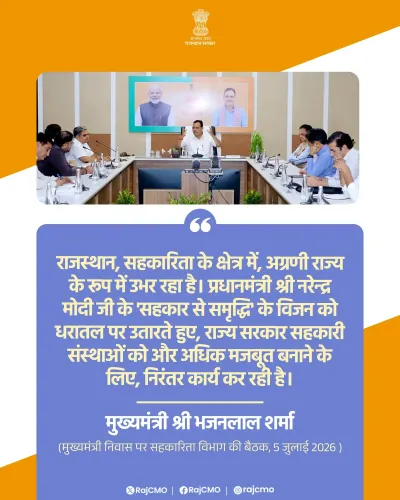
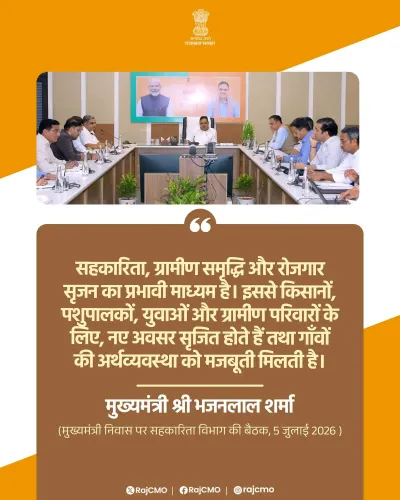
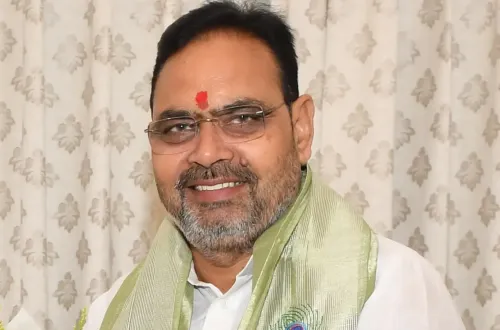
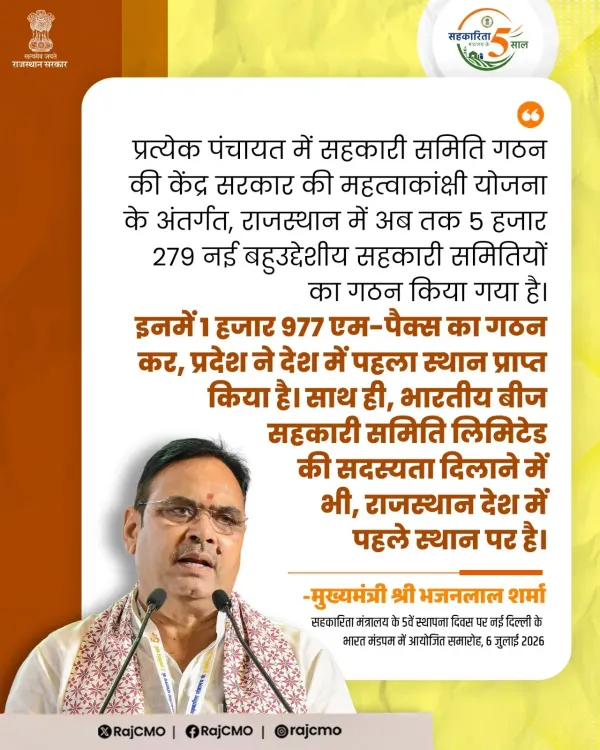
The Chief Minister's Office of Rajasthan announced on Tuesday, 7 July 2026 that 5,279 new multipurpose cooperative societies have been formed across the state under the central government's ambitious drive to establish a cooperative body in every panchayat. The post, attributed to Chief Minister Bhajanlal Sharma's office, highlights Rajasthan's progress under the Union government's flagship cooperative expansion programme.
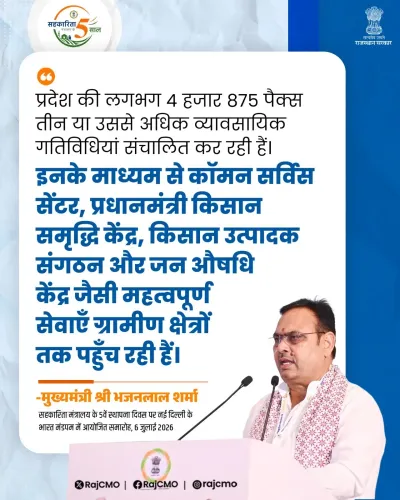
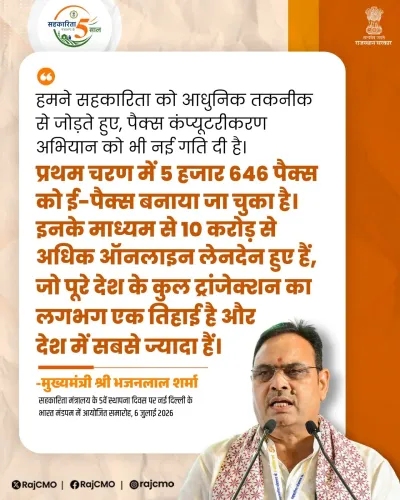
The post states: 'प्रत्येक पंचायत में सहकारी समिति गठन की, केंद्र सरकार की महत्वाकांक्षी योजना के अंतर्गत, राजस्थान में अब तक 5 हजार 279 नई बहुउद्देशीय सहकारी समितियों का गठन किया गया है।' ('Under the central government's ambitious scheme to form a cooperative society in every panchayat, 5,279 new multipurpose cooperative societies have so far been formed in Rajasthan.')
Context
The announcement comes under the Union government's target, set in 2023–24, to register approximately 2 lakh new multipurpose Primary Agricultural Credit Societies (PACS) in uncovered panchayats across India within five years. Rajasthan's figure of 5,279 societies represents a measurable share of that national goal. The state government has been reporting incremental registrations to the central ministry as part of a structured tracking mechanism. The broader push traces back to July 2021, when the Government of India created a dedicated Ministry of Cooperation — the first of its kind — to revitalise a sector that had seen decades of policy neglect. The ministry's mandate includes expanding the cooperative network from traditional credit functions into multi-purpose rural economic platforms covering inputs, storage, and marketing.Policy Backdrop
Multipurpose PACS are designed as last-mile institutions that can simultaneously offer agricultural credit, farm inputs, warehousing, and produce marketing services at the panchayat level. Unlike older single-purpose credit cooperatives, these new societies are envisioned as comprehensive rural economic hubs. Rajasthan, with its vast rural geography and large agrarian population, is among the key states where the central ministry has focused implementation efforts. The state has been governed by the BJP under Chief Minister Bhajanlal Sharma since December 2023, aligning its administrative priorities closely with central cooperative policy. The hashtag #आपणो_अग्रणी_राजस्थान ('Our Frontrunner Rajasthan') used in the post signals the state government's intent to project this progress as a marker of governance performance.Stakeholders and Impact
The primary beneficiaries of the new cooperative societies are rural farmers and panchayat-level communities who previously lacked access to formal cooperative infrastructure. Each new society is intended to reduce dependence on informal moneylenders and private intermediaries by providing institutional credit and market linkages at the village level. For Rajasthan's farming households — many of whom cultivate in semi-arid conditions with limited financial buffers — access to a local cooperative can be materially significant. Panchayat bodies are also key stakeholders, as they are expected to coordinate with the new societies on local economic planning. The central ministry monitors state-level registrations, and progress figures like the one announced today feed into national dashboards tracking the 2-lakh PACS target.What's Next
Attention will now turn to the operationalisation of the 5,279 registered societies — whether they are adequately staffed, capitalised, and linked to banking institutions to begin actual service delivery. Registration is the first administrative step; functional activation is the harder governance challenge. Quarterly progress reports from the Ministry of Cooperation and any dedicated budget allocations in Rajasthan's state finances will be closely watched as indicators of whether the cooperative expansion translates into tangible rural economic benefit.Point of View
279 societies is a credible incremental milestone within the national 2-lakh PACS framework, but the harder test is whether registered bodies become functional institutions rather than paper entities, a gap that has historically plagued cooperative drives in India. Chief Minister Bhajanlal Sharma, governing since December 2023, has an incentive to demonstrate alignment with central BJP policy priorities, and the cooperative push offers a rural-welfare narrative that cuts across caste and community lines. The broader arc — a dedicated Union ministry, a five-year numerical target, and state-by-state reporting — represents a more structured institutional approach to cooperative revival than previous attempts, though independent verification of operational status remains the missing accountability layer.
NationPress
7 Jul 2026
Frequently Asked Questions
How many new cooperative societies have been formed in Rajasthan in 2026?
The Chief Minister's Office of Rajasthan announced on 7 July 2026 that 5,279 new multipurpose cooperative societies have been formed in the state under the central government's scheme to establish a cooperative in every panchayat.
What is the central government's PACS scheme for panchayats?
The scheme aims to register approximately 2 lakh new multipurpose Primary Agricultural Credit Societies (PACS) in uncovered panchayats across India within five years, enabling last-mile access to credit, farm inputs, storage, and marketing services at the village level.
What is the Ministry of Cooperation and when was it formed?
The Ministry of Cooperation is a dedicated Union ministry established in July 2021 to revitalise and expand India's cooperative sector, which had seen decades of limited policy focus. It oversees the national PACS expansion drive.
Who is the Chief Minister of Rajasthan overseeing this scheme?
Bhajanlal Sharma of the BJP has been Chief Minister of Rajasthan since December 2023 and is overseeing the state's implementation of the central cooperative expansion programme.
What is the difference between a new multipurpose PACS and an older cooperative society?
Unlike traditional single-purpose credit cooperatives, new multipurpose PACS are designed to offer a range of services — agricultural credit, farm inputs, warehousing, and produce marketing — making them comprehensive rural economic platforms rather than just lending bodies.